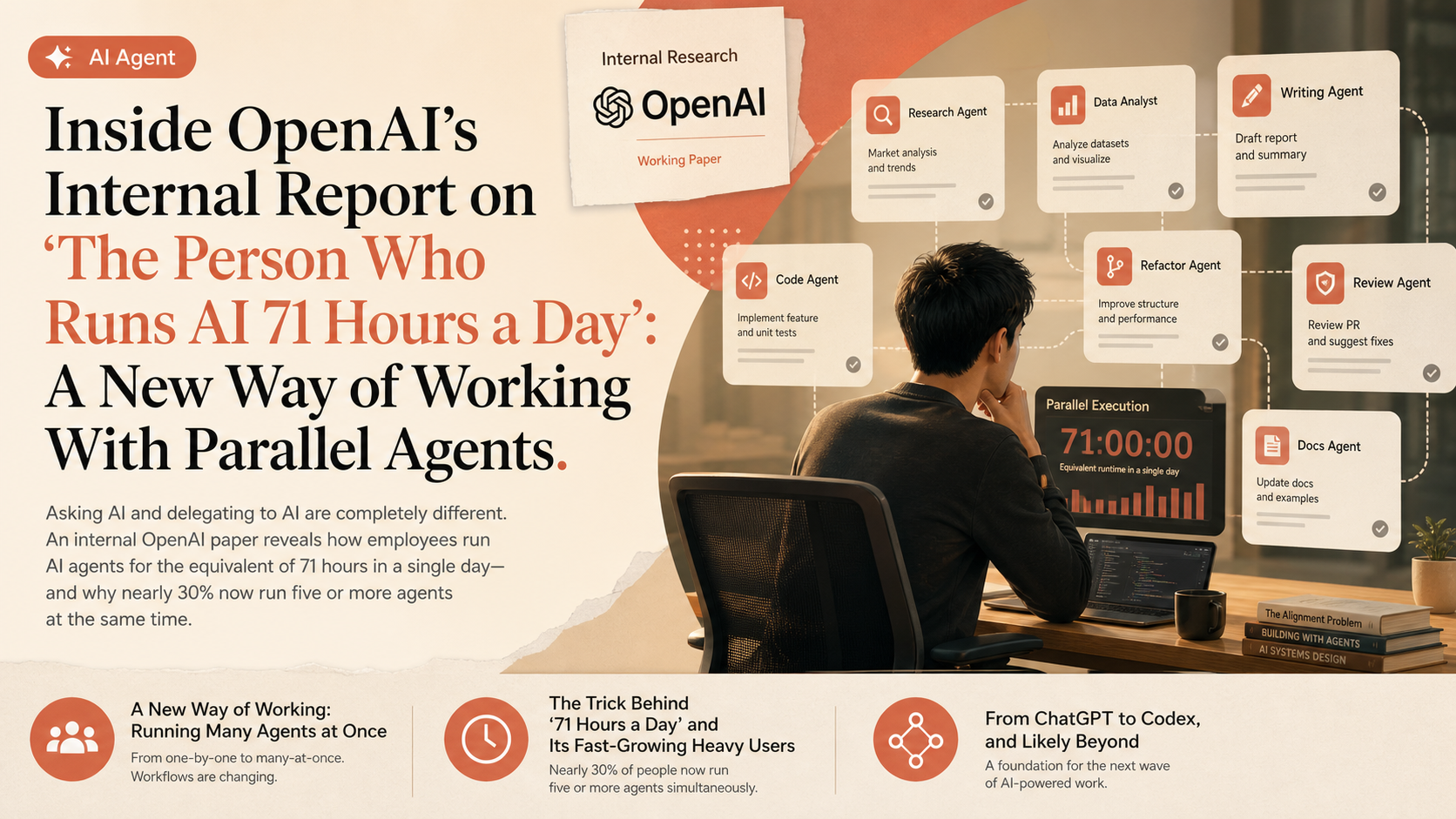
Inside OpenAI's Internal Report on 'The Person Who Runs AI 71 Hours a Day': A New Way of Working With Parallel Agents
TL;DR · What you'll learn
- 1 Asking AI and delegating to AI are completely different, the video argues, introducing an internal OpenAI paper analyzing employees who run AI agents for the equivalent of 71 hours in a single day.
- 2 Nearly 30% of people now run five or more AI agents simultaneously instead of one at a time.
- 3 The share of individual users delegating a full day's worth of work to AI has grown 10x in the past six months.
- 4 The '71 hours a day' figure comes from simply adding up the running time of multiple simultaneous agents -- if one person runs 10 agents at once, the total easily exceeds 24 hours.
- 5 The top 1% of users, who logged under 40 hours a day in April, had crossed 70 hours a day by June.
- 6 Inside OpenAI, usage has shifted dramatically from ChatGPT to Codex, reportedly at roughly a 1:99 ratio now.
- 7 This isn't unique to Codex -- the same shift is likely to play out with Claude Code, Cowork, and Google's tools too, the video argues.
Read as slides
3 slides total
A New Way of Working: Running Many Agents at Once
Drawing on a paper where OpenAI compared its own internal usage data against general and enterprise users, the video walks through a key difference in how AI gets used well. This isn't about rare geniuses or engineers -- it's about how forward-leaning organizations and individuals are actually operating today.
According to the analysis, nearly 30% of people now run five or more AI agents simultaneously instead of one at a time, with the top tier running ten or more at once. The share of individual users delegating a full day's worth of work to AI has grown 10x over the past six months.
The Trick Behind '71 Hours a Day' and Its Fast-Growing Heavy Users
The headline figure of '71 hours a day' comes from a simple accounting trick: running time across multiple simultaneous agents gets added together. If one person runs 10 agents at once, that total easily exceeds 24 hours.
The actual paper data shows the top 1% of users went from under 40 hours a day in April to over 70 hours by June. Even the top 5% and 10% are running the equivalent of 10-20 hours simultaneously -- a clear sign that a working style is spreading fast, where humans focus on defining requirements, judgment, oversight, and review while delegating the actual execution to multiple simultaneous agents.
From ChatGPT to Codex, and Likely Beyond
This analysis is based on OpenAI's own internal data, and what stands out is how dramatically usage has shifted from ChatGPT to Codex inside the company -- reportedly at a ratio of roughly 1:99.
This pattern isn't unique to Codex, the video argues -- the same shift is likely to unfold with tools like Claude Code, Cowork, Google's AntiGravity, or Gemini Spark. The shift toward agent-centric work is clearly underway, and it's worth getting comfortable with it early.
Editor's Take
What this analysis reveals is that skill in using AI is starting to diverge at a deeper level than simply 'conversing' versus 'delegating.' Even the eye-catching '71 hours a day' figure becomes a reproducible skill once decomposed into the concrete practice of running multiple agents in parallel. The fact that the top 1% of users doubled their running time in just two months suggests the learning curve for agentic AI use is still in its early, steep phase. OpenAI's own heavy skew toward Codex internally is itself worth reading as a leading indicator for similar shifts likely to play out with Claude Code, Cowork, and other vendors' tools.
Source
いけともch
【衝撃】OpenAI最新論文『AIを1日71時間動かす人』の正体
This article auto-summarizes the YouTube video's transcript with Claude. Please refer to the original video for nuance and exact wording.
Watch on YouTube →Related
3 articles
AI News & Strategy Daily | Nate B Jones
AI Agents Do Not Improve by Addition: Lessons From Vercel and Agent Maintenance
Vercel reportedly improved its agents by removing 80 percent of their tools rather than adding more.
Claude
How Claude Tag Is Reshaping Work: From One Person, One Machine to Whole Teams Working With Claude
Three years ago teams were just starting to adopt AI into daily workflows, and two years ago typeahead -- predicting the next character -- was the limit of what AI could do.

AIで創作効率化とマネタイズby嗚呼蛙
Seven Codex Features Worth Knowing, Even on the Free Tier: From Browser Control to Phone Access
With Fable 5's return generating buzz for Claude Code, this video revisits seven useful features of Codex, OpenAI's agent, usable even without paying.