Claude Daily Claude Daily
RSS
AI News & Strategy Daily | Nate B Jones 18 min video 3 slides

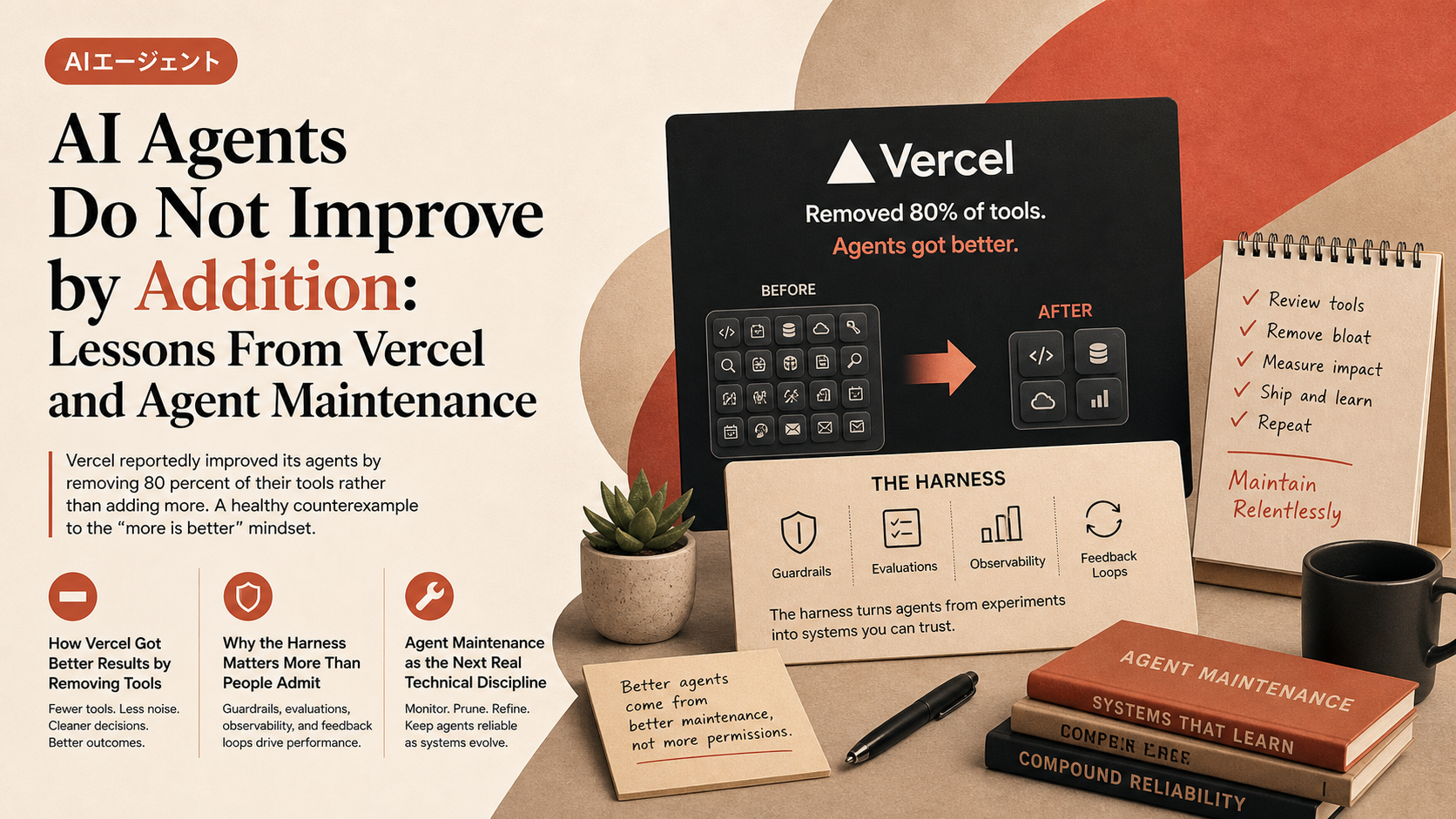
AI Agents Do Not Improve by Addition: Lessons From Vercel and Agent Maintenance
Don't build more AI agents until you watch this
30,637 views 8 highlights

TL;DR · What you'll learn

  • 1 Vercel reportedly improved its agents by removing 80 percent of their tools rather than adding more.
  • 2 The video frames that as a healthy counterexample to the idea that more features and permissions automatically make agents better.
  • 3 Instead of designing from an idealized playbook, Vercel studied the real workflows of its best performers and built from observed behavior.
  • 4 The speaker argues Codex is powerful not only because of the model but because OpenAI keeps maintaining the surrounding harness.
  • 5 He says the Claude Code team is making a similar bet by investing heavily in the harness around terminals, browsers, and related tools.
  • 6 He closes by asking whether the agent's output is actually being read, changing work, and saving time even after human review.
  • 7 Agents, he argues, break in two directions: when the world changes around them and when the internal models inside them evolve.
  • 8 He recommends the book "The Maintenance of Everything" as a way to think more clearly about keeping technical systems working.

Read as slides

3 slides total

01 Slide 1 / 3
Watch at 00:00

How Vercel Got Better Results by Removing Tools

Vercel improved the performance of its internal agent by removing 80 percent of its tools. The example is presented as a useful counterpoint to the common assumption that agents automatically improve when given more context, memory, tools, permissions, and autonomy.

The key, the speaker says, was careful observation of how the company's best salespeople actually worked. Rather than building around an idealized process on paper, the team studied what they ignored, what they responded to, and where human judgment still mattered, then designed the agent around the workflow that existed in reality.

Claude Daily 01 / 03
02 Slide 2 / 3
Watch at 08:42

Why the Harness Matters More Than People Admit

Codex is strong, the speaker argues, not just because the model itself is strong, but because OpenAI keeps investing in the harness around it: terminals, desktop apps, IDEs, browsers, computer-use flows, approvals, and sandboxes.

That makes it more than a smart chatbot. It becomes a carefully maintained workbench for mechanical work. He argues that the Claude Code team is making the same strategic bet by investing heavily in the harness, treating the place where real work happens as the starting point for agent design.

Claude Daily 02 / 03
03 Slide 3 / 3
Watch at 17:26

Agent Maintenance as the Next Real Technical Discipline

The final point is that agent value has to be audited. Are people actually reading the outputs? Did the outputs change the work? After review, are they still saving time, or are they quietly adding more overhead?

Agents differ from ordinary tools because they can break in two ways at once: the surrounding world changes, and the internal models get upgraded. Maintenance is the practice of preserving fit between those two moving targets. To think about that more clearly, the speaker recommends Stewart Brand's "The Maintenance of Everything."

Claude Daily 03 / 03

Editor's Take

Vercel's case — removing 80% of tools improved performance — directly overturns conventional agent-design wisdom. The intuition that more features and permissions help is wrong; what actually works is observing the best operator's real workflow and refining the harness. The framing that 'agents break from both world change and model evolution' is rare and valuable, treating agents as something you operate continuously rather than build once.

Source

Don't build more AI agents until you watch this

AI News & Strategy Daily | Nate B Jones

Don't build more AI agents until you watch this

Published 6/17/2026 18 min 30,637 views

This article auto-summarizes the YouTube video's transcript with Claude. Please refer to the original video for nuance and exact wording.

Watch on YouTube

Related

3 articles