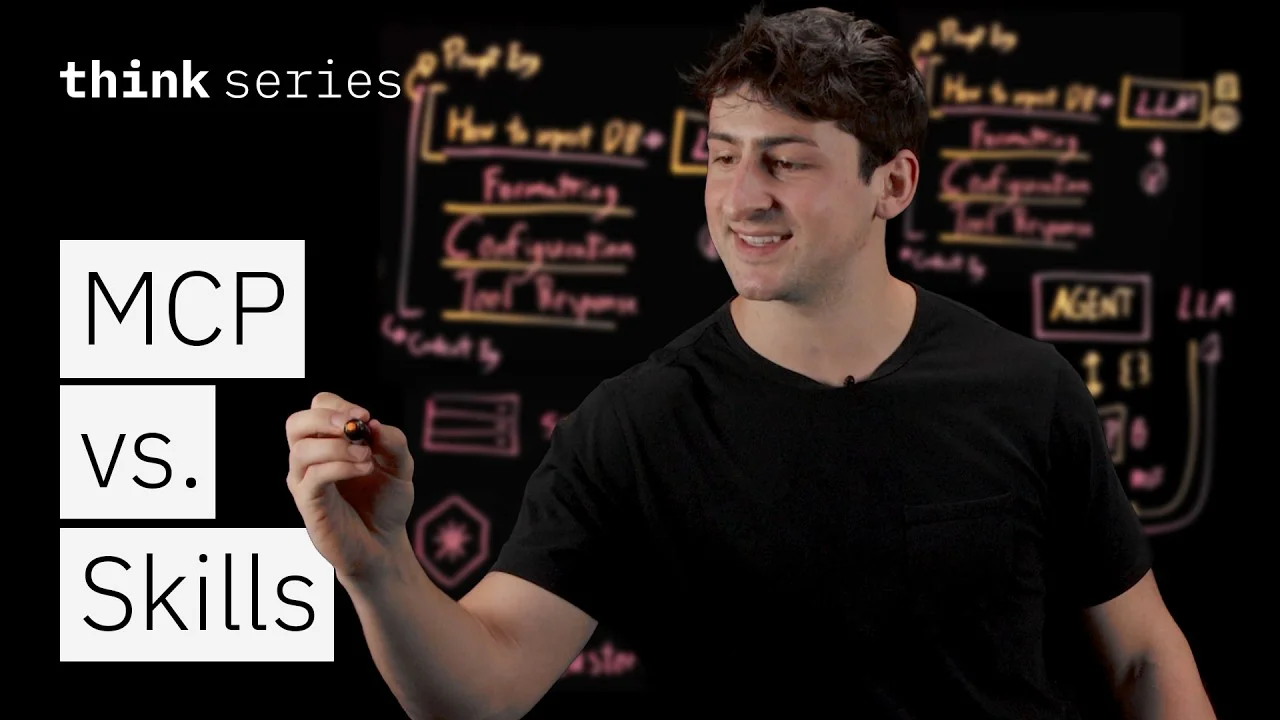
MCP vs. Skills: IBM Breaks Down When to Use Each for Building AI Agents
TL;DR · What you'll learn
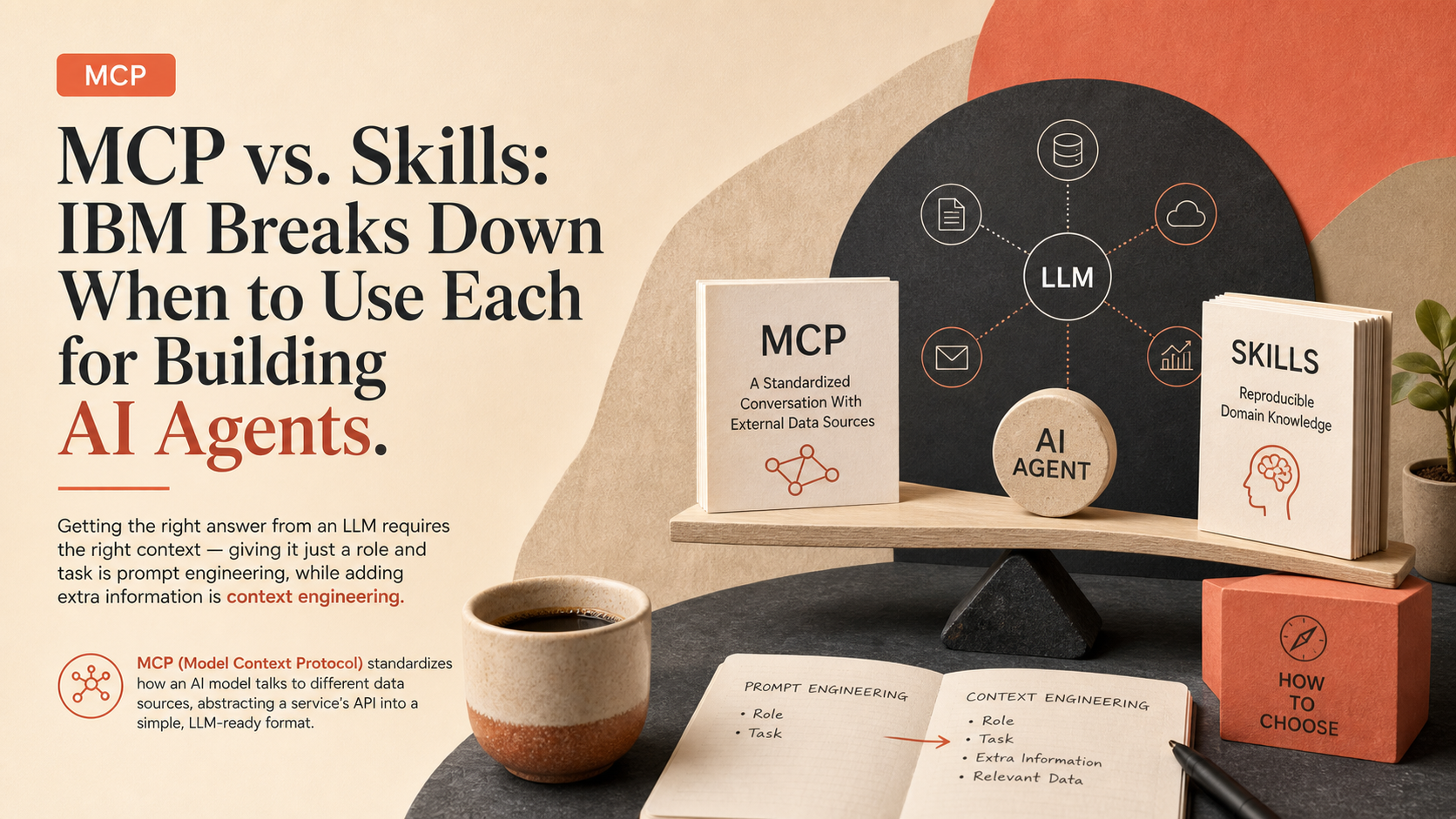
- 1 Getting the right answer from an LLM requires the right context -- giving it just a role and task is prompt engineering, while adding extra information is context engineering.
- 2 MCP (Model Context Protocol) standardizes how an AI model talks to different data sources, abstracting a service's API into a simple, LLM-ready format.
- 3 MCP is a standardized layer between the LLM and data sources, supported by nearly every AI tool out there.
- 4 MCP solves the problem of feeding external data to an LLM, but leaves a gap: how do you give it domain knowledge, reproducibly, the same way every time?
- 5 Skills are essentially markdown files with metadata -- a title, a description of when to use it, and the actual prompt passed to the LLM -- packaged into a folder.
- 6 Use MCP when you need real-time, tightly-permissioned access to data; use Skills when you need a lightweight, reusable custom capability.
- 7 Both MCP and Skills are open source and broadly supported across today's major AI tools, and you can start using both locally right now.
Read as slides
3 slides total
Prompt Engineering vs. Context Engineering
An LLM is essentially a prediction engine trained on vast amounts of information, capable of answering many kinds of questions -- but getting the right answer depends on giving it the right context. Providing just a role and a task is prompt engineering; adding extra information, like how you want data formatted or how your team's database is configured, is context engineering. Understanding that distinction is the foundation for knowing when to reach for MCP versus Skills.
MCP: A Standardized Conversation With External Data Sources
Using an agent that needs CRM data as the example, the video explains how MCP works. Instead of pasting a service's raw API docs and a token into the LLM and hoping for the best, MCP standardizes how an AI model talks to different data sources -- abstracting a service's API into a simple, LLM-ready format and handling authentication. An MCP server gets wired into your IDE or AI application, has the LLM generate a JSON request for the information it needs, and translates that into the actual POST or GET request to the service. It's a standardized layer supported by nearly every AI tool out there.
Skills: Reproducible Domain Knowledge, and How to Choose
MCP solves the problem of feeding external data to an LLM, but leaves one gap: how do you give it domain knowledge it doesn't already have -- for example, a sales team wanting CRM data formatted the exact same way every time, down to a customer's name, contact info, and even their favorite type of cookie. Since LLMs are inherently non-deterministic, reliably repeating a format like that is genuinely hard.
Skills are essentially markdown files with metadata -- a title, a description of when to use it, and the actual prompt passed to the LLM -- packaged into a folder, auto-loaded into the context window only when needed. Use MCP for situations requiring real-time, tightly-permissioned data access (checking VM status, for example); use Skills when you need a lightweight, reusable custom capability (fetching and analyzing investment data, for example). Both are open source, broadly supported across today's AI tools, and usable locally starting today.
Editor's Take
The value in this explainer is reframing MCP versus Skills not as a 'which is better' debate but as a question of what problem each actually solves. MCP handles real-time, permissioned access to external data; Skills inject reproducible domain knowledge -- a division of labor that's clear and practically useful when actually designing an AI agent. The observation that setting up MCP can be overkill for something Skills alone would cover is a good reminder that the most powerful tool isn't always the right choice. Coming from IBM, a company with decades of enterprise infrastructure experience, this reads as a genuinely practical decision framework for designing AI agents in enterprise environments.
Source
IBM Technology
MCP vs Skills: Which Is Right for Your AI Agent and LLMs?
This article auto-summarizes the YouTube video's transcript with Claude. Please refer to the original video for nuance and exact wording.
Watch on YouTube →Related
3 articles
Eric Tech
The Complete OpenCode Tutorial: Keep Claude Code's Playbook (Skills, MCP, agents.md) While Freely Choosing Your Model
Coding agents tend to lock you into one provider and model, but OpenCode lets you freely choose between existing subscriptions, free models, API-key models, or local models -- while keeping the features popularized by Claude Code and Codex.
Mac-TV
Apple Enters MCP: Toward an Era When Software Is Written for AI Bots, Not GUIs
Apple recently announced MCP (Model Context Protocol) support, a move the presenter says sent a shockwave through the industry.
Google Cloud Tech
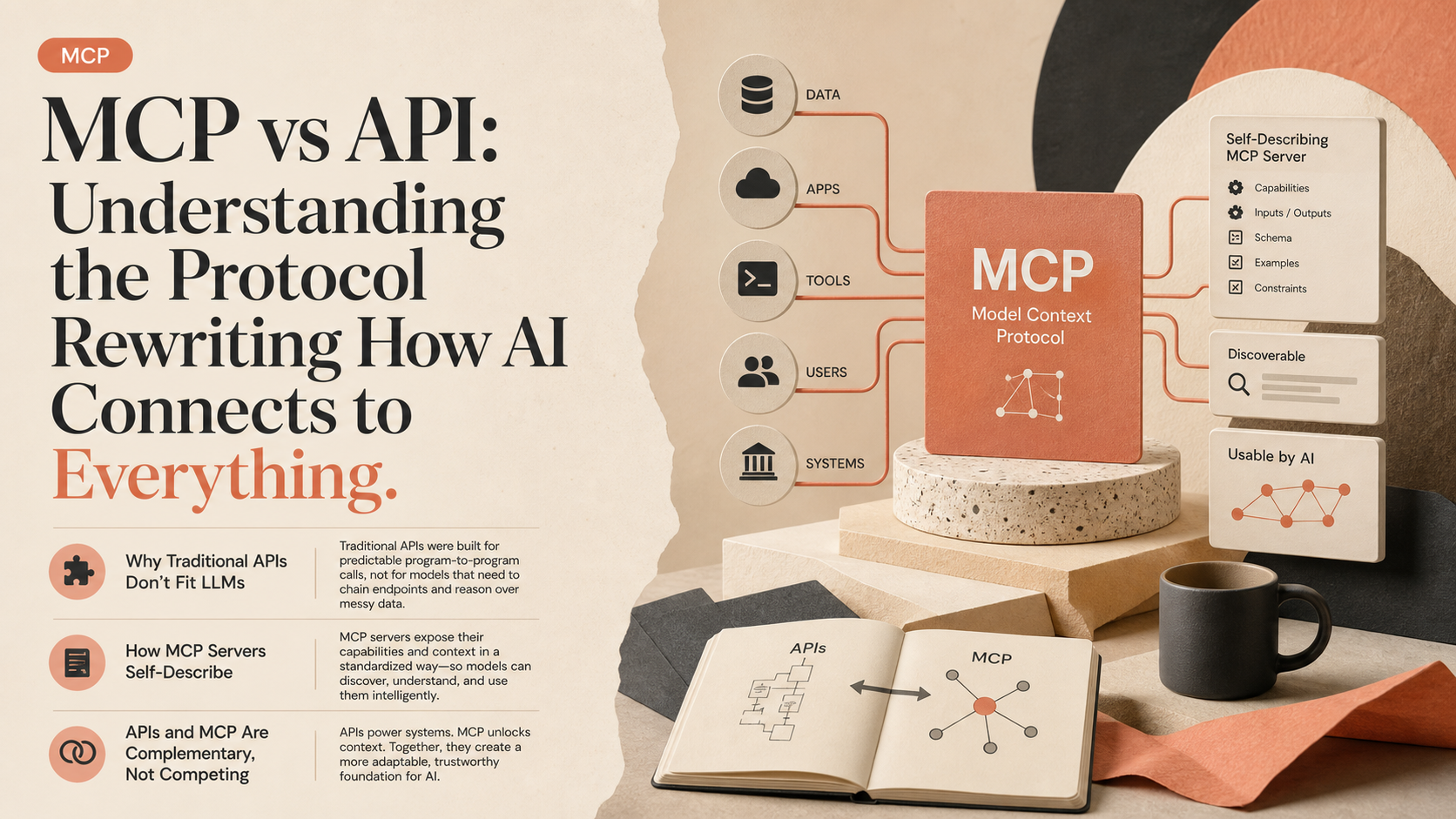
MCP vs API: Understanding the Protocol Rewriting How AI Connects to Everything
The way AI models connect to tools, data, and systems is being rewritten around a new standard: the Model Context Protocol (MCP).