Claude Daily Claude Daily
RSS
Google Cloud Tech 8 min video 3 slides

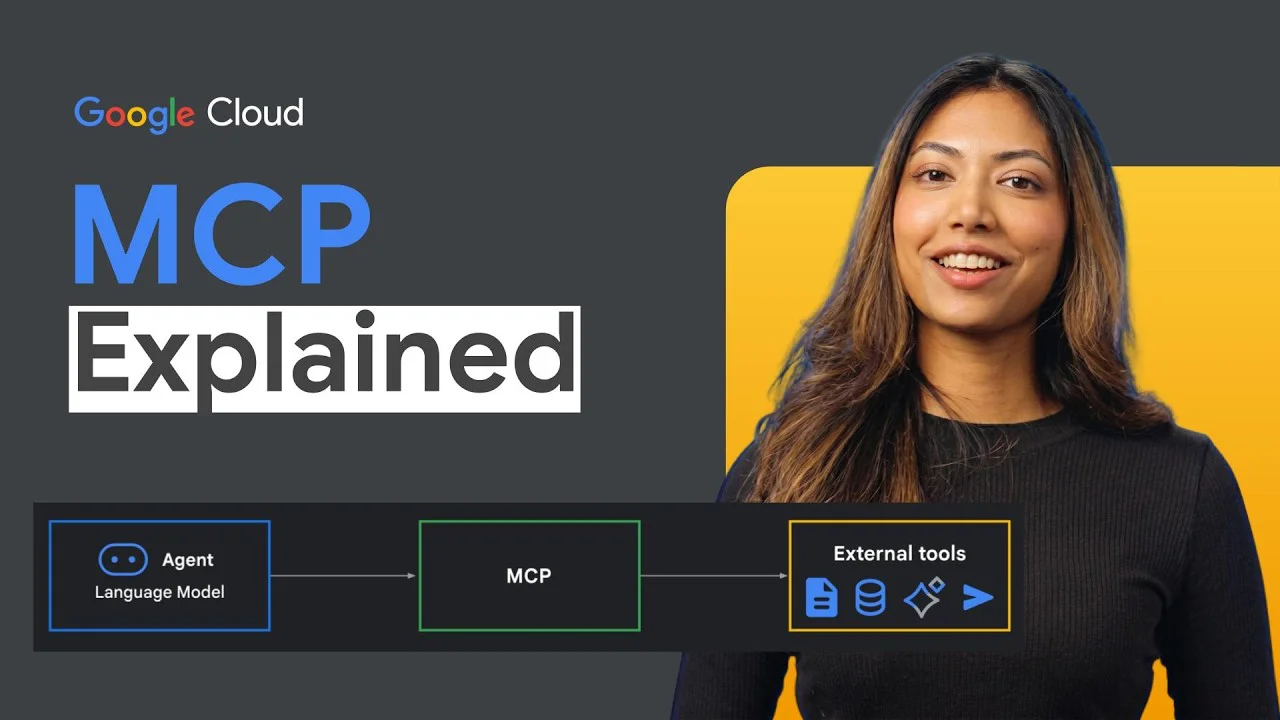
Google Cloud Explains MCP — Why Anthropic's Open Standard Is Becoming the 'HTTP of AI'
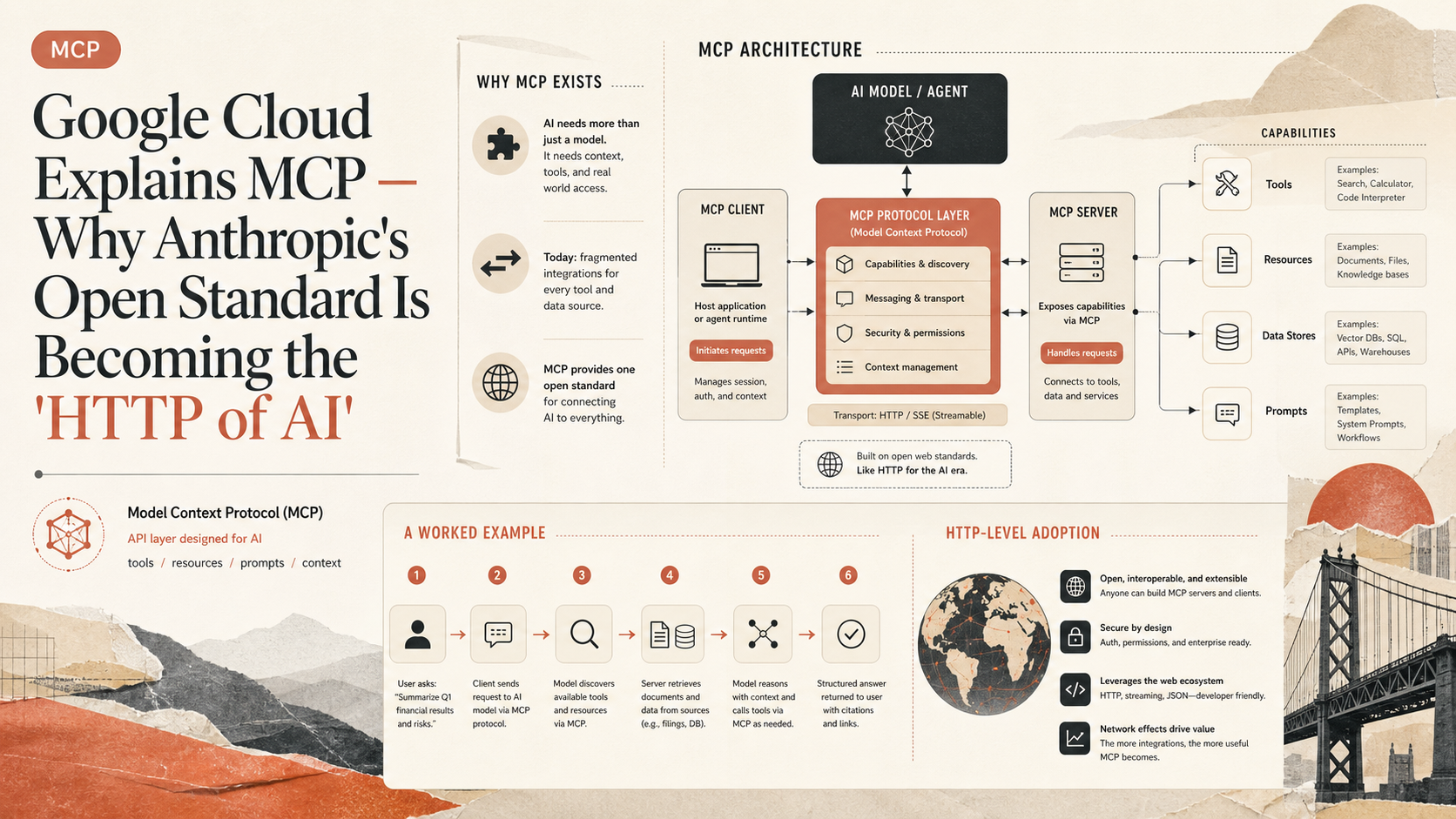
How Model Context Protocol (MCP) actually works
6,004 views 8 highlights

TL;DR · What you'll learn

  • 1 Connecting an AI model to your tools and data has always been messy. Every API behaves differently, every integration needs custom code, and every model change breaks the connection. Model Context Protocol (MCP) was created to fix exactly that.
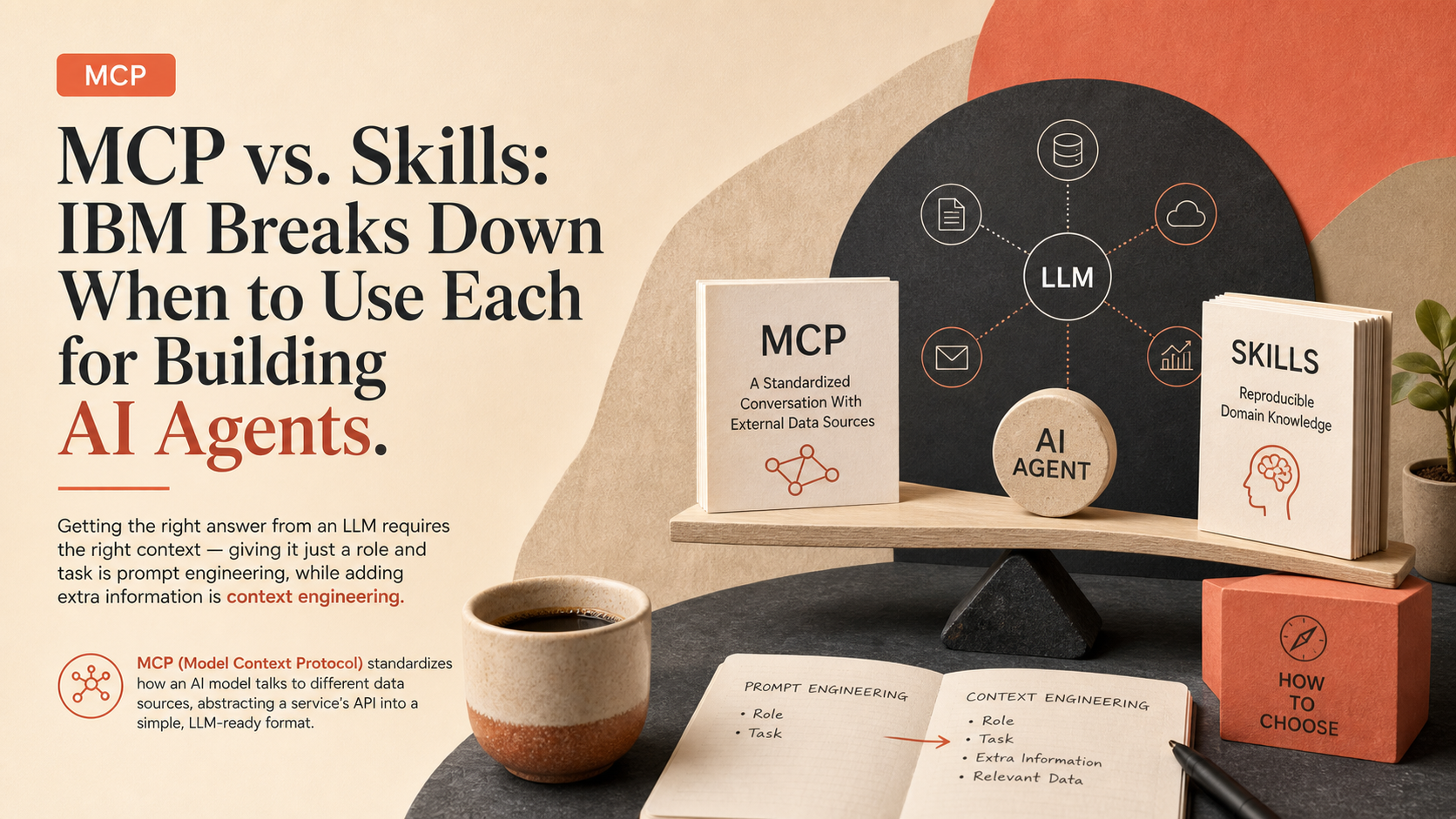
  • 2 MCP is an open standard for connecting models to tools, data, and context in a consistent, structured way — a shared language between models and the systems around them.
  • 3 Introduced by Anthropic and now being adopted across the industry, MCP addresses one of AI development's biggest pain points: making models use external resources safely and reliably.
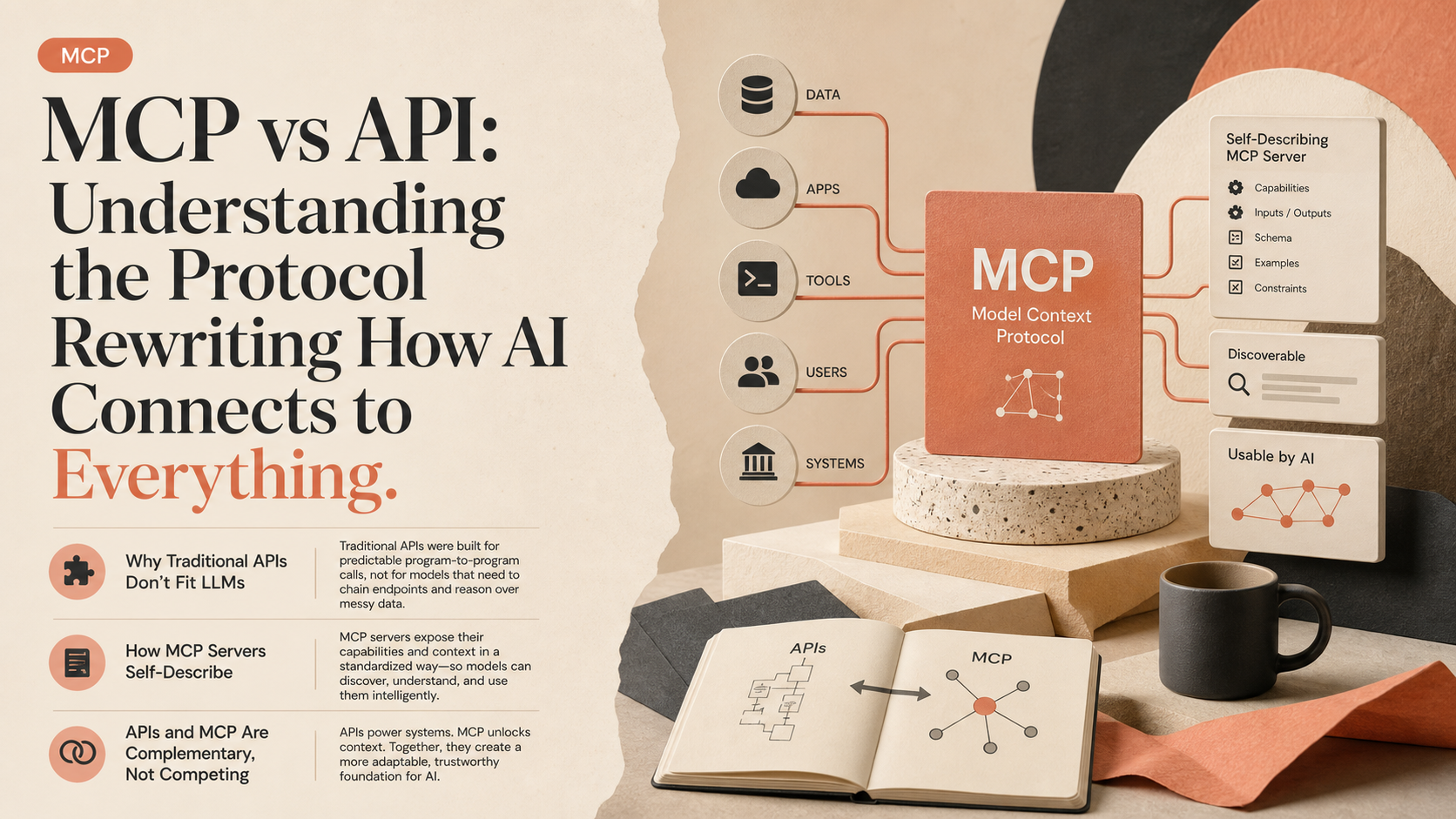
  • 4 Why traditional APIs don't fit: they were designed for programs that already know exactly what they want and form precise, deterministic requests. LLMs generate probabilistically and need to ask, clarify, and explore first.
  • 5 Architecture: the server exposes resources — a database, a file system, internal tools, a document search engine. On connection, the server advertises what it supports, what resources exist, what actions are possible, and what inputs are required.
  • 6 MCP defines four main resource types: tools (actions the model can invoke), resources (data and state), prompts (reusable templates), and context (external information for reasoning).
  • 7 Practical example: a personal assistant agent that checks your calendar, pulls meeting notes, and drafts follow-up emails. In the old world you'd integrate Google Calendar, Notion, and Gmail APIs with glue code and brittle system prompts.
  • 8 MCP is starting to unify how models talk to tools the way HTTP unified the web. Every serious AI developer will soon need to make their systems MCP-aware.

Read as slides

3 slides total

01 Slide 1 / 3
Watch at 00:04

Why MCP exists — the structural mismatch between APIs and AI models

Google Cloud Tech's official explainer on Anthropic's Model Context Protocol (MCP) opens with the lived pain. Wire an AI model to your tools and data and the mess hits immediately — every API behaves differently, every integration needs custom code, and any model change breaks the connection. Familiar territory for AI developers.

The root cause sits in API design philosophy. APIs were built for programs that already know exactly what they want and can form precise, deterministic requests. LLMs work the other way — they generate probabilistically, reason over uncertain inputs, and often need to ask, clarify, or explore before they can decide. Forcing two mismatched interfaces to talk has historically been the developer's burden, glued together with brittle system prompts. MCP introduces an interface layer designed for AI on the AI side.

Claude Daily 01 / 03
02 Slide 2 / 3
Watch at 02:49

MCP architecture — client / server and the four resource types

MCP uses a clean client/server architecture. Servers expose resources — databases, file systems, internal tools, document search engines. When a client (like Claude) connects, the server doesn't return data; it advertises capabilities. What can be done, what resources exist, what actions are available, what inputs are required.

The payoff is substantial. The model doesn't need to be pre-programmed with every API or endpoint — it discovers them at connection time. Communication runs on a simple, well-defined schema: the client sends requests like 'list resources,' 'call this action,' 'retrieve this data,' and the server replies with structured JSON describing what's possible and what happened. Four resource types form the basis: tools (invocable actions), resources (data and state), prompts (reusable templates), and context (external information). Each carries metadata describing what it does, what input it expects, and what output it returns.

Claude Daily 02 / 03
03 Slide 3 / 3
Watch at 06:00

A worked example, and HTTP-level adoption

The example makes the win concrete. Build a personal assistant agent that checks your calendar, pulls meeting notes, and drafts follow-up emails. In the old world you wrote integrations against Google Calendar, Notion, and Gmail APIs, handled authentication, rate limits, and every edge case, then taught the model how to use those endpoints through long, fragile system prompts.

Under MCP you build or install a server per system — a calendar server, a notes server, an email server. Each advertises what it can do: list events, get meeting summary, send email. The model reasons about which to use, in what order, and what data to pass between them. The developer doesn't write glue code per tool. The video closes with the historical parallel: HTTP unified the web; MCP is doing the same for how models talk to tools. Every serious AI developer will need MCP-aware systems soon. That's Google Cloud's framing of the shift.

Claude Daily 03 / 03

Editor's Take

The fact that Google Cloud is publishing the explainer for an Anthropic-originated protocol on its official channel says a lot about how the industry is sorting itself out. The frontier-model race continues; the connection layer is standardising, and the hyperscalers are now actively pushing adoption. Two implications for readers. Short term, agent implementation flexibility goes up — stand up one MCP server and Claude, Codex, and Gemini can all reach the same tool. Long term, which SaaS ships an MCP server first determines its position in the business-AI economy. If Notion, Gmail, CRMs, and your internal tools all expose MCP connectors, your in-house agent stack inherits a general-purpose foundation tailored to your operations. Predicting which frontier model wins is probably the wrong question; making your own business platform MCP-aware is the more defensible investment.

Source

How Model Context Protocol (MCP) actually works

Google Cloud Tech

How Model Context Protocol (MCP) actually works

Published 6/24/2026 8 min 6,004 views

This article auto-summarizes the YouTube video's transcript with Claude. Please refer to the original video for nuance and exact wording.

Watch on YouTube

Related

3 articles