Claude Daily Claude Daily
RSS
Jason Lee 26 min video 3 slides

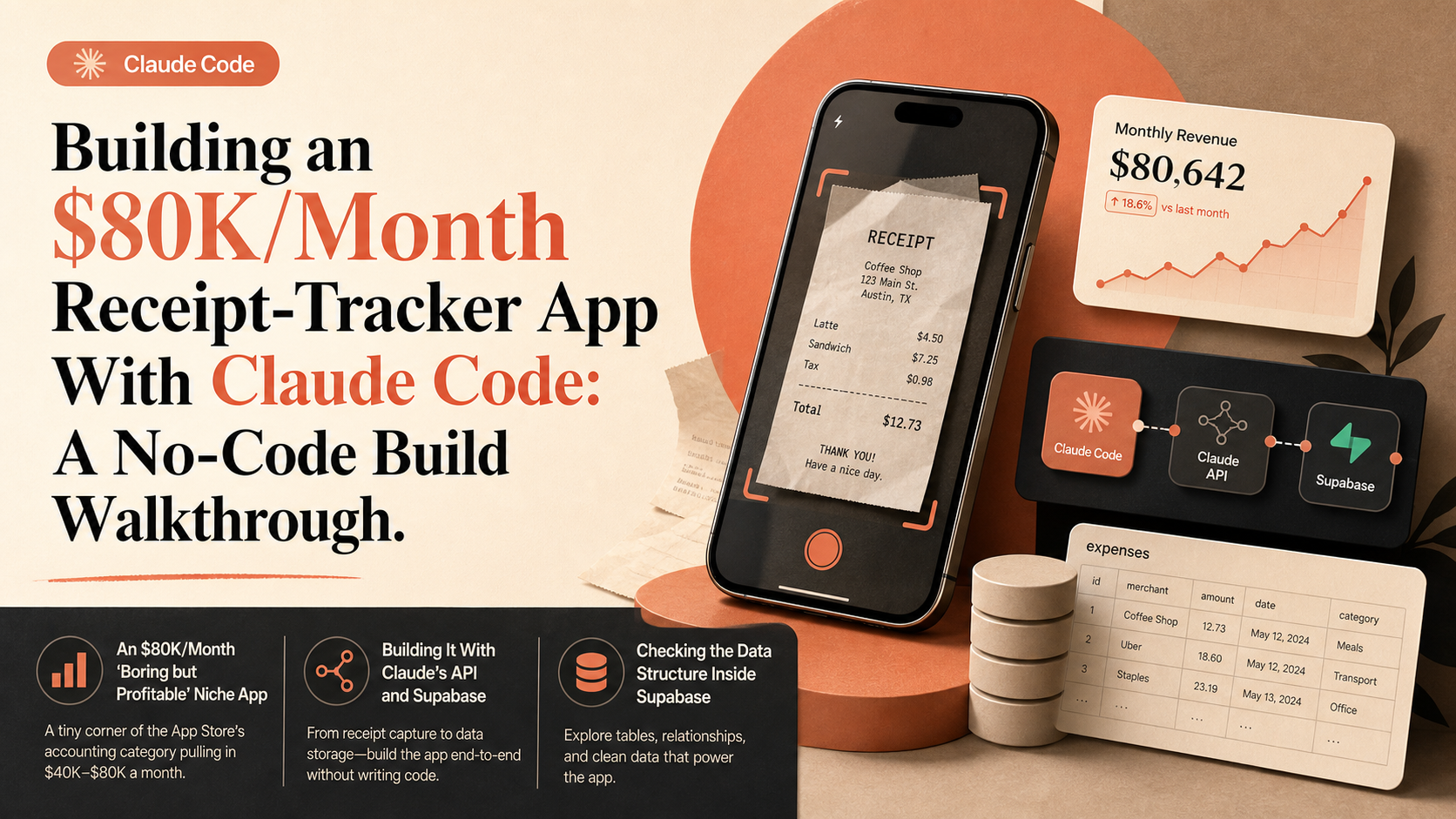
Building an $80K/Month Receipt-Tracker App With Claude Code: A No-Code Build Walkthrough
How I built an $80K/Mo mobile app with Claude Code (Full Vibe Code Tutorial)
31,133 views 6 highlights

TL;DR · What you'll learn

  • 1 The video highlights a tiny niche in the App Store's accounting category -- receipt and expense tracking -- where several apps pull in $40,000-$80,000 a month.
  • 2 It walks through building a receipt-tracker app from scratch with Claude Code, adding premium touches like animations, entirely without writing a single line of code.
  • 3 The build uses Claude's API to scan and parse receipt images -- a separate, credit-based charge from a regular Claude subscription.
  • 4 The creator warns never to paste an API key directly into chat, since a leaked chat history would expose it -- it should be stored in a .env file instead.
  • 5 Supabase is used as the database, connected to Claude Code via an MCP connector.
  • 6 Opening Supabase's table editor shows the receipts, categories, and user-information tables that Claude Code generated automatically.

Read as slides

3 slides total

01 Slide 1 / 3
Watch at 00:00

An $80K/Month 'Boring but Profitable' Niche App

The video zeroes in on a small sub-niche inside the App Store's accounting category: receipt and expense tracking. Apps like SimplyWise pull in $60,000-$80,000 a month doing essentially one thing -- scanning physical receipts -- making the case that even the smallest categories can hide genuinely profitable, narrowly-focused apps.

Claude Daily 01 / 03
02 Slide 2 / 3
Watch at 12:25

Building It With Claude's API and Supabase

To parse receipt images with AI, the build uses Claude's API (noting OpenAI's API is cheaper, but he already had credits on hand). API usage is billed separately from a Claude subscription, so credits need to be purchased in advance, and the API key should be stored in a .env file rather than pasted into chat, where a leaked conversation could expose it.

The database layer runs on Supabase, connected to Claude Code through an MCP connector, with receipts, categories, and user data all stored there -- and QuickBooks integration built in as a target for accounting software sync.

Claude Daily 02 / 03
03 Slide 3 / 3
Watch at 25:03

Checking the Data Structure Inside Supabase

Opening Supabase's table editor reveals the receipts table Claude Code generated automatically -- totals, line-item breakdowns, card info, and categories -- scoped per user. Add authentication on top, and the same structure is ready to ship as a full multi-user SaaS product.

Claude Daily 03 / 03

Editor's Take

This video is a textbook example of the 'full-stack solo build' pattern now emerging around Claude Code, an AI API, Supabase, and an MCP connector. That a narrowly-scoped niche app -- just receipt scanning -- can pull in tens of thousands of dollars a month shows how falling implementation costs from AI are opening up previously high-barrier, fragmented markets to individual developers. At the same time, the explicit warning about storing API keys in a .env file is a reminder that as AI-driven development spreads, basic security hygiene needs to be taught just as deliberately.

Source

How I built an $80K/Mo mobile app with Claude Code (Full Vibe Code Tutorial)

Jason Lee

How I built an $80K/Mo mobile app with Claude Code (Full Vibe Code Tutorial)

Published 7/9/2026 26 min 31,133 views

This article auto-summarizes the YouTube video's transcript with Claude. Please refer to the original video for nuance and exact wording.

Watch on YouTube

Related

3 articles