Building a Membership Site With Claude Code in a Weekend, $20K in the First Week: 'You Don't Need the Terminal'

TL;DR · What you'll learn
- 1 The guest says he built a membership platform, digitalcreatorclub.com, that would have previously cost $50,000-$100,000, in a single weekend using Claude Code -- and made about $20,000 in its first week.
- 2 His first encounter with Claude Code was handing it a folder of photos and saying 'make me a gallery site' -- a portfolio site was done in five minutes.
- 3 In January 2026, he went further, using Opus 4.8 to build a full membership site with payments, a database, and invite-email logic, in a single weekend, despite having almost no coding background.
- 4 He recommends using the 'Code' tab inside the Claude app rather than the terminal -- chat, Cowork, and Claude Code are all unified in one app, which is more than enough for his work.
- 5 'You don't need to open the terminal -- don't even look at it,' he says, adding that's the advice he gives all his friends who ask.
Read as slides
3 slides total
It Started With 'Make Me a Gallery Site From This Folder'
The guest's first real taste of Claude Code's power came around September-November 2025: he handed it a folder of photos and simply said 'look at this folder and make me a gallery -- a portfolio site.' It was done in five minutes -- work that would have taken him days by hand. He describes the moment as feeling like magic.
A Membership Site in a Weekend, $20K in the First Week
Building on that experience, in January 2026 he used Opus 4.8 to build a full-fledged membership site, digitalcreatorclub.com, complete with payment processing, a database, pricing logic, and invite emails (including Discord invites). With almost no background in databases or APIs, he built in a single weekend something that would have previously cost $50,000-$100,000 -- and it made roughly $20,000 in its first week live.
'You Don't Need the Terminal' -- the Claude App's Code Tab Is Enough
Asked whether he'd recommend the Claude app or the web version, the guest strongly recommended the app's unified 'Code' tab, which combines chat, Cowork, and Claude Code in one place. The terminal allows more advanced operations, he says, but for his purposes the app is more than capable -- 'you don't need to open the terminal and start reading the matrix.'
Editor's Take
This interview captures how Claude Code's value has moved well beyond 'productivity tool for engineers' into territory where non-engineers can build genuinely monetizable products on their own. A membership site with payments, a database, and email logic -- the kind of project that used to require a five- or six-figure development budget -- built in a weekend is a real shift in the underlying economics of software production. And recommending the app's GUI over the terminal points to Claude Code's user base continuing to widen well beyond a technical audience.
Source
The Calum Johnson Show
I Made $20K In 7 Days: The Fastest Way To Use AI Agents To Make Money & Be More Productive (No Code)
This article auto-summarizes the YouTube video's transcript with Claude. Please refer to the original video for nuance and exact wording.
Watch on YouTube →Related
3 articles
Jason Lee
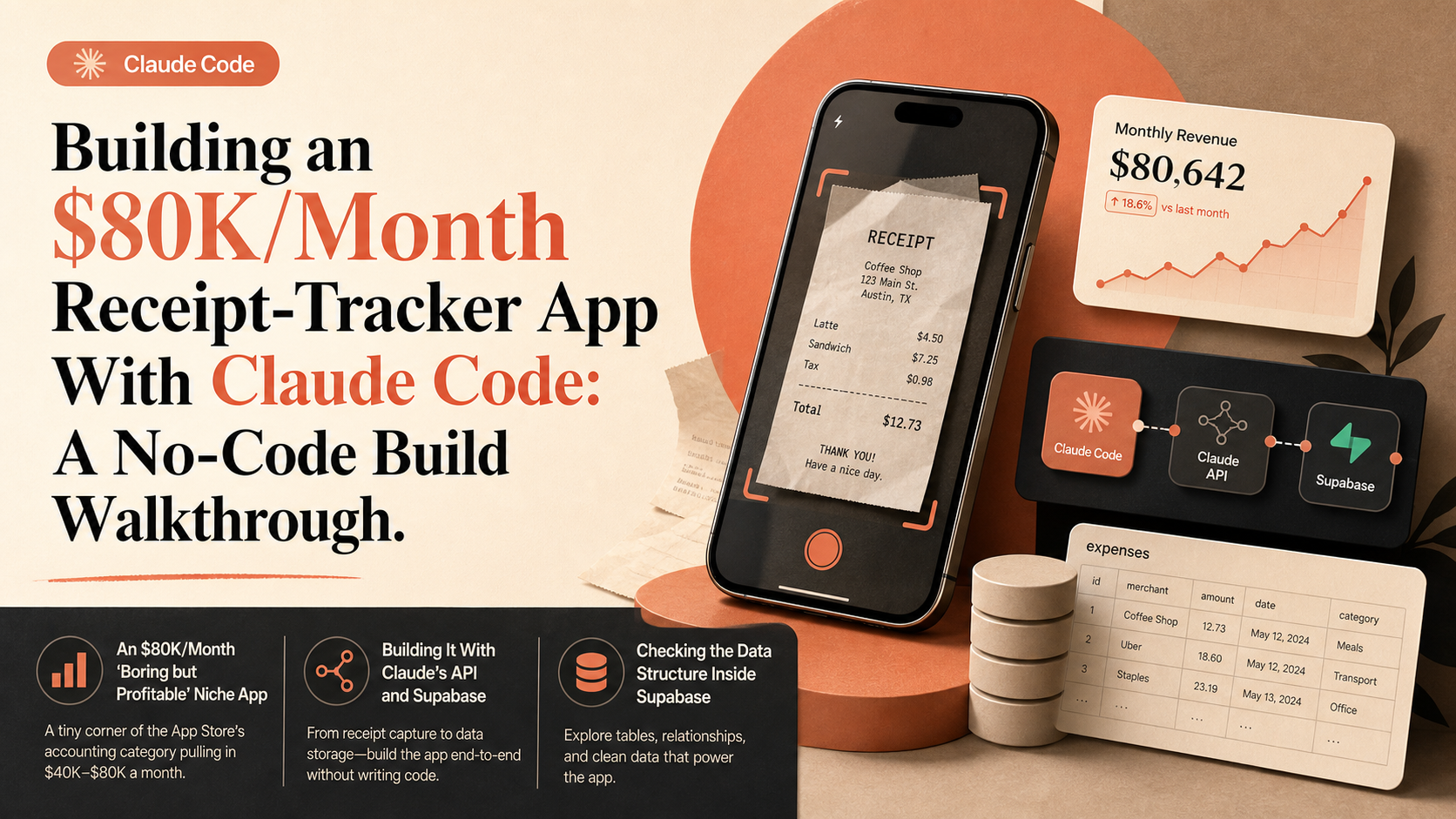
Building an $80K/Month Receipt-Tracker App With Claude Code: A No-Code Build Walkthrough
The video highlights a tiny niche in the App Store's accounting category -- receipt and expense tracking -- where several apps pull in $40,000-$80,000 a month.

Nate Herk | AI Automation
Running GLM 5.2 Inside Claude Code: An Open Model at One-Fifth the Cost
After spending a full day running the open-source large model GLM 5.2 inside Claude Code's harness, the creator concludes that it is fast, far cheaper, and fits surprisingly well into the workflow. It even edited the intro of the video itself from raw footage.

Nate Herk | AI Automation
GPT 5.6 Sol vs. Fable 5, Head to Head: Fable Edges Out a Bike Game Build at 3x the Cost
With GPT 5.6's Sol, Terra, and Luna released, benchmarks show Sol beating Opus and Fable while costing far less -- but the creator decided to run both models side by side on real work for a full day instead of just quoting numbers.