
Claude Daily Claude Daily
RSS
为什么叫QQ 10 min video 3 slides

A 120x Token Reduction? How Codebase-Memory-MCP Is Rewriting the Economics of AI Coding
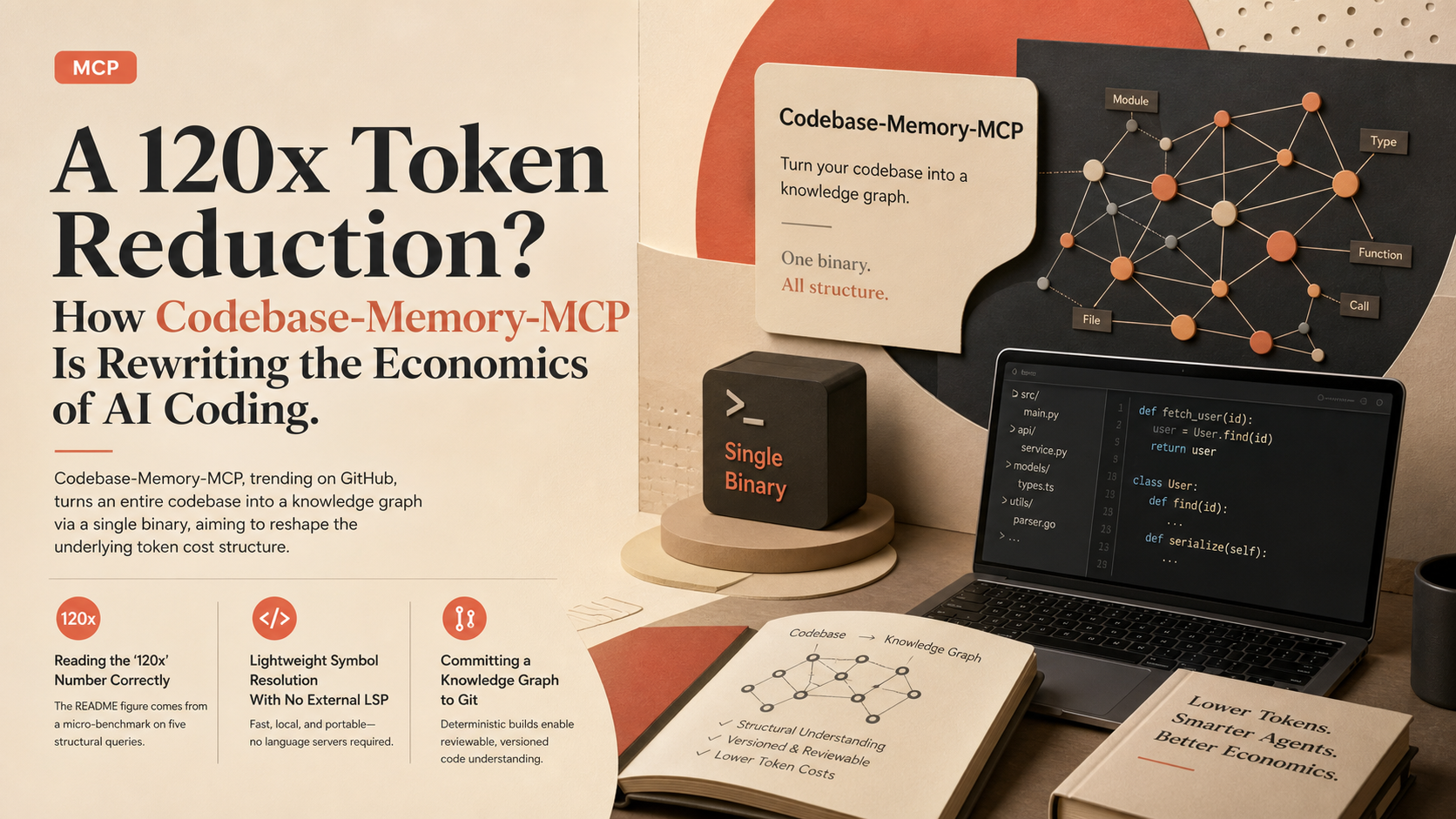
Token消耗减少120倍?Codebase-Memory-MCP的性能突破原理解析
4,144 views 7 highlights

TL;DR · What you'll learn

  • 1 Codebase-Memory-MCP, trending on GitHub, turns an entire codebase into a knowledge graph via a single binary, aiming to reshape the underlying token cost structure.
  • 2 Its paper reports roughly a 10x reduction in tokens and a 2.1x reduction in tool calls; the '120x' figure from the README comes from a micro-benchmark on five structural queries.
  • 3 The similar project CodeGraph has more GitHub stars, but attention has been shifting rapidly toward Codebase-Memory-MCP recently.
  • 4 Tools like Cursor or Claude Code today understand a codebase by repeatedly grepping and reading files -- a 'blind groping' process that can burn hundreds of thousands of tokens.
  • 5 Codebase-Memory-MCP implements lightweight symbol and type resolution in C itself, with no dependency on an external Language Server, covering Python, TypeScript, Go, Java, and more.
  • 6 Its knowledge graph can be committed straight into a Git repo as a compressed snapshot (graph.db.zst), so new team members get instant project memory without re-indexing.
  • 7 As inference cost becomes the bottleneck, surrounding AI infrastructure will need to get radically lighter -- expect more of it rewritten in C/C++ or Rust going forward.

Read as slides

3 slides total

01 Slide 1 / 3
Watch at 00:16

Reading the '120x' Number Correctly

Codebase-Memory-MCP, trending on GitHub, converts an entire codebase into a knowledge graph via a single binary. Its published evaluation shows roughly a 10x reduction in token usage and a 2.1x reduction in tool calls. The widely-cited '120x' figure from the README comes from a narrower micro-benchmark on five structural queries, where about 3,400 tokens replaced roughly 412,000 -- an impressive result, but not something that generalizes to every task.

The similar project CodeGraph leads on GitHub stars (57.3k vs. 25.5k), yet attention has been shifting rapidly toward Codebase-Memory-MCP. Both parse ASTs via Tree-sitter, store results in SQLite, and expose an MCP interface -- but they've taken different paths, one prioritizing performance and deployment form factor, the other prioritizing agent workflows and ecosystem expansion.

Claude Daily 01 / 03
02 Slide 2 / 3
Watch at 04:23

Lightweight Symbol Resolution With No External LSP

Tools like Cursor or Claude Code today understand a codebase by repeatedly grepping and reading files -- a blind-groping process where finding one function call can mean jumping through a dozen files and burning hundreds of thousands of tokens. CodeGraph takes a practical, engineering-heavy route -- solid parsing rules and framework adaptation (route recognition, dynamic dispatch, and so on) -- but maintenance costs climb every time a new framework or complex language semantic gets added.

Codebase-Memory-MCP instead implements lightweight symbol and type resolution in C itself, with no external Language Server dependency, covering call, import, and inheritance relationships across Python, TypeScript, Go, Java, and more. That means when asked 'who calls this interface,' it can return symbol-level, file-level, line-level answers -- higher information density, less noise, and a smaller context for the AI to process.

Claude Daily 02 / 03
03 Slide 3 / 3
Watch at 05:23

Committing a Knowledge Graph to Git

CodeGraph treats its knowledge graph as a local cache, requiring each developer to re-run indexing locally. Codebase-Memory-MCP instead treats the graph as a code asset: it supports a zstd-compressed snapshot (graph.db.zst, roughly 8-13x compression) that can be committed straight into the Git repo. A new hire pulling the repo gets instant access to full project memory just by loading the snapshot -- no hours-long re-indexing.

With large-model inference cost already the bottleneck, the surrounding infrastructure has to become radically lighter and more efficient -- expect more of it rewritten in C/C++ or Rust going forward. The prediction: future repositories will routinely carry a standardized knowledge-graph file, much like package.json or requirements.txt today.

Claude Daily 03 / 03

Editor's Take

What this breakdown suggests is that the bottleneck for AI coding tools is gradually shifting from 'how smart the model is' to 'how efficient the surrounding infrastructure is.' Committing a knowledge graph to Git so a team can share it marks a shift from every developer repeatedly paying the same compute cost to computing it once and treating it as a shared asset. The claim that refactoring turns from a 'human nightmare' into a 'computable problem' matters most for organizations sitting on million-line legacy codebases. The video's closing question -- let the AI grope through files, or give it a knowledge graph -- is a practical framing worth revisiting as more teams evaluate the true cost of AI-assisted coding.

Source

Token消耗减少120倍?Codebase-Memory-MCP的性能突破原理解析

为什么叫QQ

Token消耗减少120倍?Codebase-Memory-MCP的性能突破原理解析

Published 7/4/2026 10 min 4,144 views

This article auto-summarizes the YouTube video's transcript with Claude. Please refer to the original video for nuance and exact wording.

Watch on YouTube

Related

3 articles