Claude Daily Claude Daily
RSS
海外Yパパラジオ 世界を読み解く 10 min video 3 slides

Every Licensed Professional Becomes an Insurer — My AI Just Passed the Singapore CPA Exam 10 for 10
全ての士業は保険屋になる。僕のAIエージェントが3か国の公認会計士試験に受かるようになって確信したこと
16,739 views 8 highlights

TL;DR · What you'll learn

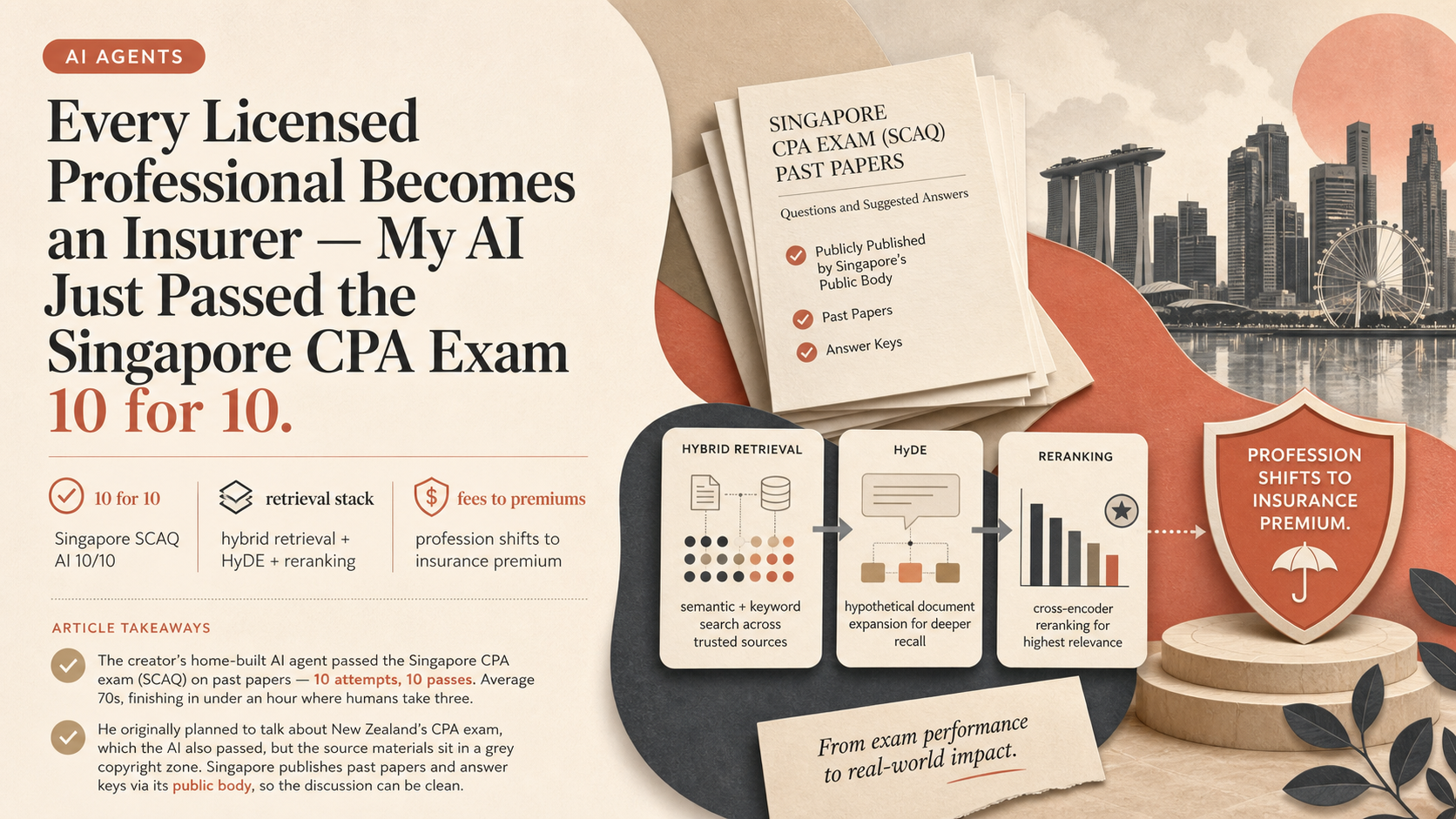
  • 1 The creator's home-built AI agent passed the Singapore CPA exam (SCAQ) on past papers — 10 attempts, 10 passes. Average 70s, finishing in under an hour where humans take three.
  • 2 He originally planned to talk about New Zealand's CPA exam, which the AI also passed, but the source materials sit in a grey copyright zone. Singapore publishes past papers and answer keys via its public body, so the discussion can be clean.
  • 3 SCAQ has four serious modules — financial reporting, audit, tax, and governance — taken online under webcam proctoring.
  • 4 The AI stack has three pieces: hybrid retrieval (vector search plus keyword search — clauses and legal terms need keyword), HyDE (let the AI draft a hypothetical answer and search that), and reranking (pull 30, rerank to 5 with a specialist model).
  • 5 Before adding those three, the system averaged 52 — barely above the 50 pass line. After: low 70s. Margin of pass turned into margin of comfort.
  • 6 Failure modes mirror humans. Image and table questions drop 5–10 points (multimodal isn't there yet), Singapore's 8→9% GST tax change gets confused occasionally, and audit is weaker than financial reporting — same skew real candidates show.
  • 7 The point isn't 'AI became a CPA.' It can't sign a tax return or take liability for client advice. The point is what the profession itself is becoming.
  • 8 The conclusion: what clients pay licensed professionals for shifts from research and analysis to an insurance premium. The early adopters scale 10× on volume with premium-based pricing; the holdouts get squeezed on hourly billing.

Read as slides

3 slides total

01 Slide 1 / 3
Watch at 00:00

10 attempts, 10 passes — the SCAQ experiment

The creator built an AI agent and ran it against past papers for the Singapore CPA exam (SCAQ). It passed 10 times out of 10. He had originally planned to talk about the New Zealand CPA exam, which his AI also passed, but the source materials there sit in a grey zone — copyright and exam-board terms get murky the moment you describe where the questions came from. Singapore's public exam body publishes past papers and answer keys as PDFs, so this whole video can be discussed cleanly.

SCAQ is no toy exam. Four modules — financial reporting, audit, tax, and governance — taken online under webcam proctoring. Not the kind of test you cheese with question-guessing. That's the workload the AI was put against.

Claude Daily 01 / 03
02 Slide 2 / 3
Watch at 03:52

The retrieval stack — hybrid + HyDE + rerank

The AI's edge comes from three layered tricks. First, hybrid retrieval — vector search and keyword search run in parallel, results merged. Clause numbers and legal terms favour keyword search, which pure embeddings can miss. Second, HyDE: instead of searching with the question, ask the AI to draft a hypothetical answer first, then search with that. In the source material, the answer text sits closer to the real answer than the question text does.

Third, reranking. Pull a wide 30 candidates, then use a separate specialist model to filter down to the actual 5 needed. Before these three layers landed, average score was 52 — just over the 50 pass line. After: low 70s. The system moved from barely-passing to comfortably-passing in one upgrade. The AI finishes in under an hour where humans take three. Its failure modes are oddly human — 5–10 points off on image and table questions (multimodal isn't there yet), occasional confusion on Singapore's 8→9% GST change, audit weaker than financial reporting. Same skew real candidates show.

Claude Daily 02 / 03
03 Slide 3 / 3
Watch at 05:34

Where the profession actually goes — from fees to premiums

The headline isn't 'AI became a CPA.' The AI can't sign a tax return or take liability for advice given to a real client. The author's actual claim is sharper, and structural.

What clients pay licensed professionals for shifts. Today they pay for research, analysis, and a deliverable. Tomorrow they're paying for liability absorption — the professional's malpractice insurance is what's really being purchased. Today professional indemnity insurance is a side item, with the main bill being the professional service fee. That gets inverted. Premium becomes the main line item. The professional sits between an AI doing the research and a human doing the sign-off, taking a premium to absorb the risk. Once that flips, new insurance products and new liability designs follow. The author's prediction: licensed professionals who embrace AI scale 10× on case volume and run on premium-based pricing. The holdouts keep billing hourly and get squeezed. That's the 10–20 year view he says became unmistakable from this one experiment.

Claude Daily 03 / 03

Editor's Take

The conclusion that 'professionals become insurers' matters more than the AI passing the exam. Even with a self-built AI going 10-for-10 on the SCAQ, it cannot sign off on a client's tax advice and bear liability — sharply drawing the line between what automation reaches and where humans remain. The view that fees shift from research cost to a liability-insurance premium is a persuasive redefinition of professional value. That hybrid search plus HyDE plus reranking lifted 52 to the 70s is also a clean example of RAG design deciding the outcome.

Source

全ての士業は保険屋になる。僕のAIエージェントが3か国の公認会計士試験に受かるようになって確信したこと

海外Yパパラジオ 世界を読み解く

全ての士業は保険屋になる。僕のAIエージェントが3か国の公認会計士試験に受かるようになって確信したこと

Published 6/23/2026 10 min 16,739 views

This article auto-summarizes the YouTube video's transcript with Claude. Please refer to the original video for nuance and exact wording.

Watch on YouTube

Related

3 articles