Claude Daily Claude Daily
RSS
海外Yパパラジオ 世界を読み解く 13 min video 3 slides

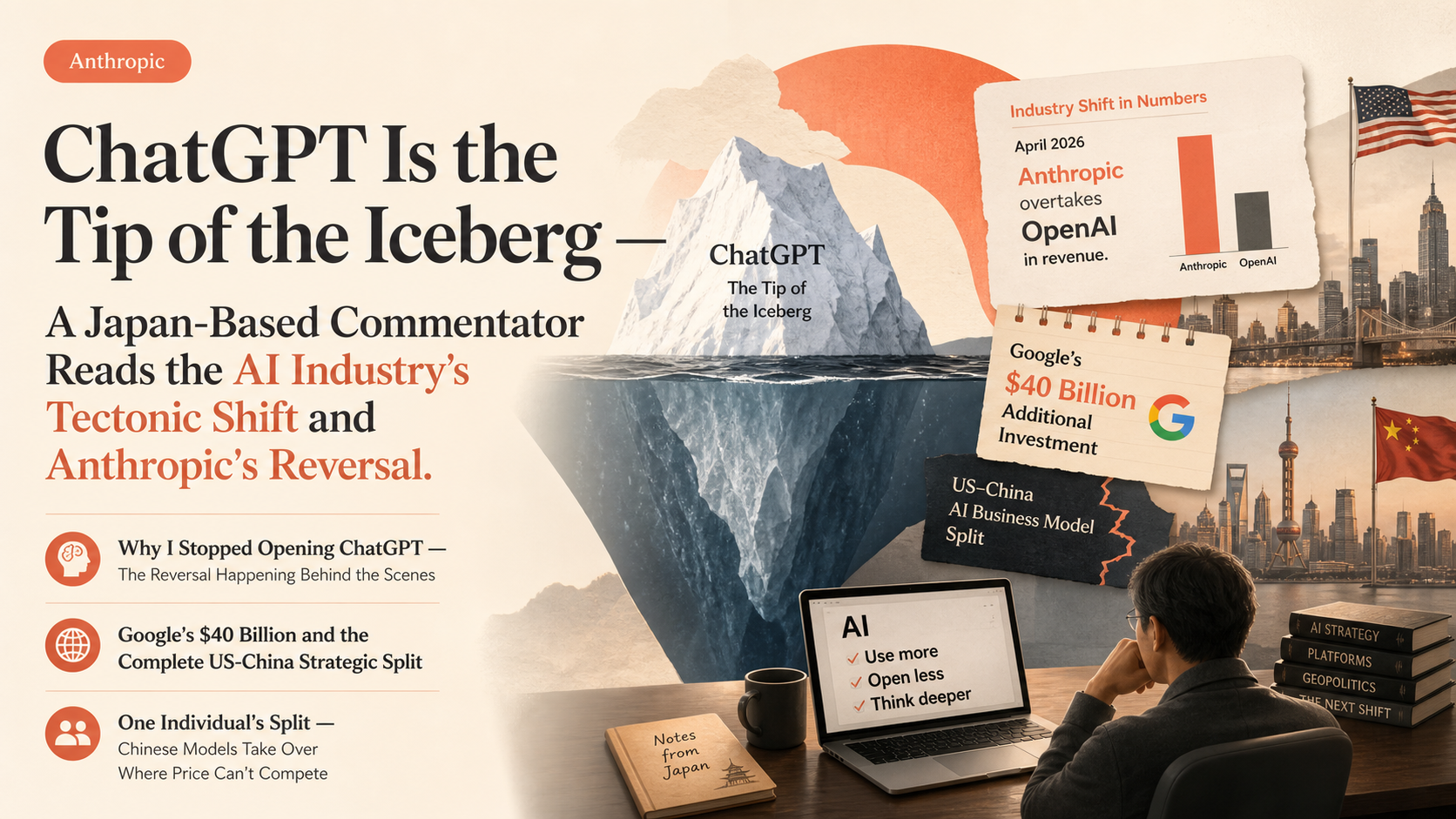
ChatGPT Is the Tip of the Iceberg — A Japan-Based Commentator Reads the AI Industry's Tectonic Shift and Anthropic's Reversal
ChatGPTは氷山の一角。AI業界で起きている地殻変動
46,306 views 8 highlights

TL;DR · What you'll learn

  • 1 The host of 'Overseas Y-Papa Radio' opens with 'I barely open ChatGPT for work anymore.' Not because he's using AI less — he's using it more than ever — and that paradox is the entry point into a bigger story about tectonic shifts in the AI industry.
  • 2 In Japan, 'AI' still mostly means ChatGPT, and by monthly active users it remains the largest. But industry-wide numbers tell a different story: in April 2026, Anthropic overtook OpenAI in revenue.
  • 3 He organizes the discussion into three parts: first, the premise that AI isn't just chat-box Q&A; second, what's happening behind the scenes that let Anthropic overtake OpenAI; third, his personal model-switching strategy (opinion, for reference only).
  • 4 The symbolic event: Google announced up to $40 billion in additional investment in Anthropic. That Google — which has its own strong AI in Gemini — would still pour that much into Anthropic signals how seriously it's chasing the enterprise-backend AI market.
  • 5 Chinese players (DeepSeek, Alibaba's Qwen, etc.) run a completely opposite strategy: distribution. DeepSeek's latest model claims equivalent performance at roughly a quarter of Claude's top-tier price, distributed as downloadable open weights anyone can run on their own hardware.
  • 6 As of 2025, Chinese open models' global download share overtook the US — nearly 20% of the total is Chinese-made. The US side runs closed, high-quality, high-price-per-enterprise; the Chinese side runs open, cheap, and mass-distributed.
  • 7 In his own personal split: financially sensitive analysis and tasks that can't fail go to closed, high-quality models. Bulk, low-cognitive-load processing is increasingly being taken over by cheap Chinese open models.
  • 8 Information that absolutely can't leave the premises, or processing that needs to run fully local, is now 80-90% Chinese open models — not because he's actively choosing 'Chinese,' but because that's practically the only option that can run on his own server.

Read as slides

3 slides total

01 Slide 1 / 3
Watch at 00:00

Why I Stopped Opening ChatGPT — The Reversal Happening Behind the Scenes

The host, who has lived in Shanghai, New York, and now New Zealand with his family, opens with a paradox: 'I barely open ChatGPT for work anymore' — even though his overall AI usage is far higher than before. That contradiction is his entry point into the episode's core subject.

In Japan, 'AI' still mostly means ChatGPT, and by monthly active users it remains the world's largest. But the industry-wide numbers tell a different story: in April 2026, Anthropic overtook OpenAI in revenue. 'Claude — that's the chat thing, right? Why is it so strong?' is exactly the naive question that leads into the distinction between AI's visible surface and its invisible backend, which is the spine of the whole episode.

Claude Daily 01 / 03
02 Slide 2 / 3
Watch at 05:23

Google's $40 Billion and the Complete US-China Strategic Split

What's happening behind the scenes? The symbolic event is Google announcing up to $40 billion in additional investment in Anthropic. That Google — with its own strong AI in Gemini — would still pour that much into Anthropic signals just how seriously it's chasing the enterprise-backend AI market.

Shift perspective to China, and the strategy is a complete opposite: distribution above everything. DeepSeek and Alibaba's Qwen are the flagship names. Price-wise, DeepSeek's latest model claims equivalent performance at roughly a quarter of Claude's top-tier price, and it's distributed as downloadable open weights anyone can run on their own hardware or servers. As of 2025, Chinese open models' global download share overtook the US — nearly 20% of the total worldwide is Chinese-made. To summarize: the US side runs closed, high-quality, high-price enterprise sales; the Chinese side runs open, cheap, mass distribution. Under the same word 'AI,' the business model has split into two completely opposite poles.

Claude Daily 02 / 03
03 Slide 3 / 3
Watch at 10:38

One Individual's Split — Chinese Models Take Over Where Price Can't Compete

From here the host shifts to his own opinion. Financially sensitive analysis or intricate decision-making — work that can't afford to fail — goes to closed, high-quality models. But bulk, low-cognitive-load processing is being taken over fast by cheap Chinese open models, where the price gap can be one or even two orders of magnitude. For simple, high-volume tasks like routine classification, price competition is essentially over.

And information that absolutely can't leave the premises, or processing that needs to run fully local, is now 80-90% Chinese open models. This isn't a deliberate preference for 'Chinese' — it's a process of elimination: that's practically the only option that can be downloaded and run on his own server. Recalling the opening premise — that AI isn't just chat-box Q&A — the volume of AI usage in coding and business automation dwarfs one-off chat interactions by orders of magnitude. Behind that much larger volume, the same US-high-quality-high-price versus China-cheap-broad split is happening naturally even at the individual-user level, and ChatGPT — long the runaway leader — is quietly losing ground. That's the real shape of the tectonic shift happening in AI right now, and he notes this isn't getting much coverage in Japan.

Claude Daily 03 / 03

Editor's Take

The value of this video is that it illuminates a structural shift, invisible if you're only watching chat-interface market share, by looking at enterprise backend capital flows instead. Google's $40 billion investment and Chinese open models' rising global share look unrelated at first glance, but they're two opposite answers to the same question: how should companies procure AI. Two implications for readers. First, judging AI competitiveness by monthly active users alone is risky — enterprise API revenue and infrastructure investment figures are the 'invisible metrics' that need to be tracked in parallel. Second, the task-based routing strategy this video demonstrates — closed high-quality models for critical judgment, cheap open models for bulk low-stakes processing, fully local processing for sensitive data — is a practical blueprint any individual user can replicate, and a concrete way to avoid single-vendor dependence. The host's observation that this shift is barely covered in Japan is itself worth noting as an information asymmetry.

Source

ChatGPTは氷山の一角。AI業界で起きている地殻変動

海外Yパパラジオ 世界を読み解く

ChatGPTは氷山の一角。AI業界で起きている地殻変動

Published 6/28/2026 13 min 46,306 views

This article auto-summarizes the YouTube video's transcript with Claude. Please refer to the original video for nuance and exact wording.

Watch on YouTube

Related

3 articles