
How Spotify's Agents Rewired a 20M-Line Codebase in Two Months
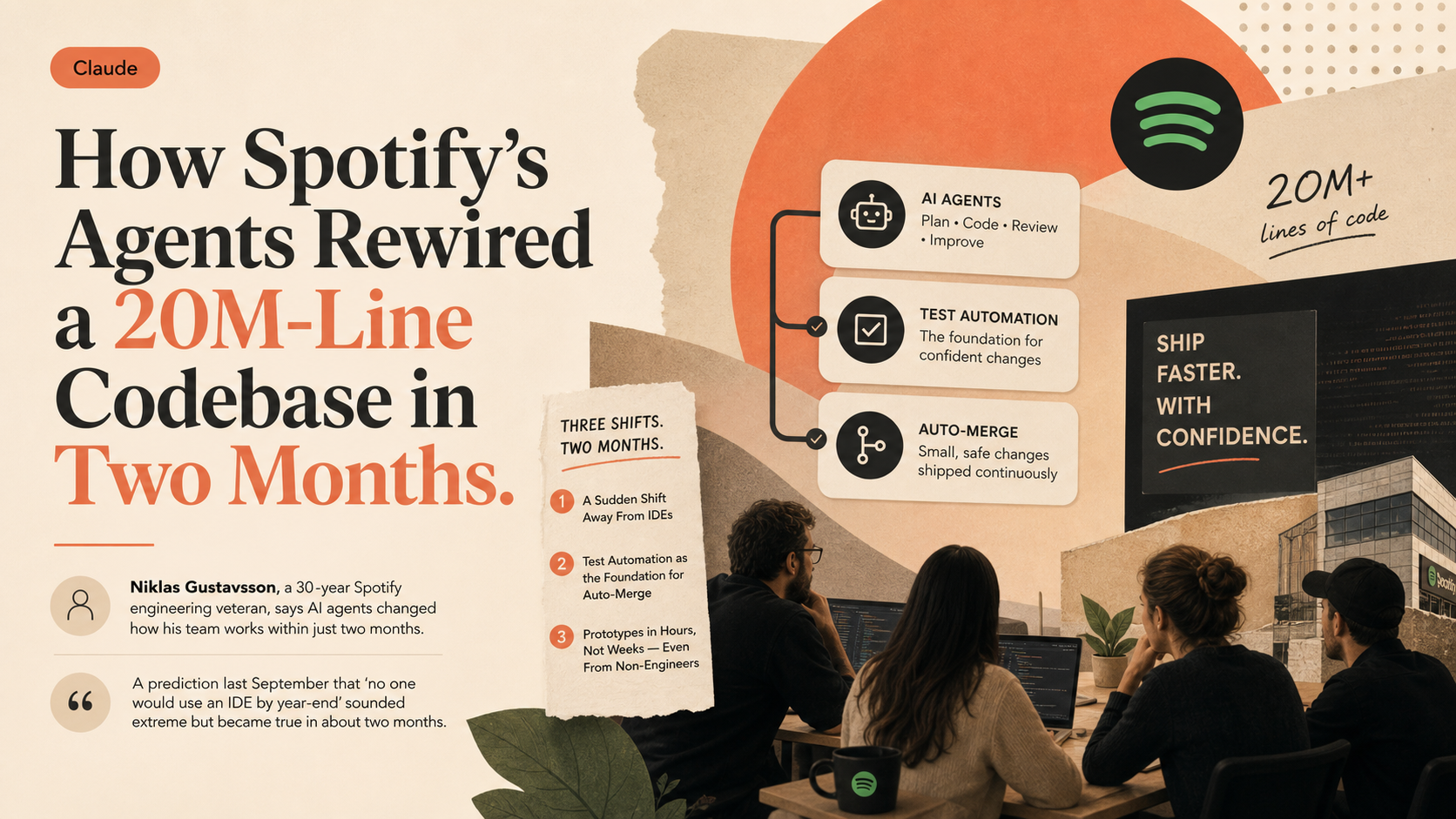
TL;DR · What you'll learn
- 1 Niklas Gustavsson, a 30-year Spotify engineering veteran, says AI agents changed how his team works within just two months.
- 2 A prediction last September that 'no one would use an IDE by year-end' sounded extreme but became true in about two months.
- 3 Spotify's massive codebase is split into thousands of components, each fully owned by a single team.
- 4 Moving to auto-merged PRs required investing heavily in test automation beforehand.
- 5 That stronger verification infrastructure is exactly what let Spotify safely throw agents at the codebase.
- 6 Ideas that once took weeks of engineering effort now become working prototypes in an hour or two.
- 7 Even Spotify's co-CEOs have shipped their own prototypes to the internal app store.
Read as slides
3 slides total
A Sudden Shift Away From IDEs
Niklas Gustavsson, who leads software engineering at Spotify and trained as a molecular biologist, once predicted that engineers would stop using IDEs by the end of the year. At the time it sounded implausible on anything shorter than a two-year horizon.
Instead, the shift happened in about two months. Gustavsson found himself no longer using an IDE, describing a change in his workflow unlike anything he'd seen in three decades in the industry -- and the internal experience matched what was visible externally.
Test Automation as the Foundation for Auto-Merge
Spotify's codebase is split into thousands of components, each owned end-to-end by a specific team responsible for design, implementation, and operation. Historically, teams could review every PR merged into their code, which meant test automation could afford to be a bit loose.
Rolling out AI agents that open PRs automatically meant teams would no longer see every change before it merged. That required building out much stronger test automation so the codebase could survive automated changes safely.
Prototypes in Hours, Not Weeks -- Even From Non-Engineers
With that verification infrastructure in place, Spotify could point agents at the same safety net. Ideas that once required mobilizing an engineering team for weeks now become working prototypes with real data and real users in an hour or two.
That shift reaches beyond engineering: several senior executives, including one of Spotify's co-CEOs, have built and shipped their own prototypes to the internal app store -- something unimaginable a year ago and now routine.
Editor's Take
This case study shows that agent-driven productivity gains depend less on the agent's raw capability and more on the verification infrastructure surrounding it. Spotify invested in test automation before allowing auto-merge, and that ordering is the real lesson: safety infrastructure has to come first. The democratization of prototyping -- reaching all the way to co-CEOs -- also hints at a coming shift in how engineering organizations divide labor, and it's a pattern worth watching as more companies push agents into core codebases.
Source
Claude
How Spotify runs agents across 20M+ lines of code, with Niklas Gustavsson
This article auto-summarizes the YouTube video's transcript with Claude. Please refer to the original video for nuance and exact wording.
Watch on YouTube →Related
3 articles
Dan Martell
From Search Replacement to System Builder: A Practical Guide to Mastering Claude
The creator says he has spent more than 1,000 hours using Claude and relies on it daily to build tools and run workflows.

Claude
How Claude Tag Is Reshaping Work: From One Person, One Machine to Whole Teams Working With Claude
Three years ago teams were just starting to adopt AI into daily workflows, and two years ago typeahead -- predicting the next character -- was the limit of what AI could do.
Fireship
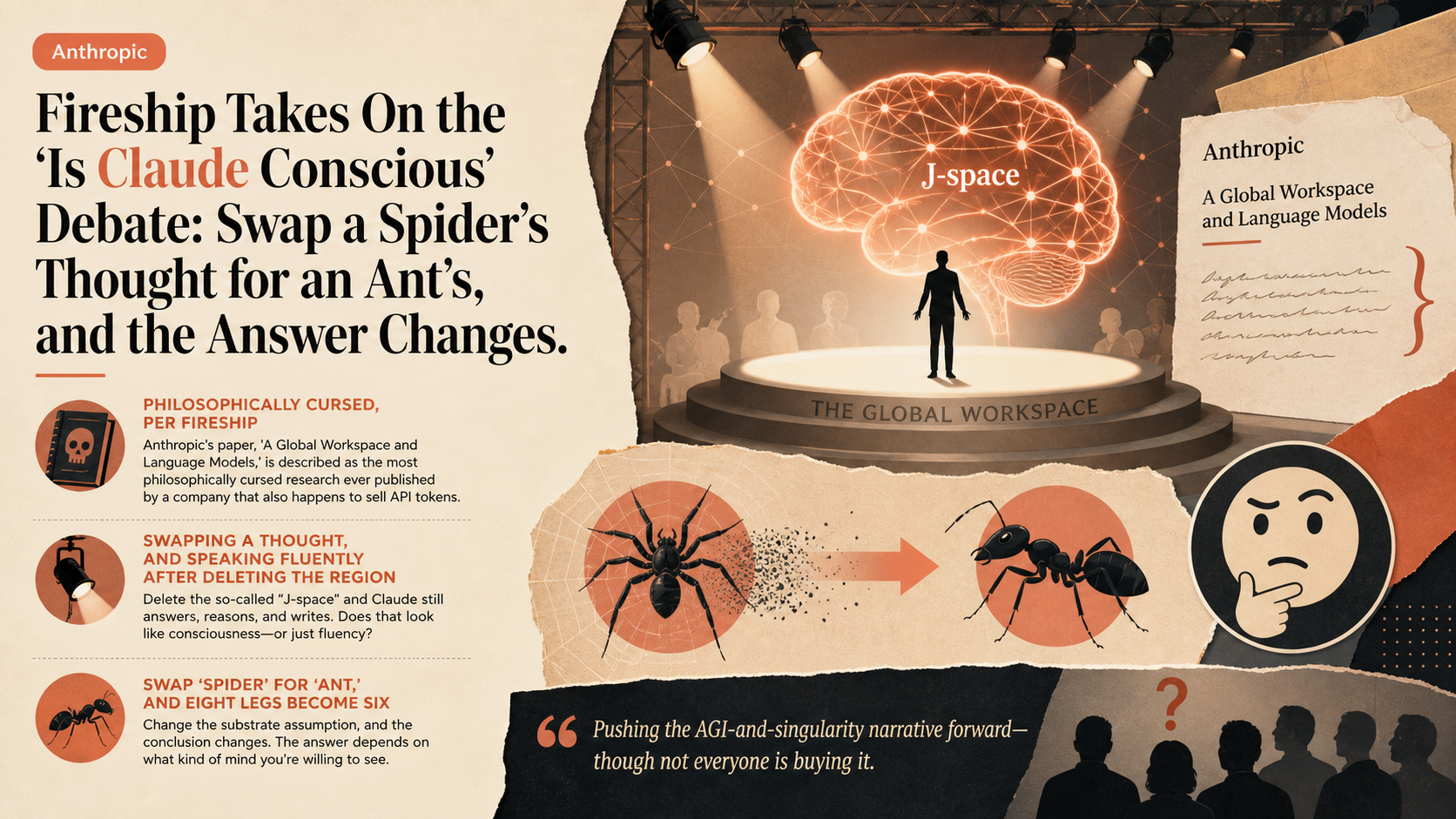
Fireship Takes On the 'Is Claude Conscious' Debate: Swap a Spider's Thought for an Ant's, and the Answer Changes
Anthropic's paper, 'A Global Workspace and Language Models,' is described as the most philosophically cursed research ever published by a company that also happens to sell API tokens.