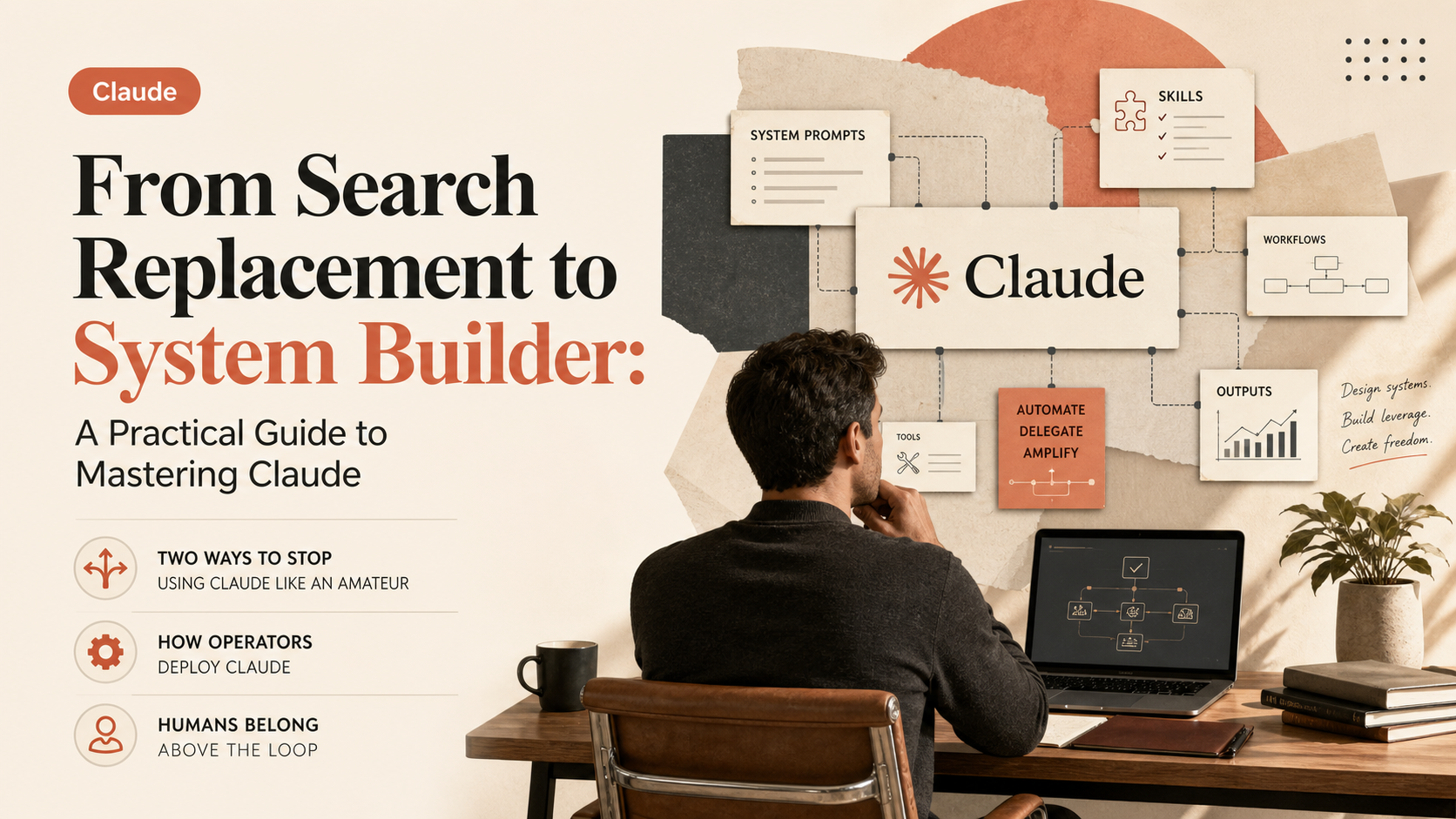
From Search Replacement to System Builder: A Practical Guide to Mastering Claude
TL;DR · What you'll learn
- 1 The creator says he has spent more than 1,000 hours using Claude and relies on it daily to build tools and run workflows.
- 2 At Level 1, the "amateur" uses Claude like an advanced search engine and taps only about 5% of its capabilities.
- 3 Two ways to level up: make Claude ask the questions it needs before answering, and have it check its own work.
- 4 Operators start by defining the output format in a system prompt so it can be reused repeatedly.
- 5 Turn recurring tasks into skills or commands. If you do something three times or more, it is worth formalizing.
- 6 Use co-work to run tasks on a schedule, while humans focus only on review and approval.
- 7 Have a critique agent review deliverables and iterate on fixes to maintain quality.
- 8 The key is not collecting features but turning them into habits, starting with one feature used every day for 30 days.
Read as slides
3 slides total
Two Ways to Stop Using Claude Like an Amateur
Most people treat Claude like an advanced Google search, ask one question, get one answer, and close the tab. That is like using a NASA supercomputer to calculate 2+2, and it means using only about 5% of its potential.
There are two ways out of that pattern. First, ask Claude to "ask any questions needed to do this task correctly" so it can pull out the missing context. Second, tell it to "check your own work" so it can find errors in its output on its own.
How Operators Deploy Claude
Advanced users do not just "use" Claude. They deploy it to solve problems. The first step is the system prompt, where they define the output format in advance. The creator argues that the future value of teams and companies will increasingly lie in the stockpile of these system prompts.
The second step is skills, which save repeatable workflows for reuse. If a task comes up three times or more, that is the threshold for turning it into a skill. The third step is scheduled execution through co-work, where routine processing is delegated and humans step in only to verify the results.
Humans Belong Above the Loop
The creator uses a setup where a main agent hands copy or research to a critique agent for review. By having it produce improvement notes and rerun the work, he says he consistently gets the best possible output.
That moves humans out of the task itself. Instead of being "in the loop," they stand "above the loop." What matters is not accumulating features, but building habits around them, starting with one feature used consistently for 30 days.
Editor's Take
The value of the five-level framework for mastering Claude lies not in feature tours but in the conclusion that 'habit formation is the divider.' Making it ask questions first and check its own work, turning frequent tasks into skills, using a critique agent to guarantee quality — these aren't isolated tips but a staged path that lifts your relationship with Claude from 'a search substitute' to 'a builder of autonomous systems.' The advice to sustain one practice for 30 days reframes tooling as behavior change.
Source
Dan Martell
Full Claude Guide: Beginner to Pro in Under 15 Minutes
This article auto-summarizes the YouTube video's transcript with Claude. Please refer to the original video for nuance and exact wording.
Watch on YouTube →Related
3 articles
Claude
How Spotify's Agents Rewired a 20M-Line Codebase in Two Months
Niklas Gustavsson, a 30-year Spotify engineering veteran, says AI agents changed how his team works within just two months.

Riley Brown
Becoming Agent-Native: 9 Durable AI Skills That Put You Ahead of 99%
This is for people who want to get genuinely good with agent platforms such as ChatGPT, Claude, Claude Code, and Codex. The goal is to become "agent-native," or the person in your organization who uses AI agents best.

Duncan Rogoff | Learn Claude Code
Anthropic's 'Launch Your Agent' Skill Brings Managed Agents to Claude Code
Anthropic released a free, open-source Claude Code skill called "Launch Your Agent" designed to take users from an idea to a production managed agent in minutes.