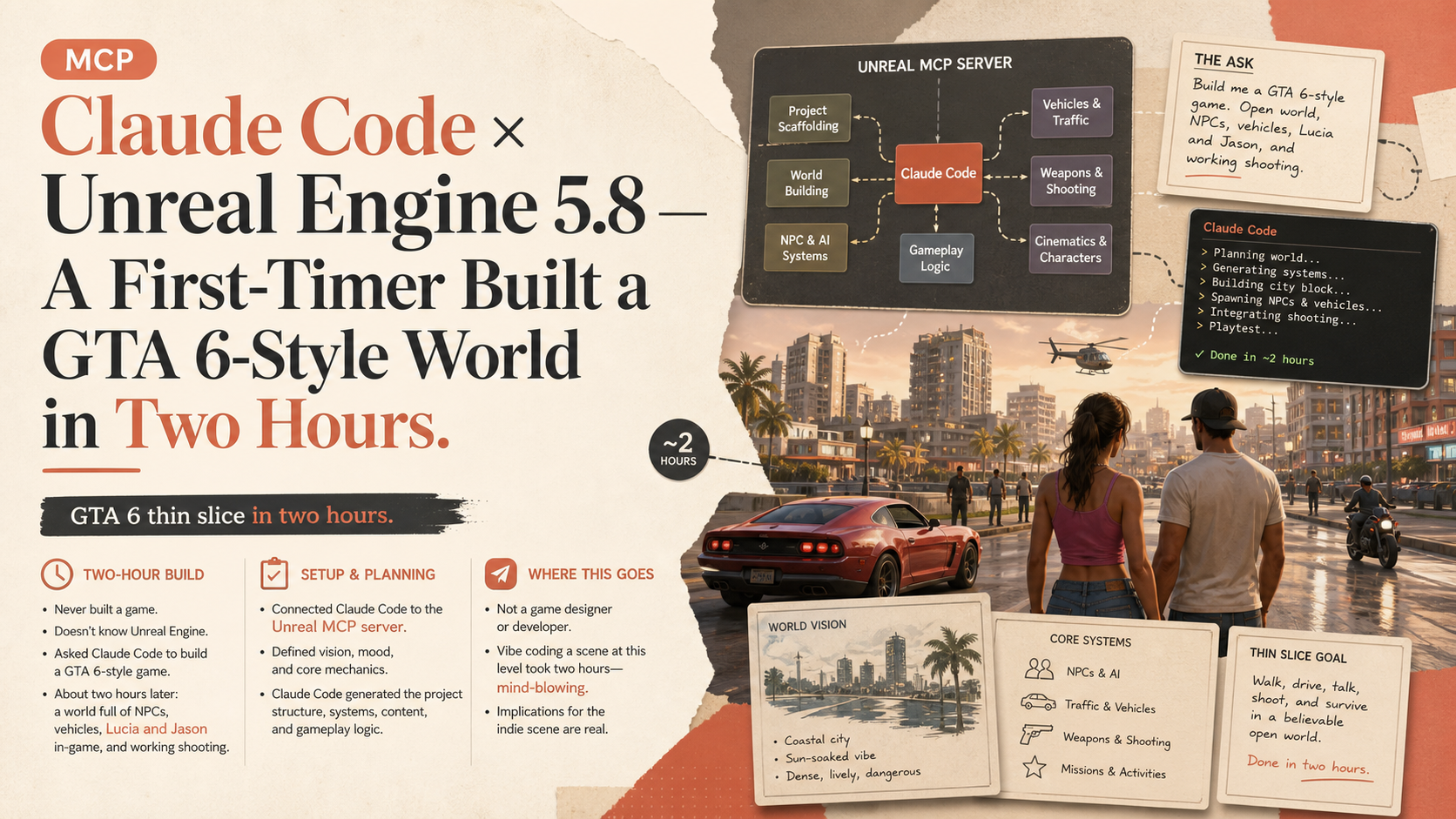
Claude Code × Unreal Engine 5.8 — A First-Timer Built a GTA 6-Style World in Two Hours
TL;DR · What you'll learn
- 1 The creator has never built a game and doesn't know Unreal Engine. He asked Claude Code to build a GTA 6-style game; about two hours later he had a world full of NPCs, vehicles, Lucia and Jason in-game, and working shooting.
- 2 He's not a game designer or developer. The fact that vibe coding a scene at this level took two hours is, he says, mind-blowing. Implications for the indie scene are real.
- 3 Setup is minimal: Unreal Engine 5.8+ via the official launcher, and Claude Code (or any equivalent coding agent). The Unreal MCP server is the unlock.
- 4 The first walk-through is a cube-add command, which Claude lands in the scene. Hit play and the cube is there. Basic interaction confirmed.
- 5 The big productivity tip: planning mode. Claude won't touch the scene, so you can hash out mechanics, character design, visual direction, and locations before any code or asset moves.
- 6 Sample prompt used: 'Hey Claude, I'm tired of waiting for GTA 6 — research mechanics, character design, visual design, location, and create a thin slice of GTA 6 inside this game world.'
- 7 The honest caveat: the MCP server is new, scene editing is currently synchronous, so multi-agent parallel work isn't there yet. Expect Epic to refine this.
- 8 His take on indie devs: this isn't a replacement. It frees solo creators from trivial tasks so they can spend their time on the higher-leverage parts of the build.
Read as slides
3 slides total
Zero game-dev experience to GTA 6 thin slice in two hours
Leon van Zyl's opener doesn't pull punches. 'I've never built a game in my life and I don't really know much about Unreal Engine at all.' He asked Claude Code to build a GTA 6-style game. Roughly two hours later he had a world full of NPCs, working vehicles, Lucia and Jason both in the scene, and working shoot mechanics. He stopped recording because he wanted to show the setup, not because the build had run out.
He's careful to call himself neither a game designer nor a developer. The point isn't 'AI made me a game dev.' The point is that vibe coding a scene at this level in two hours is, in his words, mind-blowing — and what it implies for the indie scene and for creative people generally is the larger story.
Setup and planning mode — Unreal Engine 5.8 + Claude Code
Setup is two items. Download Unreal Engine via the official launcher (5.8 minimum), and install Claude Code or any equivalent coding agent. The actual unlock is the Unreal MCP server, which lets an external agent reach into the scene directly. The tutorial confirms it with the smallest possible test: ask Claude to add a cube, watch the cube show up, hit play, and see the cube in the running scene. Basic interaction works.
The productivity move is planning mode. Claude won't touch the scene in this mode, so you can talk through mechanics, character design, visual direction, and locations until both sides are on the same page. The example prompt used is concrete enough to be useful and abstract enough to give Claude room: 'Hey Claude, I'm tired of waiting for GTA 6 — research mechanics, character design, visual design, location, and create a thin slice of GTA 6 inside this game world.'
Current limits and where this is going
The honest closing is balanced. Build time was long for the agent, but the MCP server is new. Epic will refine it. The current limitation is synchronous editing — only one change to the scene at a time. The ideal is a team of agents each handling a separate change in parallel, and that isn't here yet.
On indie devs: Leon enjoys indie games and is consistently impressed by what solo developers ship. He doesn't think these tools replace those developers. They make their lives easier — hand the trivial work to the agent, focus your time on the higher-leverage parts of the game. That's the future he's watching for.
Editor's Take
A game-development novice assembling a GTA 6-style scene in two hours with Unreal Engine 5.8 and Claude Code shows the barrier of engine mastery beginning to fall. The turning point is the MCP server on the Unreal side letting AI operate the editor directly. What matters is planning mode — discussing mechanics and design before implementation, where design dialogue, not one-shot generation, drives the result. The creator's conclusion — not replacement, but handing off chores to focus on high-ticket work — is the most realistic read on AI-assisted development.
Source
Leon van Zyl
Claude Code + Unreal Engine: Build a Full Game with AI (MCP Setup Tutorial)
This article auto-summarizes the YouTube video's transcript with Claude. Please refer to the original video for nuance and exact wording.
Watch on YouTube →Related
3 articles
Eric Tech
The Complete OpenCode Tutorial: Keep Claude Code's Playbook (Skills, MCP, agents.md) While Freely Choosing Your Model
Coding agents tend to lock you into one provider and model, but OpenCode lets you freely choose between existing subscriptions, free models, API-key models, or local models -- while keeping the features popularized by Claude Code and Codex.
IBM Technology
MCP vs. Skills: IBM Breaks Down When to Use Each for Building AI Agents
Getting the right answer from an LLM requires the right context -- giving it just a role and task is prompt engineering, while adding extra information is context engineering.
Griffin Wooldridge
The Mobbin MCP Gives Claude Code Access to 600,000+ Real UI Design References
Claude Code can now pull from over 600,000 real UI screens -- onboarding flows, paywalls, settings pages -- before it designs anything.