An Anthropic Engineer's 'Field Guide to Fable': Closing the Gap Between the Map and the Territory
TL;DR · What you'll learn
- 1 A member of the Claude Code team spoke at the AI Engineer conference and described Fable as a model where the open world suddenly opens up.
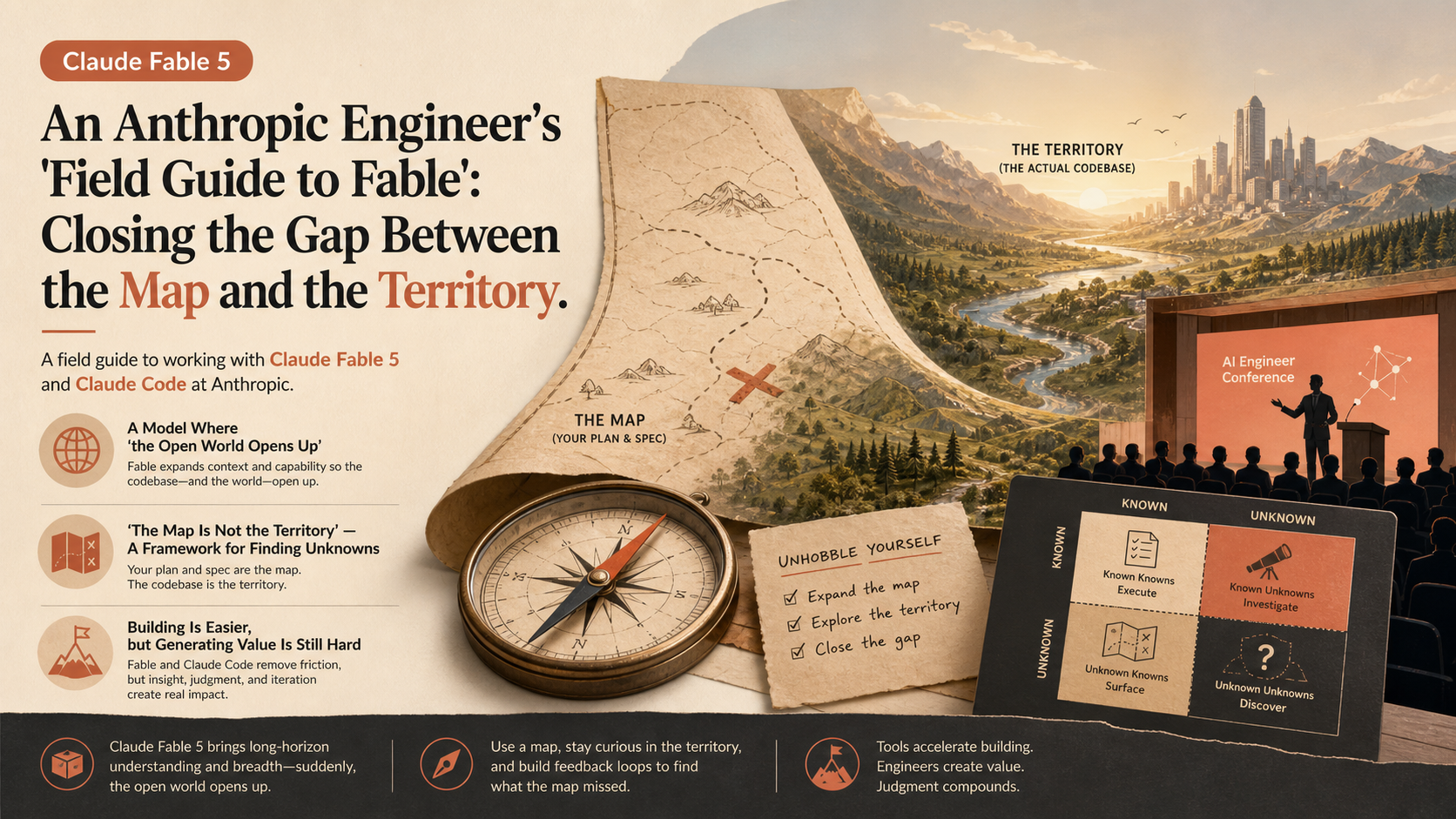
- 2 Working with Fable requires 'unhobbling yourself' too -- your mental plan and spec is the 'map,' the actual codebase is the 'territory.'
- 3 He calls it an 'unknown' whenever Claude runs into something in the territory that wasn't on the map -- and finding those unknowns ahead of time is the key to using Fable well.
- 4 He proposes thinking in a matrix of known knowns (what you write in the prompt) and known unknowns (things you know you haven't figured out yet).
- 5 He reveals he built his own conference slide deck in about 4 hours the night before using Fable, as a concrete example of pairing speed with quality.
- 6 Building has gotten easier, he notes, but generating actual value remains hard.
- 7 He closes with: go explore, make it real, and be less reasonable.
Read as slides
3 slides total
A Model Where 'the Open World Opens Up'
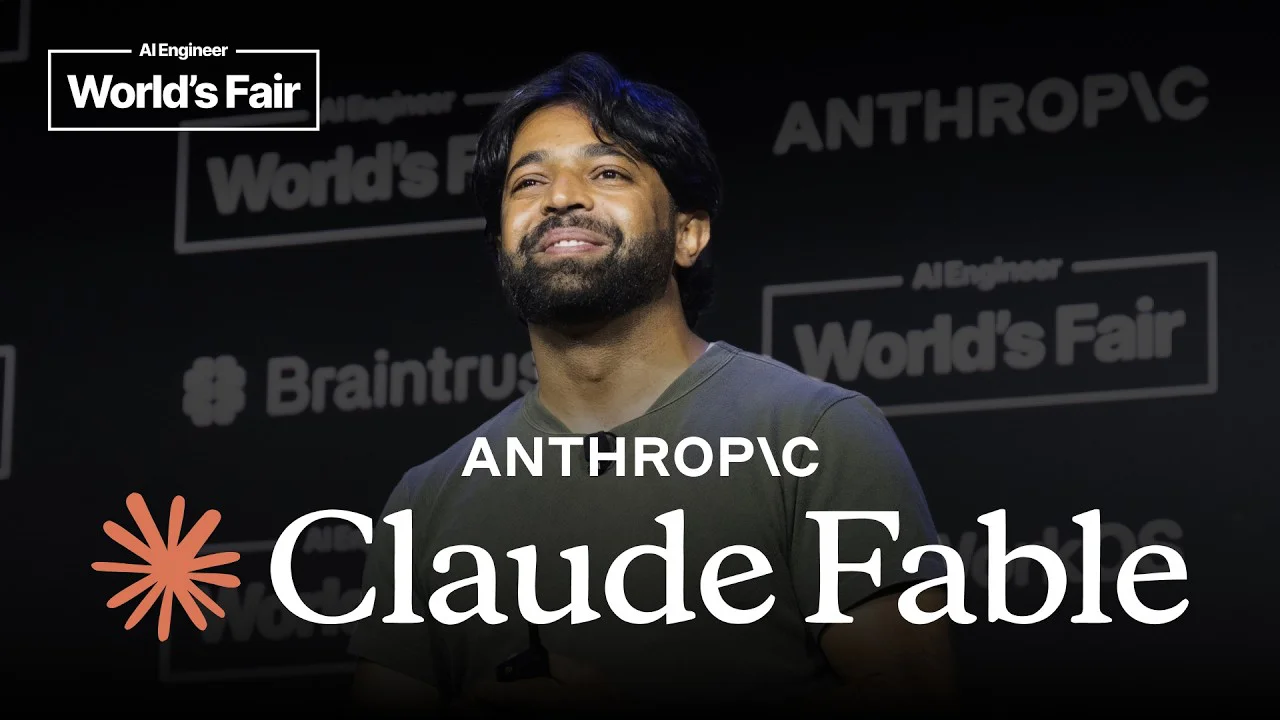
Thariq Shihipar, who works on Claude Code at Anthropic, took the stage at the AI Engineer conference to talk about his strong affection for Fable. He places it among Anthropic models people just remember, like Sonnet 3.5 new or Opus 4, and describes the experience of using Fable as finishing an RPG's tutorial and finally reaching the point where the open world unlocks. There's suddenly so much you can do and explore -- which is exciting, but also a little intimidating.
'The Map Is Not the Territory' -- A Framework for Finding Unknowns
One thing he's learned working with Fable is that it's not just Claude that needs to be 'unhobbled' -- you do too. The plan, prompt, and spec in your head is just the map; the actual codebase and real-world constraints are the territory. Whenever Claude runs into something in the territory that isn't on the map, he calls that an 'unknown.'
Because Fable can explore such a large space, if you don't find your unknowns ahead of time, it's going to run into a lot of them. He proposes organizing this as a matrix -- known knowns (what you put in your prompt) versus known unknowns (things you know you haven't figured out) -- arguing that your ability to use Fable well ultimately comes down to how accurately you can match the map to the territory and surface your unknowns.
'Building Is Easier, but Generating Value Is Still Hard'
He reveals he built the very slide deck for this talk in about 4 hours the night before, using Fable -- a concrete example of combining speed with quality he was genuinely happy with. He tells AI engineers the world is looking to them to prove AI isn't just a fad, that it can genuinely make people more productive and save time -- and shares his own resolution for the year: be more productive, but work less, and spend more time with the people he cares about.
Building itself has gotten easier thanks to AI, he notes, but generating actual value remains hard and takes a lot of swings to find what's genuinely valuable. He closes with: go explore, make it real, and be less reasonable.
Editor's Take
What makes this talk valuable isn't a feature rundown -- it's a cognitive framework, the map-versus-territory metaphor, for actually working with a high-capability model like Fable. The paradox that as model capability rises, what's demanded of humans shifts from precise instructions to knowing what you don't know ahead of time is a genuinely important insight that generalizes across agentic AI use. The line 'building is easier, but generating value is still hard' also reads as a warning against a trap organizations adopting AI often fall into: mastering the tool becomes the goal instead of a means to an end.
Source
AI Engineer
Field Guide to Fable — Thariq Shihipar, Anthropic
This article auto-summarizes the YouTube video's transcript with Claude. Please refer to the original video for nuance and exact wording.
Watch on YouTube →Related
3 articles
Inteligencia Artificial
Behind Fable 5's Comeback, Anthropic's Relationship With Washington Sours -- Could Europe Become a 'Safe Harbor'?
Fable 5, previously pulled offline, is back and currently the world's most powerful AI model -- included in standard plans until the 7th, after which usage-based billing returns and prices rise.
Nate Herk | AI Automation
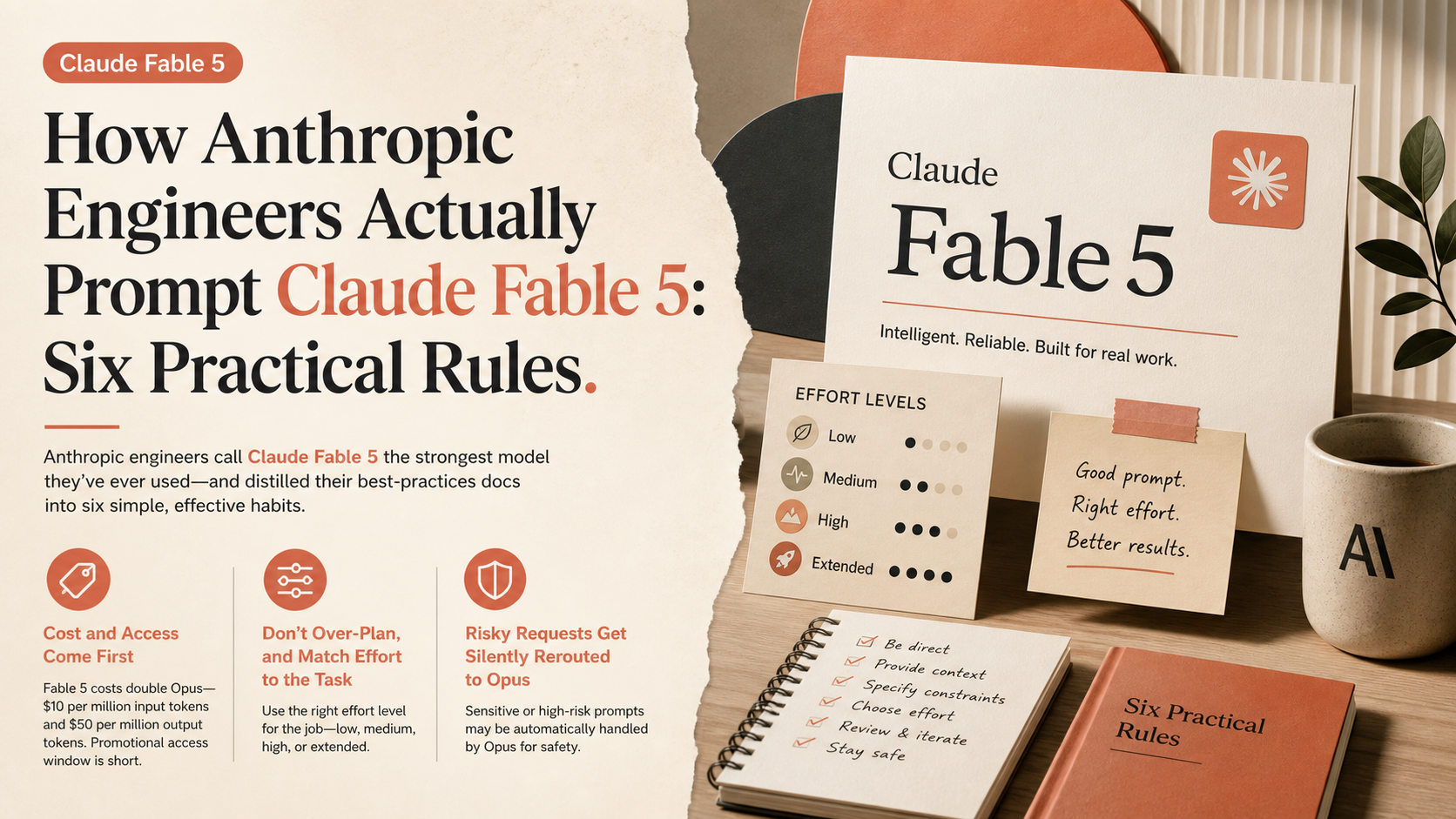
How Anthropic Engineers Actually Prompt Claude Fable 5: Six Practical Rules
The creator calls Claude Fable 5 the strongest model he's ever used, and distilled Anthropic's best-practices docs into six simple, effective habits.
The Infographics Show
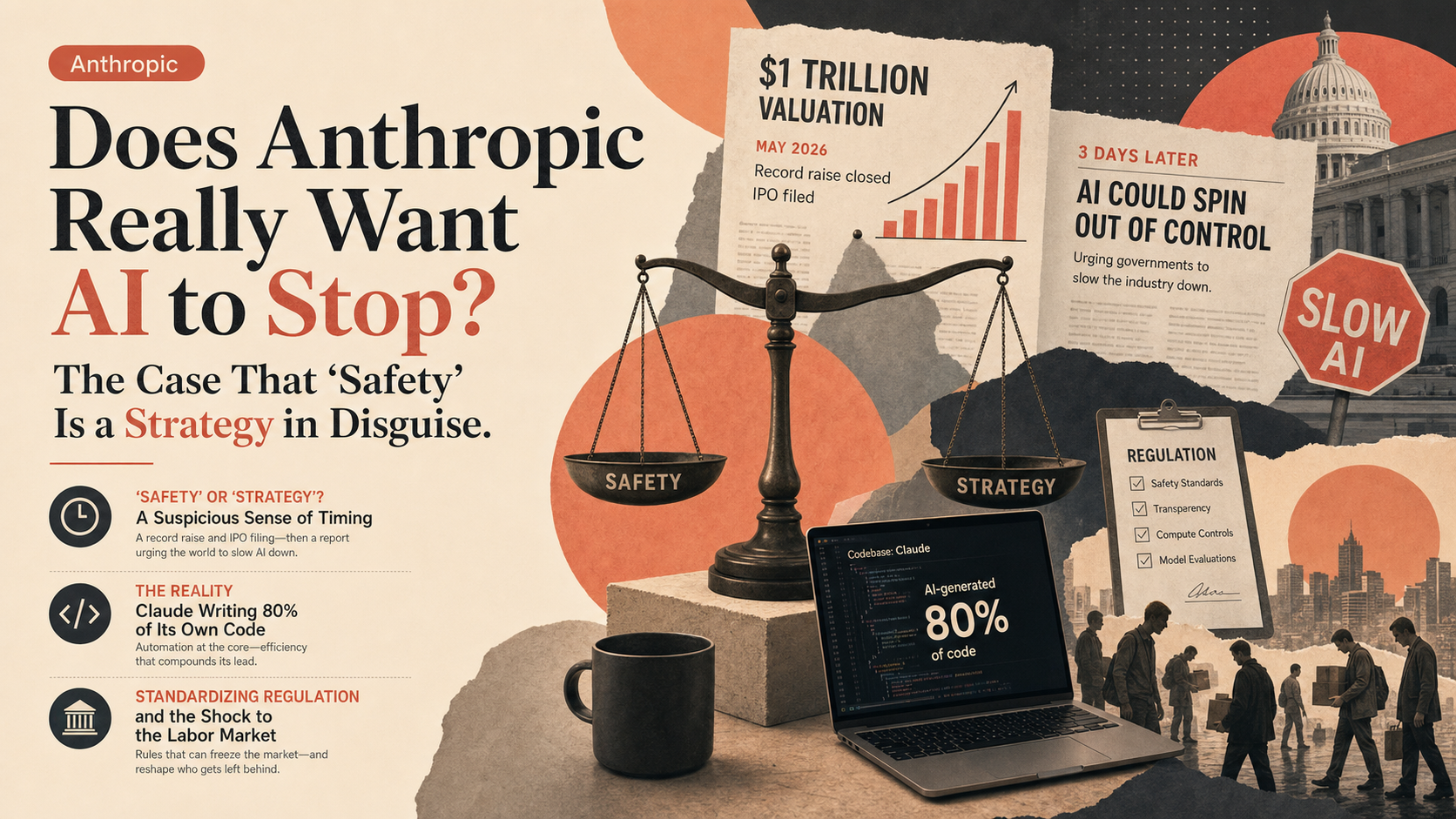
Does Anthropic Really Want AI to Stop? The Case That 'Safety' Is a Strategy in Disguise
Anthropic frames its mission as 'responsible scaling' to prevent human extinction, but there is a more cynical reading: a global slowdown also freezes the market, locks in today's front-runners, and makes it harder for open-source players to catch up.