
Claude Daily Claude Daily
RSS
Nate Herk | AI Automation 11 min video 3 slides

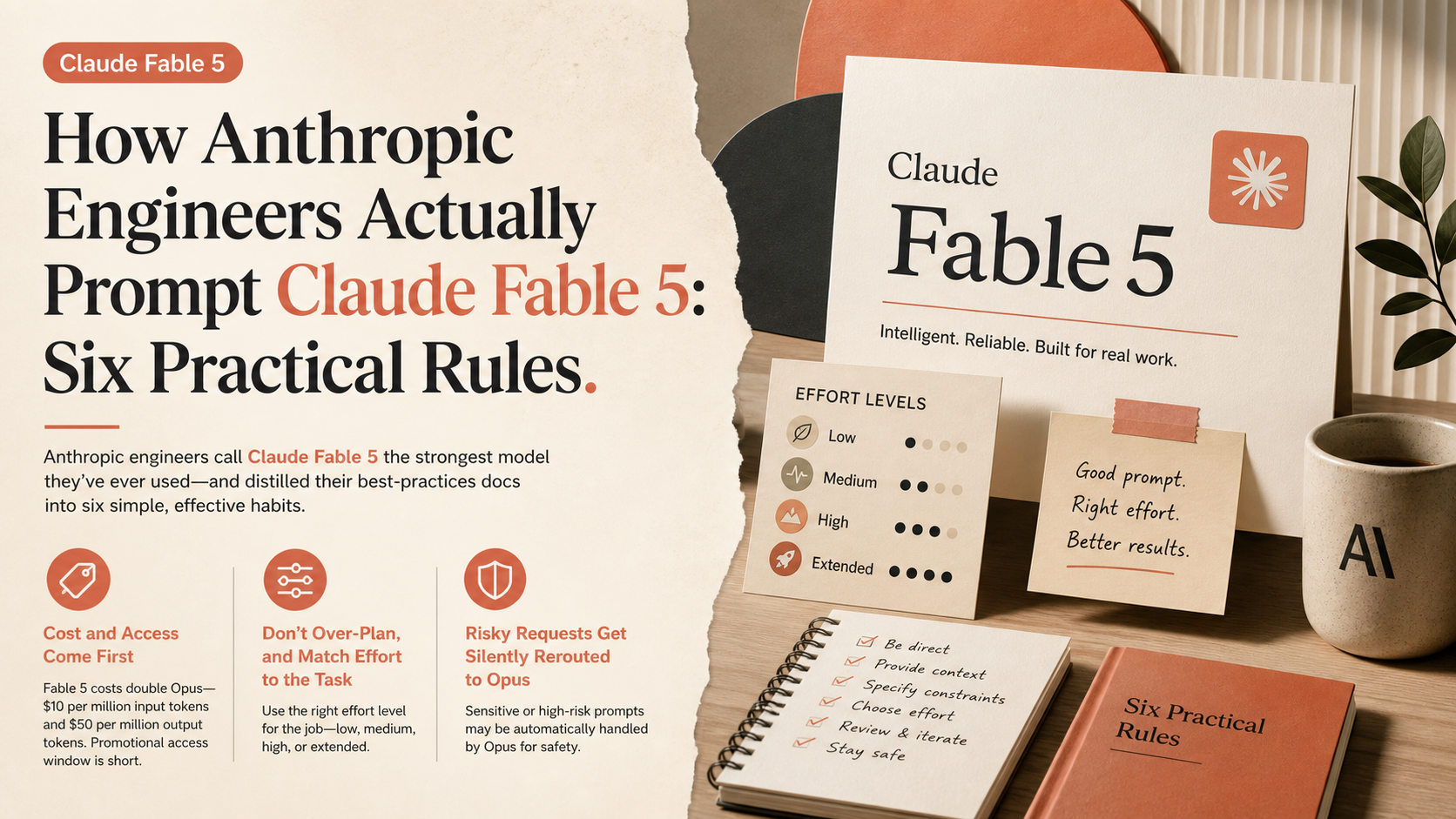
How Anthropic Engineers Actually Prompt Claude Fable 5: Six Practical Rules
How Anthropic Engineers Actually Prompt Fable 5
31,440 views 7 highlights

TL;DR · What you'll learn

  • 1 The creator calls Claude Fable 5 the strongest model he's ever used, and distilled Anthropic's best-practices docs into six simple, effective habits.
  • 2 Fable 5 costs double Opus -- $10 per million input tokens and $50 per million output tokens -- and the promotional access window is short.
  • 3 During the promo period, up to 50% of weekly limits can be used at no extra cost; beyond that, usage credits are required.
  • 4 Being specific isn't enough -- negative prompting (telling the model what not to do) is increasingly effective too.
  • 5 Rather than always starting in Plan mode, the top recommendation is to let the model act once it has gathered enough information.
  • 6 Effort levels -- low, medium, high, and extra-high -- should be matched to task difficulty rather than left on a default.
  • 7 If a request looks like it involves hacking, dangerous biology, or exposing internal reasoning, Fable 5 silently reroutes it to Opus 4.8 for a safety check.

Read as slides

3 slides total

01 Slide 1 / 3
Watch at 00:25

Cost and Access Come First

Claude Fable 5 sits in a premium price tier -- double Opus at $10 per million input tokens and $50 per million output tokens -- and isn't always included in a standard Claude plan. It's currently offered through a 'promotional period' rather than as a permanent inclusion.

During that window, up to 50% of weekly limits can be used with no extra charge, after which usage credits kick in. With the promo ending July 7, using tokens efficiently -- not wastefully -- matters more than ever.

Claude Daily 01 / 03
02 Slide 2 / 3
Watch at 05:05

Don't Over-Plan, and Match Effort to the Task

Anthropic's own documentation leads with a simple recommendation: once a model has gathered enough information, let it act instead of continuing to plan indefinitely. The creator says he no longer defaults to Plan mode -- something he used to always recommend -- and instead prompts the model to act as soon as it's ready.

Because hard tasks at higher effort settings can run for many minutes while gathering context and self-verifying, choosing the right effort level -- low, medium, high, or extra-high -- for the task at hand is one of the biggest levers for both quality and cost.

Claude Daily 02 / 03
03 Slide 3 / 3
Watch at 09:31

Risky Requests Get Silently Rerouted to Opus

Fable 5 includes a built-in safety check. If a request falls into a sensitive category -- hacking assistance, dangerous biology, or attempts to expose the model's private reasoning -- it gets silently rerouted to Opus 4.8 without notifying the user in the standard interface.

API users do see a flag indicating Opus handled the response, but most users won't notice. The routing is fortunately to Opus 4.8 rather than continuing on Fable 5's pricier tier, and the simplest way to avoid it is straightforward: don't ask for anything clearly malicious or suspicious.

Claude Daily 03 / 03

Editor's Take

The guidance to match effort levels to task difficulty and avoid over-planning generalizes well beyond Fable 5 to any high-cost, high-capability model. What's most notable is the silent safety reroute to Opus -- a design where the model itself acts as both a guardrail and a cost-management mechanism, without requiring explicit user action. With the promotional window closing July 7, teams evaluating Fable 5 for production use should treat the cost structure, not just the capability jump, as a first-class part of the decision.

Source

How Anthropic Engineers Actually Prompt Fable 5

Nate Herk | AI Automation

How Anthropic Engineers Actually Prompt Fable 5

Published 7/1/2026 11 min 31,440 views

This article auto-summarizes the YouTube video's transcript with Claude. Please refer to the original video for nuance and exact wording.

Watch on YouTube

Related

3 articles