Claude Daily Claude Daily
RSS
Anthropic's War On Opensource AI
28,597 views 8 highlights

TL;DR · What you'll learn

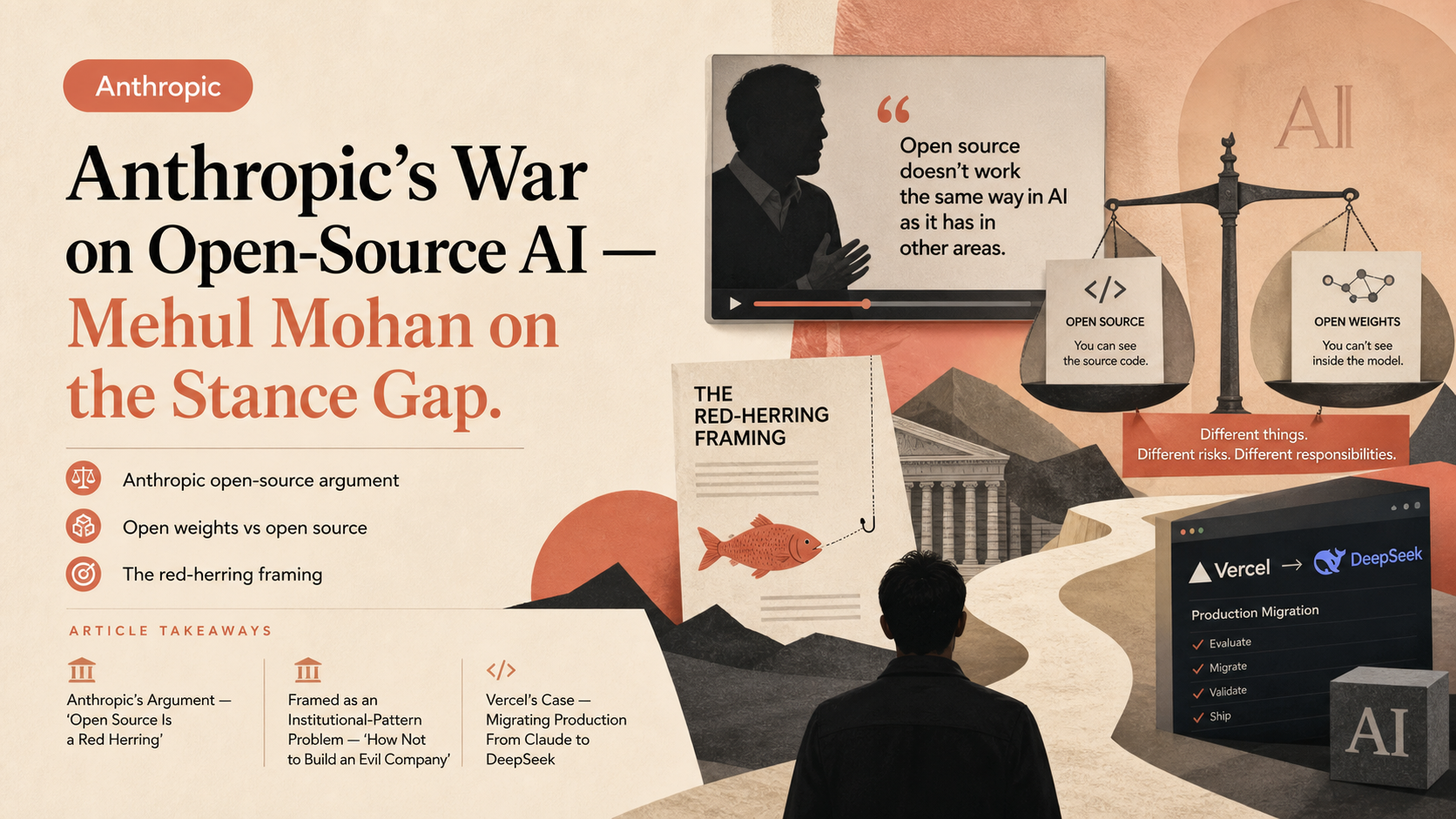
  • 1 Mehul Mohan opens by showing a video clip of an Anthropic figure discussing open-source AI. The position in the clip: 'Open source doesn't work the same way in AI as it has in other areas.'
  • 2 Anthropic's argument: in other fields you can see the source code, but with AI models you can't see inside the model. That's why it's often called 'open weights' rather than 'open source' — and the two are different things.
  • 3 Using DeepSeek as the example, 'whether the model is open source or not doesn't matter — only whether it's a good model.' Open source is framed as a 'red herring' — a discussion off the real point.
  • 4 The argument continues: in real deployment everything ends up hosted on the cloud, large models are hard to run inference on anyway, and capabilities like fine-tuning and activation inspection can be offered through the cloud to deliver equivalent value.
  • 5 Mehul threads a 'how not to build an evil company' dark-joke framing through the discussion, lifting the gap from marketing-quarrel territory to an institutional-pattern question. The structure refuses to settle for a surface-level reading.
  • 6 He cites Vercel publicly switching production workload from Claude to DeepSeek and cutting cost substantially. A real-world migration case that shows where Anthropic's argument runs into business reality.
  • 7 The pressure is on margins, not relevance, Mehul summarizes. The tier just below the frontier keeps getting cheaper, and migration to open-weight models for cost optimization is now a real, ongoing thing.
  • 8 Mehul himself is an Anthropic fan — he uses Claude constantly and praises Anthropic's vertical-stack suite. The closing position is still that 'there are points Anthropic should address sooner rather than later.'

Read as slides

3 slides total

01 Slide 1 / 3
Watch at 00:00

Anthropic's Argument — 'Open Source Is a Red Herring'

Mehul Mohan starts by showing viewers a clip of an Anthropic figure laying out the company position on open-source AI. The argument is direct: in other fields you can see the source code, but with AI models you can't see inside the model. That's why it's often called 'open weights' rather than 'open source' — and the two are different things.

The clip then pivots to DeepSeek as the example: 'whether the model is open source or not doesn't matter — only whether it's a good model.' Open source is framed as a red herring, a side argument that distracts from the real metric. The continuation: in real deployment everything ends up hosted on the cloud anyway, large models are hard to inference on, and capabilities like fine-tuning and activation inspection can be offered through the cloud platform to deliver equivalent value. That's the Anthropic side of the case.

Claude Daily 01 / 03
02 Slide 2 / 3
Watch at 08:55

Framed as an Institutional-Pattern Problem — 'How Not to Build an Evil Company'

Mehul refuses to leave this as a marketing skirmish. He runs the discussion through a dark-joke framing — 'how not to build an evil company' — and lifts Anthropic's argument into an institutional-pattern question. The same company that markets safety and transparency is, in the technical argument, downplaying the value of open source. The construction is designed to make that gap visible.

A DNSimple sponsor read drops in here, by contrast. In areas like DNS, a vendor that 'does one thing right' carries weight, and transparency and human support are evaluated on a different axis from AI models. The implicit comparison: Anthropic's argument may be convenient, but the question is whether it's the kind of vendor you actually want to be in a relationship with. That's the editorial intent.

Claude Daily 02 / 03
03 Slide 3 / 3
Watch at 17:45

Vercel's Case — Migrating Production From Claude to DeepSeek

The second half points to a concrete case: Vercel publicly switched production workload from Claude to DeepSeek and cut cost substantially. They wrote it up. The 'theoretically correct' Anthropic argument runs into business reality where cost pressure does the choosing.

'The pressure is on margins, not relevance,' Mehul sums up. The tier just below the frontier keeps getting cheaper, and migration to open-weight models for cost optimization is a real, ongoing trend. Mehul himself is an Anthropic fan — he uses Claude constantly and praises the vertical-stack suite — and even from that vantage point, he closes the video on 'there are points Anthropic should address sooner rather than later.' The question to followers is left open-ended: tell me in the comments what you think.

Claude Daily 03 / 03

Editor's Take

What gives Mehul's framing its weight is that it's coming from an Anthropic fan, not a critic. Discomfort from a current user is hard to dismiss. Anthropic has positioned itself on safety and transparency, while in the technical argument it consistently downplays the merits of open source. Two takeaways for readers. First, don't take Anthropic's argument at face value — when designing your own AI strategy, test the premise 'Claude is best' against real cases like Vercel's, not against marketing material. Second, the Anthropic-vs-open-source clash is best read not as a marketing fight but as an institutional design question for the AI industry. Are weights public? Who hosts? Who can fine-tune? Those questions decide the long-range freedom of developer communities and enterprise users alike. Letting convenience pick the defaults today risks locking in a dependency structure five years out that can't be unwound.

Source

Anthropic's War On Opensource AI

Mehul Mohan

Anthropic's War On Opensource AI

Published 6/27/2026 19 min 28,597 views

This article auto-summarizes the YouTube video's transcript with Claude. Please refer to the original video for nuance and exact wording.

Watch on YouTube

Related

3 articles