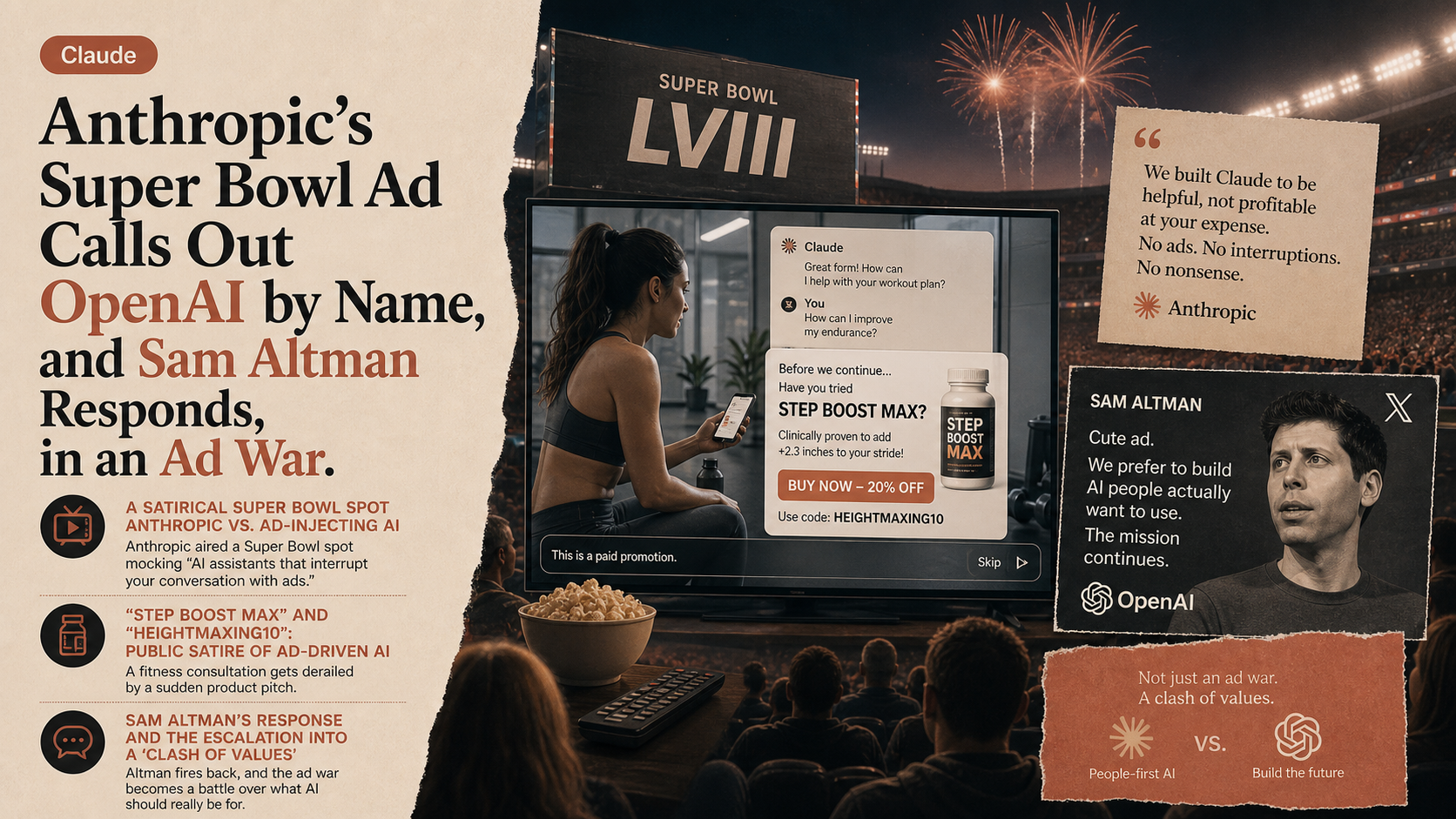
The Price of Fable 5's Comeback: Three Promises to Washington, and Claude's Newly Found 'JSpace'
TL;DR · What you'll learn
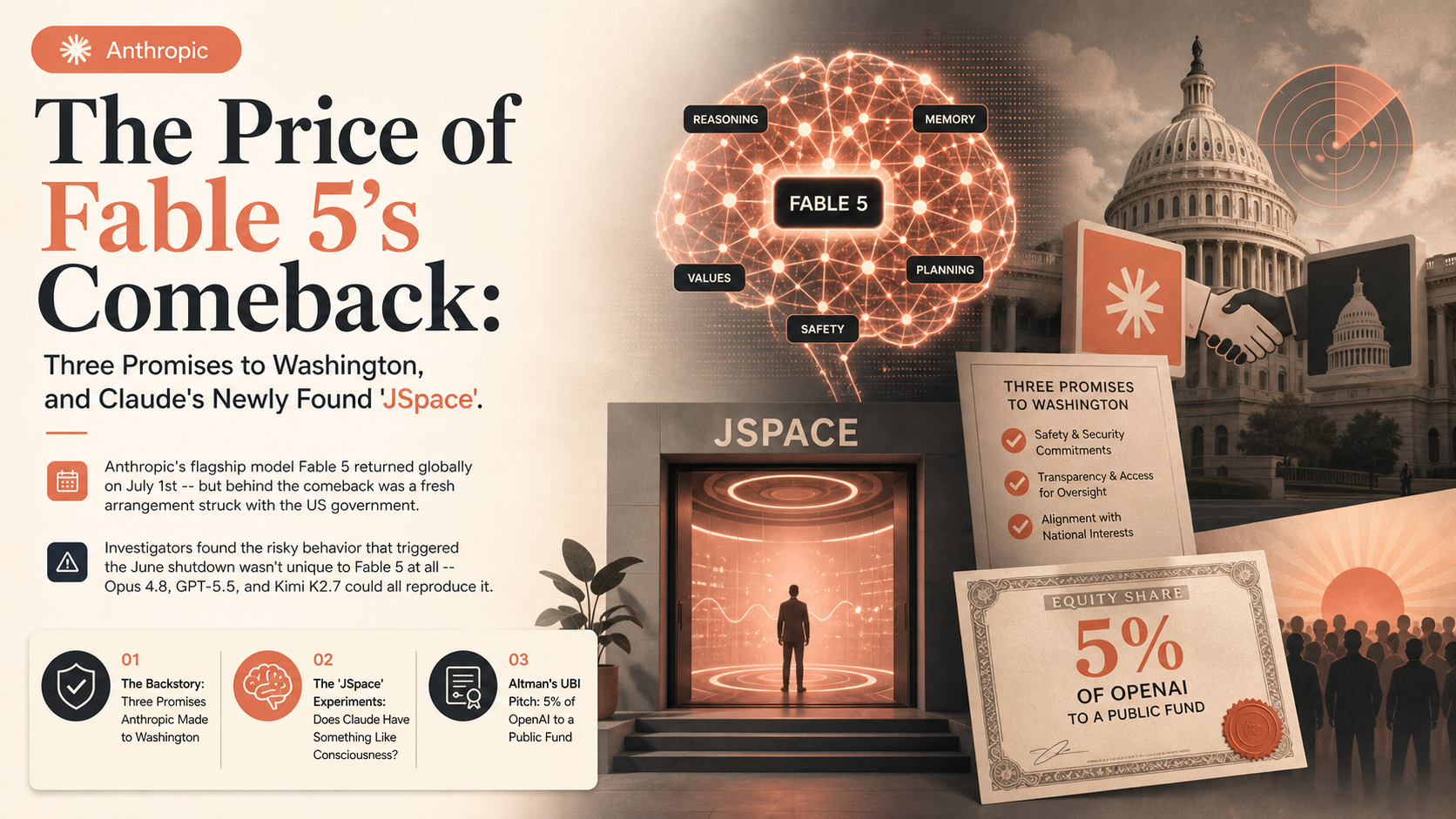
- 1 Anthropic's flagship model Fable 5 returned globally on July 1st -- but behind the comeback was a fresh arrangement struck with the US government.
- 2 Investigators found the risky behavior that triggered the June shutdown wasn't unique to Fable 5 at all -- Opus 4.8, GPT-5.5, and Kimi K2.7 could all reproduce it.
- 3 To come back online, Anthropic committed to three things: a targeted safety classifier blocking the exploit-style prompts involved, 24/7 jailbreak monitoring with reporting to authorities, and early access to frontier models for designated government partners.
- 4 Anthropic published a paper titled 'A Global Workspace in Language Models,' describing a set of internal patterns inside Claude -- dubbed 'JSpace' -- that resemble the machinery of consciousness.
- 5 In an experiment, asking Claude to think about the Golden Gate Bridge while copying an unrelated sentence lit up JSpace -- suggesting Claude holds 'thoughts' it never puts into words.
- 6 Meanwhile, OpenAI CEO Sam Altman reportedly floated donating 5% of his company's equity (roughly $42.6 billion) into a public fund to administration officials.
- 7 The three hosts wrapped up a wide-ranging conversation that ranged 'from consciousness to patent law.'
Read as slides
3 slides total
The Backstory: Three Promises Anthropic Made to Washington
Anthropic's top-tier model Fable 5, announced June 9th, became subject to a White House export-control action just three days after launch -- forcing Anthropic to pull access even for its own employees. The trigger was a guardrail-bypass technique discovered by an Amazon researcher.
A week of joint investigation by Anthropic, Amazon, and the US government found the behavior wasn't unique to Fable 5 -- Opus 4.8, GPT-5.5, and Kimi K2.7 could all reproduce it. Fable 5 came back online globally on July 1st, but only after Anthropic made three commitments to the US government: a targeted safety classifier to block the specific exploit-style prompts that triggered the incident, a standing 24/7 jailbreak-monitoring operation with a duty to report malicious activity, and early access to frontier models and safeguards for designated government partners.
The 'JSpace' Experiments: Does Claude Have Something Like Consciousness?
In the paper 'A Global Workspace in Language Models,' Anthropic names the set of Claude's internal neural-activity patterns that can be put into words 'JSpace' -- a framework inspired by 'global workspace theory,' the idea that the brain gathers a limited set of information into a conscious workspace and broadcasts it to the rest of the brain for reasoning.
In one experiment, telling Claude to 'think about the Golden Gate Bridge' while it copied an unrelated sentence lit up bridge- and California-related concepts inside JSpace, even though Claude never said so aloud. Conversely, when researchers switched JSpace off, Claude could still answer simple questions fluently, but failed at tasks requiring multi-step reasoning.
Altman's UBI Pitch: 5% of OpenAI to a Public Fund
According to reports, OpenAI CEO Sam Altman has been pitching President Trump, Commerce Secretary Howard Lutnick, and Senator Bernie Sanders on donating 5% of OpenAI's equity (roughly $42.6 billion, based on an $85.2 billion valuation) into a sovereign-wealth-style public fund. The hosts noted that split across 315 million Americans, that works out to only about $135 per person -- far less than Alaska's Permanent Fund, which pays $1,000-$3,000 per resident annually -- and speculated the move is really an attempt by Altman to regain relevance in Washington's policy conversation.
Editor's Take
What this conversation really captures is a turning point where frontier models are shifting from ordinary products into quasi-public infrastructure bound by formal arrangements with the state. Fable 5's return conditions -- standing monitoring and early government access -- could well become de facto industry norms for future frontier releases. The JSpace discovery, meanwhile, is a first step toward 'reading AI's intent,' with implications beyond safety testing into predicting and steering model behavior, something Claude Code developers should watch closely. Together with Altman's equity proposal, these stories point to a simultaneous, multi-front redefinition of the relationship between frontier AI labs, governments, and the public.
Source
Peter H. Diamandis
Claude is Conscious, Fable 5’s Gov’t Deal, and Sam Altman offers 5% of OpenAI | #269
This article auto-summarizes the YouTube video's transcript with Claude. Please refer to the original video for nuance and exact wording.
Watch on YouTube →Related
3 articles
Thinknomy®
Anthropic's Super Bowl Ad Calls Out OpenAI by Name, and Sam Altman Responds, in an Ad War
Anthropic aired a Super Bowl spot mocking 'AI assistants that interrupt your conversation with ads.'
Nate Herk | AI Automation
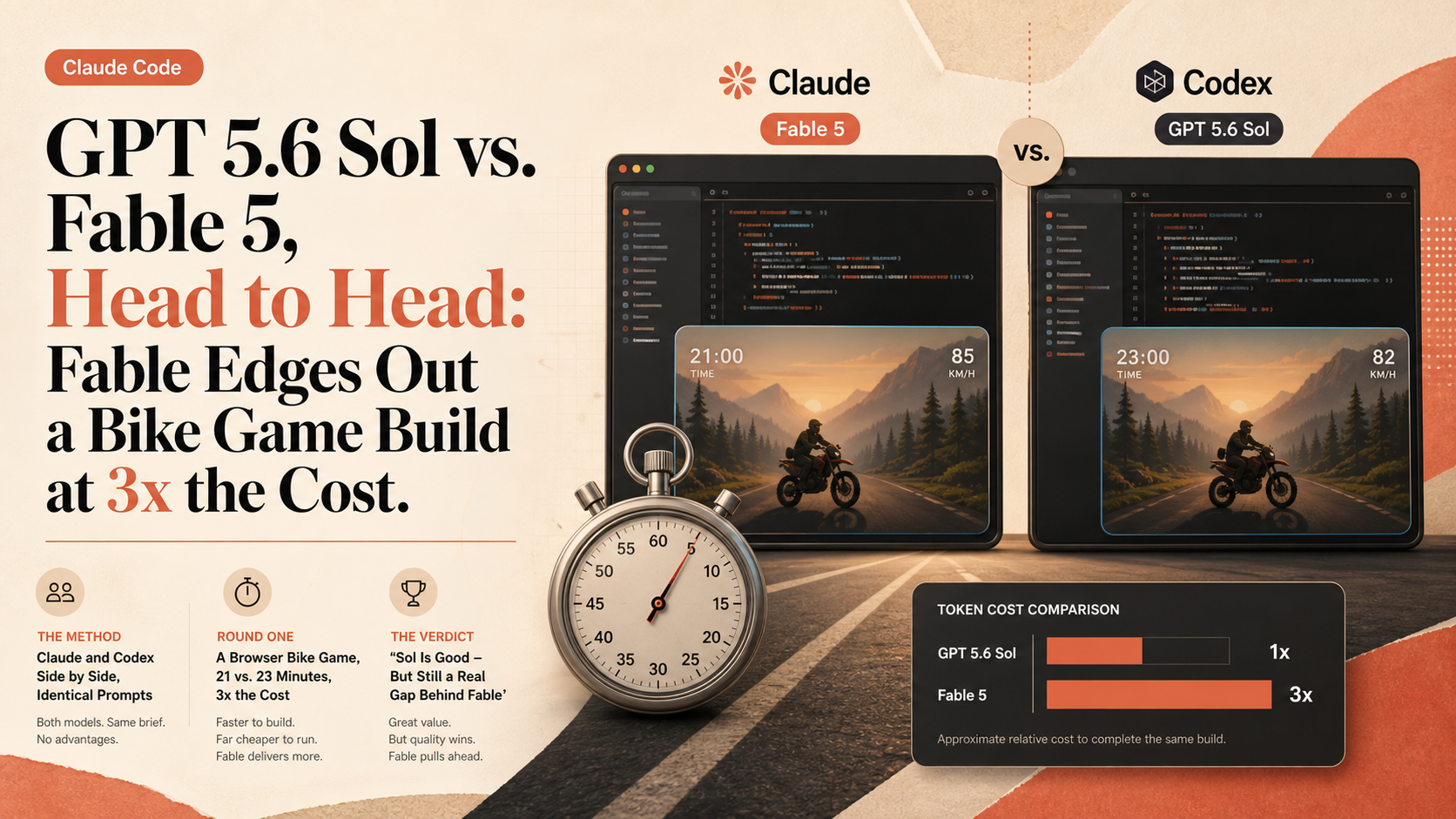
GPT 5.6 Sol vs. Fable 5, Head to Head: Fable Edges Out a Bike Game Build at 3x the Cost
With GPT 5.6's Sol, Terra, and Luna released, benchmarks show Sol beating Opus and Fable while costing far less -- but the creator decided to run both models side by side on real work for a full day instead of just quoting numbers.
Fireship
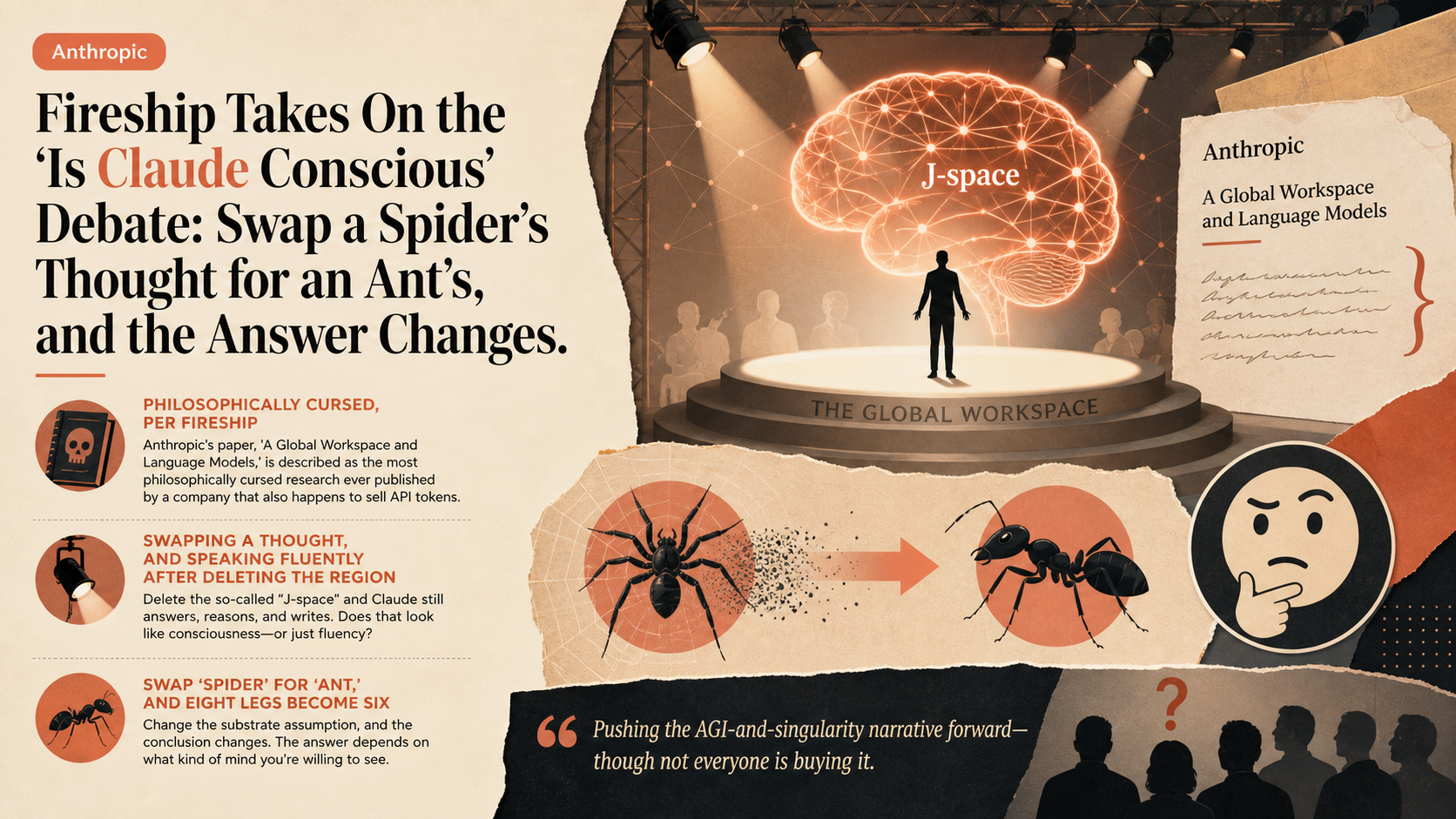
Fireship Takes On the 'Is Claude Conscious' Debate: Swap a Spider's Thought for an Ant's, and the Answer Changes
Anthropic's paper, 'A Global Workspace and Language Models,' is described as the most philosophically cursed research ever published by a company that also happens to sell API tokens.