Stop Writing Prompts, Start Designing Loops — Running Four Claude Code Boxes 24/7
TL;DR · What you'll learn
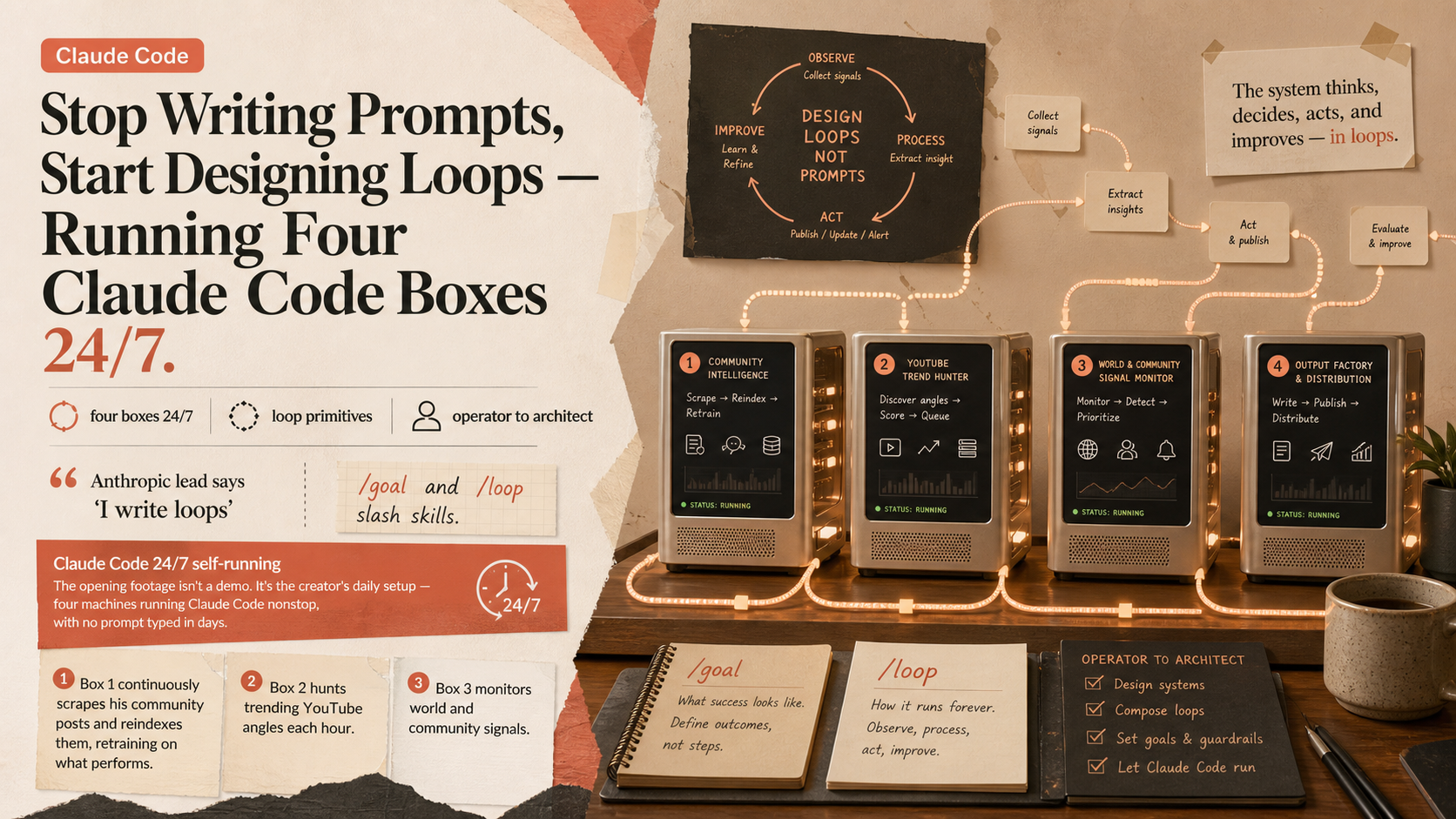
- 1 The opening footage isn't a demo. It's the creator's daily setup — four machines running Claude Code nonstop, with no prompt typed in days.
- 2 Box 1 continuously scrapes his community posts and reindexes them, retraining on what performs. Box 2 hunts trending YouTube angles each hour. Box 3 monitors world and community signals.
- 3 One box ties everything together into a running to-do list, another is mid-multi-hour build. Each box runs on its own subscription, Claude Code 24/7.
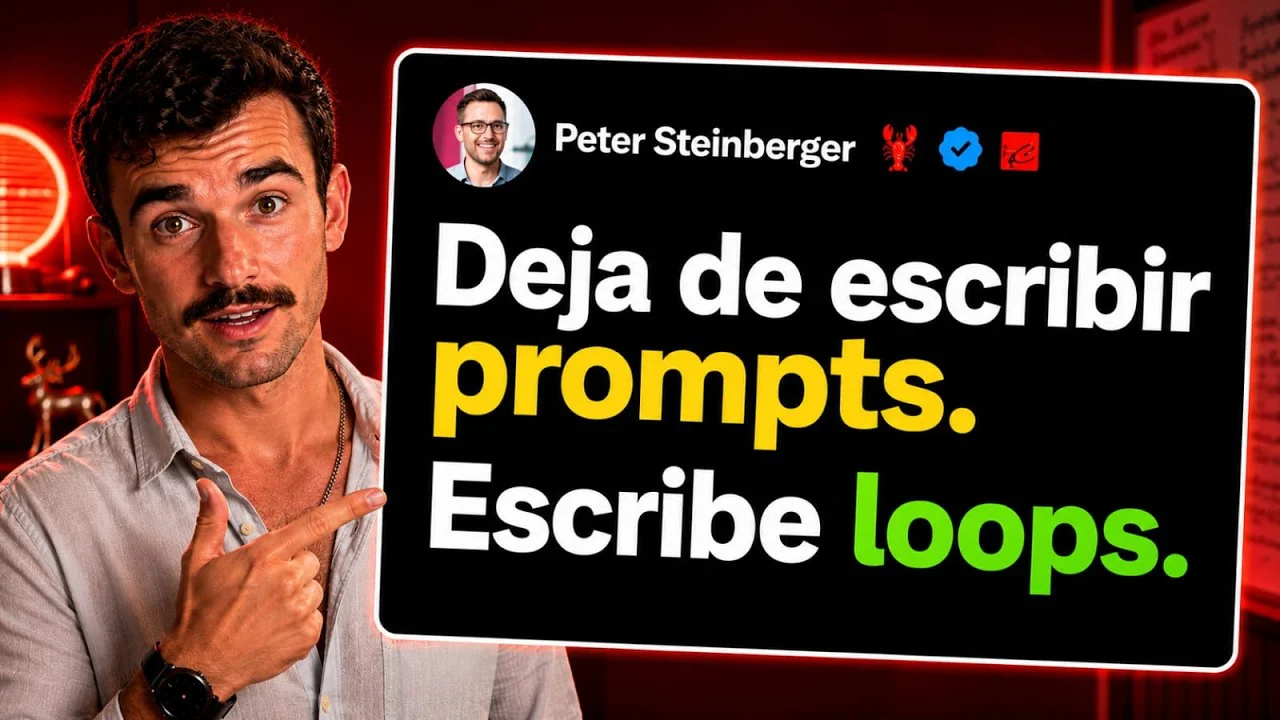
- 4 The lead on Claude Code inside Anthropic said it on stage: he doesn't write prompts anymore, he writes loops. This video walks through the design pattern from the ground up.
- 5 Four loop pieces plus memory: build → fix → verify → goal check, then a 'brain' that holds context the chat window forgets. That's the rig.
- 6 It's implementable as Claude Code slash skills (Codex has a loop function too). /goal handles bounded loops, /loop handles open-ended ones.
- 7 Thesis: stop operating tools. Orchestrate agents that operate tools. Then orchestrate the agent orchestration with loops. Move one level up the abstraction stack — stop prompting, start designing.
- 8 A prompt is spent in one message. A loop keeps running while you're not there. You are no longer an operator — you're an architect. The channel's mantra: don't buy, build, and build better with loops.
Read as slides
3 slides total
Four Claude Code machines, running 24/7 — the actual daily setup
The video opens on what looks like a flashy demo but is creator Benjamín Cordero's daily reality. Four physical machines, each running Claude Code nonstop, and he hasn't typed a prompt in days. He walks past them while they keep working.
The roles are split cleanly. Box 1 continuously scrapes his community's posts and reindexes them into a rack, retraining on which posts performed and which didn't. Box 2 goes out once an hour to hunt trending angles and videos on YouTube, dropping them in his morning queue with possible approaches. Box 3 monitors the world and the community at large. A fourth ties it all into a running to-do list, and yet another is in the middle of a multi-hour build right now. Each box has its own subscription and runs Claude Code 24/7. He didn't build this for the video — it's been his workflow for months, longer than most people have been talking about this approach.
The loop primitives — build, fix, verify, goal, and memory
The lead on Claude Code inside Anthropic said it on stage: he no longer writes prompts, he writes loops. The video walks the pattern through five concrete pieces. The main loop is build → fix → verify → goal check, repeating until the exit condition fires. The fifth piece is memory — a 'brain' that retains what falls out of the active context window so the loop doesn't forget itself.
The implementation is straight Claude Code slash skills (Codex has a loop function too, and the same pattern works there with the right prompting). `/goal` handles bounded loops — those with a definite finish line. `/loop` handles open-ended ones. The author observes that when Anthropic ships new features, they mostly land in this area — Dream and the rest are refinements on how loops work — which suggests the platform is moving toward this pattern as the primary mode.
Prompt vs loop — operator to architect
The closing thesis is crisp: stop operating tools. Orchestrate agents that operate tools. Then orchestrate the agent orchestration with loops. Move one level up the abstraction stack. Stop prompting, start designing.
A prompt is spent in one message. A loop keeps running while you're not at the keyboard. So you stop being an operator and become an architect. This isn't a technique, the author says — it's a mentality shift. If you can write and you can build, the programming language of the future is natural language. He's been pushing that thesis for over a year and a half on the channel; loops are where it finally cashes out into a concrete workflow. Channel mantra to close: don't buy, build, and build better with loops.
Editor's Take
'Don't write prompts, design loops' declares a move up one level of abstraction. The core of running four Claude Code machines 24/7 is five elements — build, fix, verify, goal, memory — and above all the principle that a loop can't end without a goal-and-verification pair. The operator-to-architect metaphor isn't hyperbole; it points to the practical difference that a prompt is consumed once while a loop keeps running when you leave your seat. For reproducible automation, loop design beats good instructions.
Source
Benjamín Cordero
El creador de Claude Code dejó de promptear (ahora corre loops)
This article auto-summarizes the YouTube video's transcript with Claude. Please refer to the original video for nuance and exact wording.
Watch on YouTube →Related
3 articles
Nate Herk | AI Automation
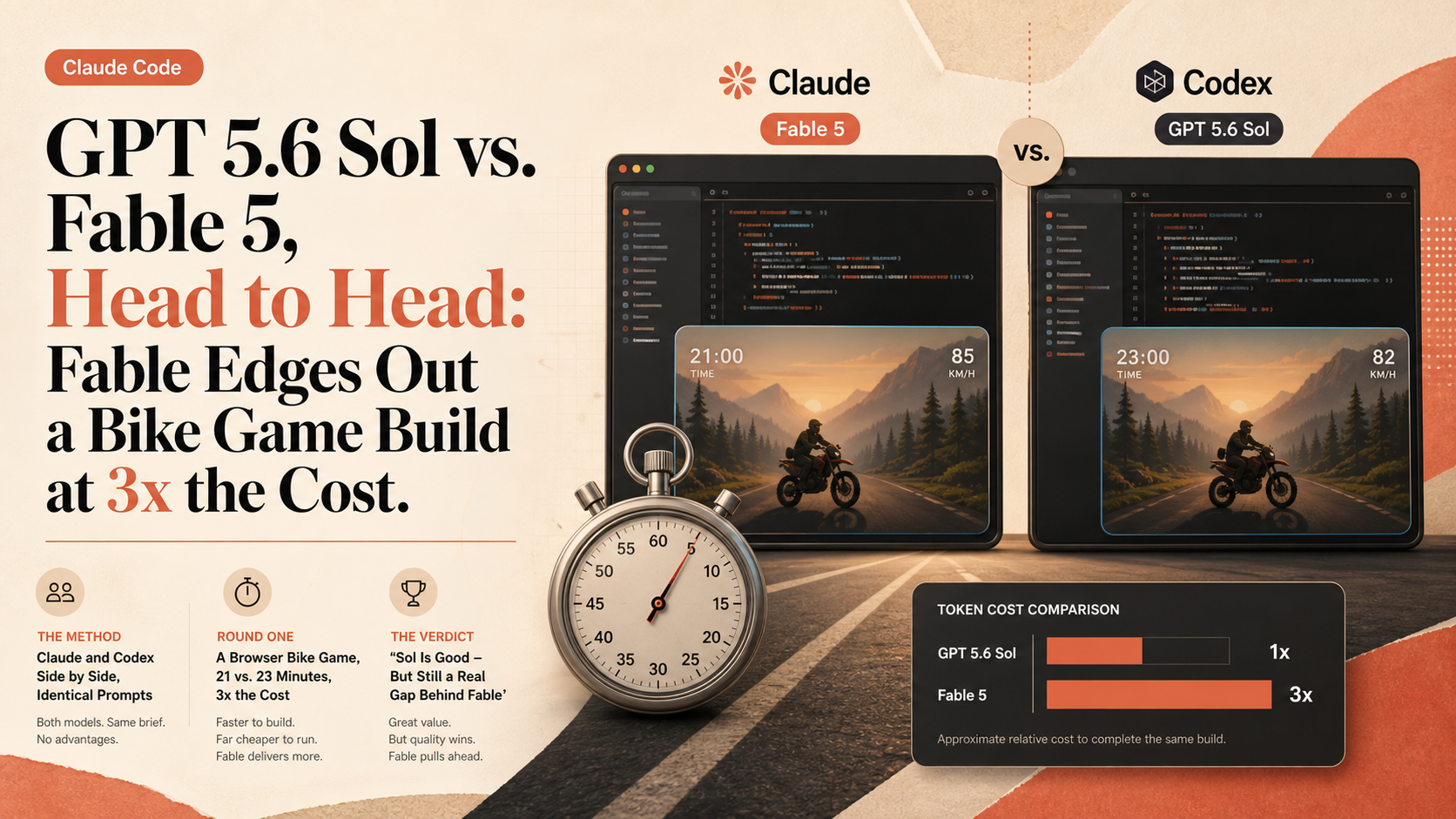
GPT 5.6 Sol vs. Fable 5, Head to Head: Fable Edges Out a Bike Game Build at 3x the Cost
With GPT 5.6's Sol, Terra, and Luna released, benchmarks show Sol beating Opus and Fable while costing far less -- but the creator decided to run both models side by side on real work for a full day instead of just quoting numbers.
Trading with DaviddTech
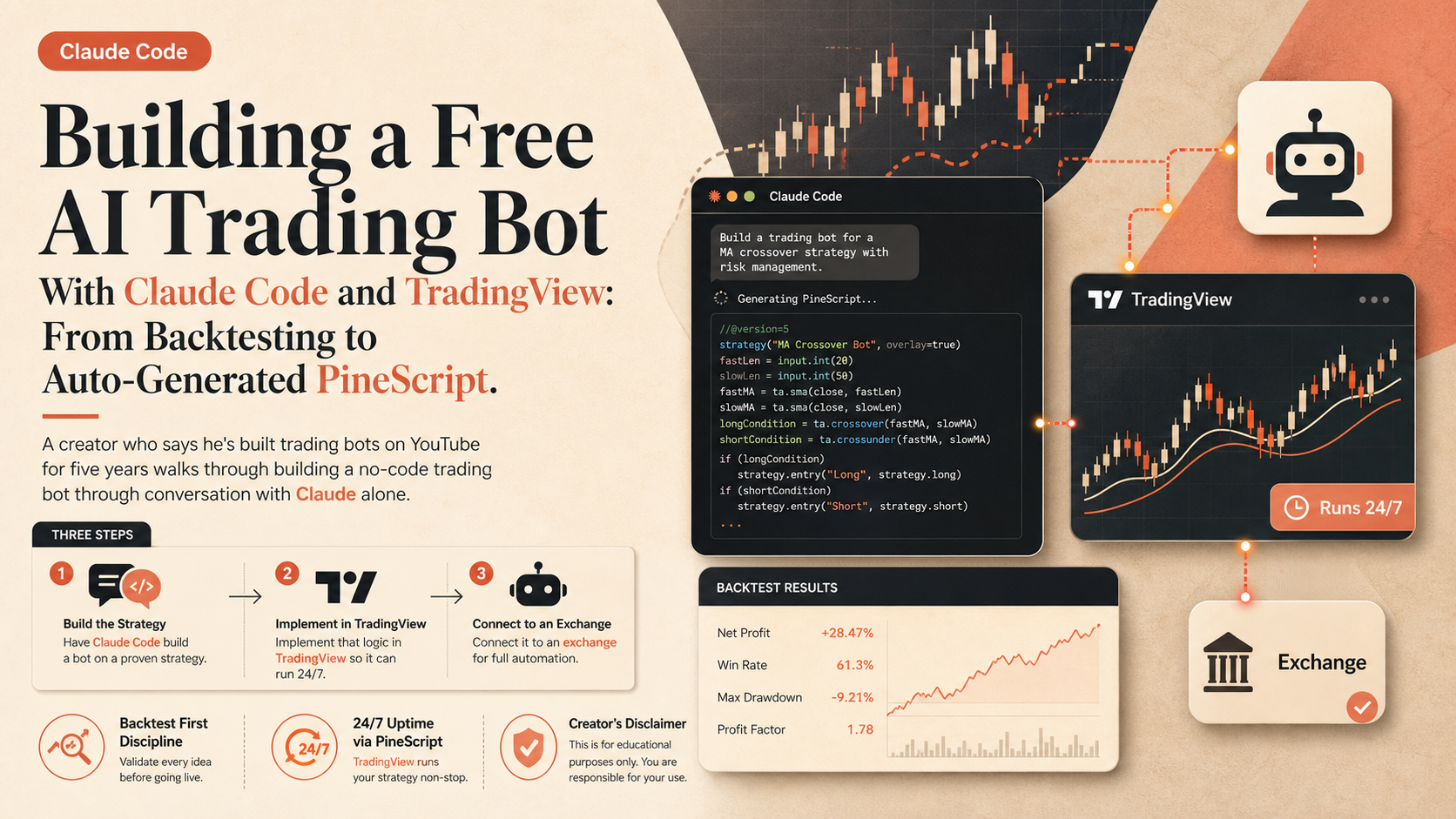
Building a Free AI Trading Bot With Claude Code and TradingView: From Backtesting to Auto-Generated PineScript
A creator who says he's built trading bots on YouTube for five years walks through building a no-code trading bot through conversation with Claude alone.

The Calum Johnson Show
Building a Membership Site With Claude Code in a Weekend, $20K in the First Week: 'You Don't Need the Terminal'
The guest says he built a membership platform, digitalcreatorclub.com, that would have previously cost $50,000-$100,000, in a single weekend using Claude Code -- and made about $20,000 in its first week.