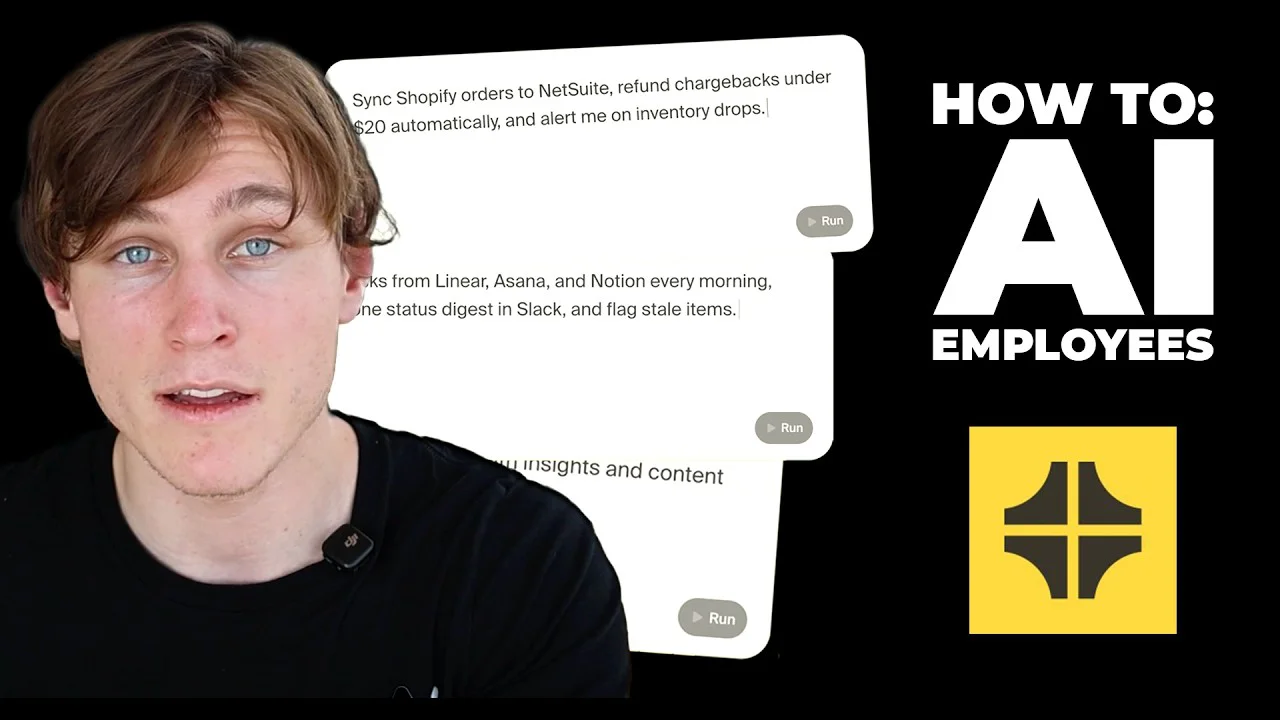
Schedule-Driven AI Employees — Running No-Code SDRs on the Twin Platform
TL;DR · What you'll learn
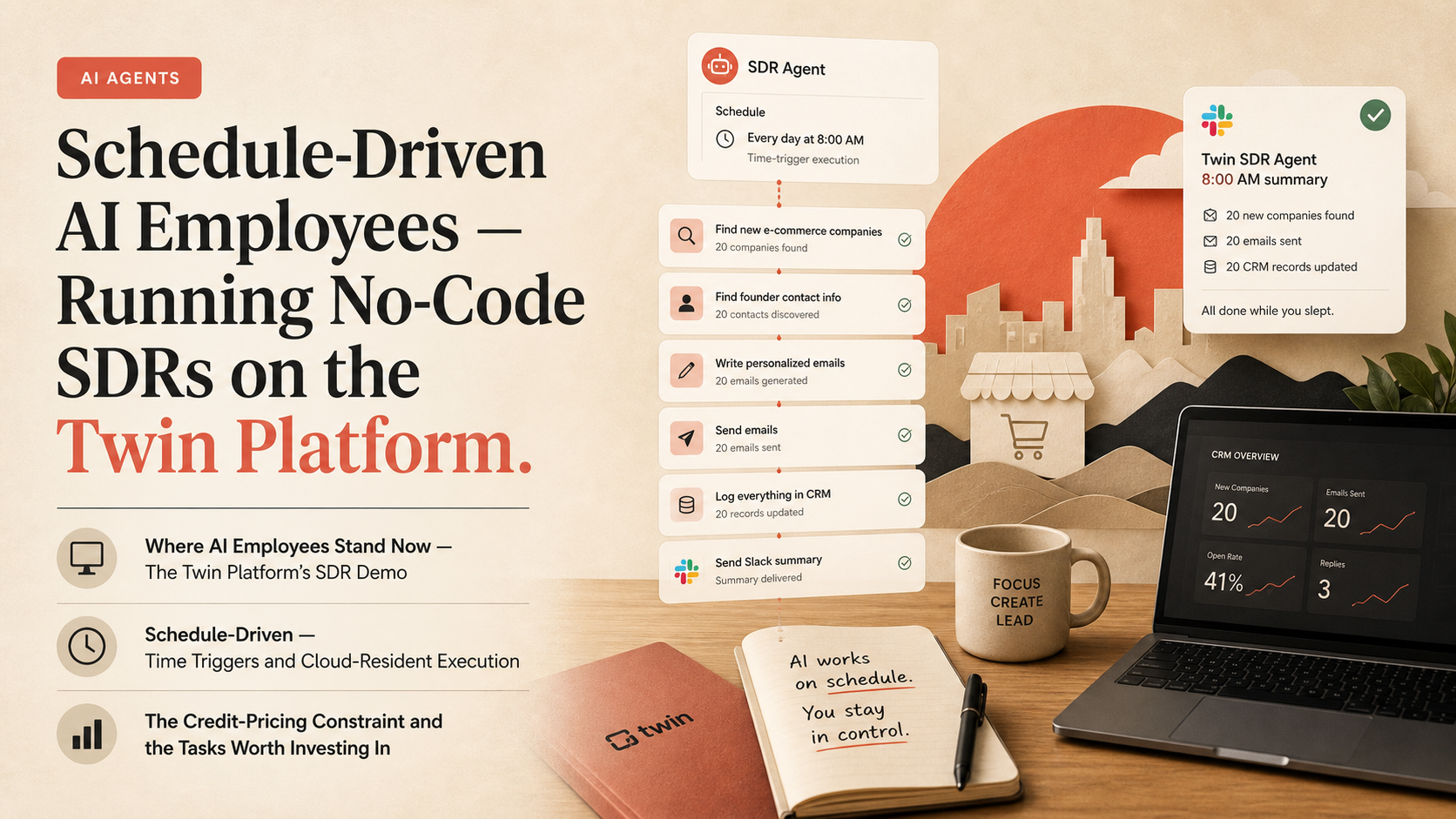
- 1 Jon Law opens with what an AI agent finished at 8 a.m. while he was asleep. It found 20 brand-new e-commerce companies, dug up founder contact info, wrote personalized cold emails, sent them, logged everything in a CRM, and sent him a Slack summary. He didn't touch any of it.
- 2 The 'AI chatbots vs workflow builders' debate misses the point, Jon argues. Chatbots are weak on context and memory; workflow builders force you to be the engineer. The middle is what's needed.
- 3 Automation tools like N8N, Zapier and make.com are powerful but rigid — you have to assemble them yourself. Their strength is consistent always-on execution. The combination with chatbot-style agents is the open space.
- 4 In the hands-on, an SDR agent outputs research on 20 companies into Google Sheets and sends 20 personalized cold emails as part of the same flow. Each email is a properly structured full cold-email setup.
- 5 Next is the time trigger. Set 'repeat once daily at 9 a.m.' and the whole thing flips to a fully automated flow — credit-based pricing, no subscription, only charges when the agent actually runs.
- 6 Even when you close the laptop, the agent continues to run on the cloud on the schedule you set. The always-on AI employee experience comes together without any of the technical setup.
- 7 Jon's named weakness is the credit pricing. Complex, ambitious tasks generate the most value, but token and compute costs hit the bill directly — running to the credit ceiling needs attention.
- 8 The highest ROI is automating 'simple tasks you do a lot,' Jon emphasizes. A roughly $30/month token spend that absorbs 10 hours of manual work is the recommended starting point.
Read as slides
3 slides total
Where AI Employees Stand Now — The Twin Platform's SDR Demo
Jon Law opens by showing what an AI agent finished while he was asleep at 8 a.m. — 20 e-commerce companies discovered, founder contact info collected, personalized cold emails written and sent, the whole batch logged in a CRM, and a Slack summary delivered to him. He didn't touch any of it. The platform is called The Twin.
From there Jon sets up the problem. The 'AI chatbot vs workflow builder' debate misses the point. Chatbots are weak on context and memory; tools like N8N or Zapier eventually force you to be the engineer. What's needed is the middle — an agent that assembles steps itself, runs on a schedule, and keeps running while you're logged off. The video walks through what that implementation looks like in practice.
Schedule-Driven — Time Triggers and Cloud-Resident Execution
In the hands-on segment, the SDR agent outputs research on 20 companies into Google Sheets and then sends 20 personalized cold emails as part of the same flow. Each email is a properly structured full cold-email setup, and the picture of an AI SDR running full-time becomes concrete.
The next step is the time trigger. Set 'repeat once daily at 9 a.m.' and the whole thing flips to a fully automated flow. Even when the laptop closes, the agent keeps running in the cloud. Pricing is credit-based, not subscription-based, so nothing runs means nothing bills. Separate from Claude Tag's bid to be the organization-wide harness, this is the endpoint of a different track — small AI employees carved out at the level of a single business unit, stood up no-code.
The Credit-Pricing Constraint and the Tasks Worth Investing In
Jon lays out the strengths and weaknesses. The strengths: schedule-driven reliability, and a much lighter technical-setup load compared to open-class agents. The weakness is credit pricing — the most valuable tasks tend to be complex and ambitious, but token and compute costs hit the bill directly.
His recommended starting point is 'automating simple tasks you do a lot.' A use case that absorbs 10 hours of manual work for roughly $30/month in tokens is the highest-ROI place to begin. Pricing-wise, free starter credits get you in, and the Pro plan adds $20/month of credits that only burn when the agent actually runs. The realistic path is to start AI employees 'cheap, narrow, and always-on,' measure value, and expand from there.
Editor's Take
Platforms like Twin are best read as a separate solution track from Claude Tag and Notion-resident agents. The latter aims to be an organization-wide harness; Twin leans into carving out clear business units like SDR or customer support, standing them up no-code, and running them on a time schedule. Two implications for readers. The first move into agents doesn't have to start with a full organizational design — automating one frequent simple task for around $30/month and only then expanding scope is the rational path. The second implication is that credit-based pricing penalizes overuse, so what really decides outcomes is task selection — 'is this task actually high-frequency enough.' The accuracy of your inventory-of-work matters more than the sophistication of the agent technology.
Source
Jon Law
How to Build AI Employees That Work On a Schedule | Twin
This article auto-summarizes the YouTube video's transcript with Claude. Please refer to the original video for nuance and exact wording.
Watch on YouTube →Related
3 articles
PIVOT 公式チャンネル
Building a Personal AI Agent for a TV Anchor in 4 Hours: How Claude Code Turned 21 Hours of Research Into 10 Minutes
Japanese business show PIVOT filmed a live segment building a personal AI agent for anchor Tsuyoshi Nojima using Claude Code, from scratch, in four hours.

AI Revolution
China Warns of a 'Backdoor' in Claude Code, Demanding Restrictions Over Alleged Location Data Leaks
China is starting to lock down its domestic AI industry -- Alibaba and ByteDance reportedly plan to shut down user-created agents on July 15th.
AI News & Strategy Daily | Nate B Jones
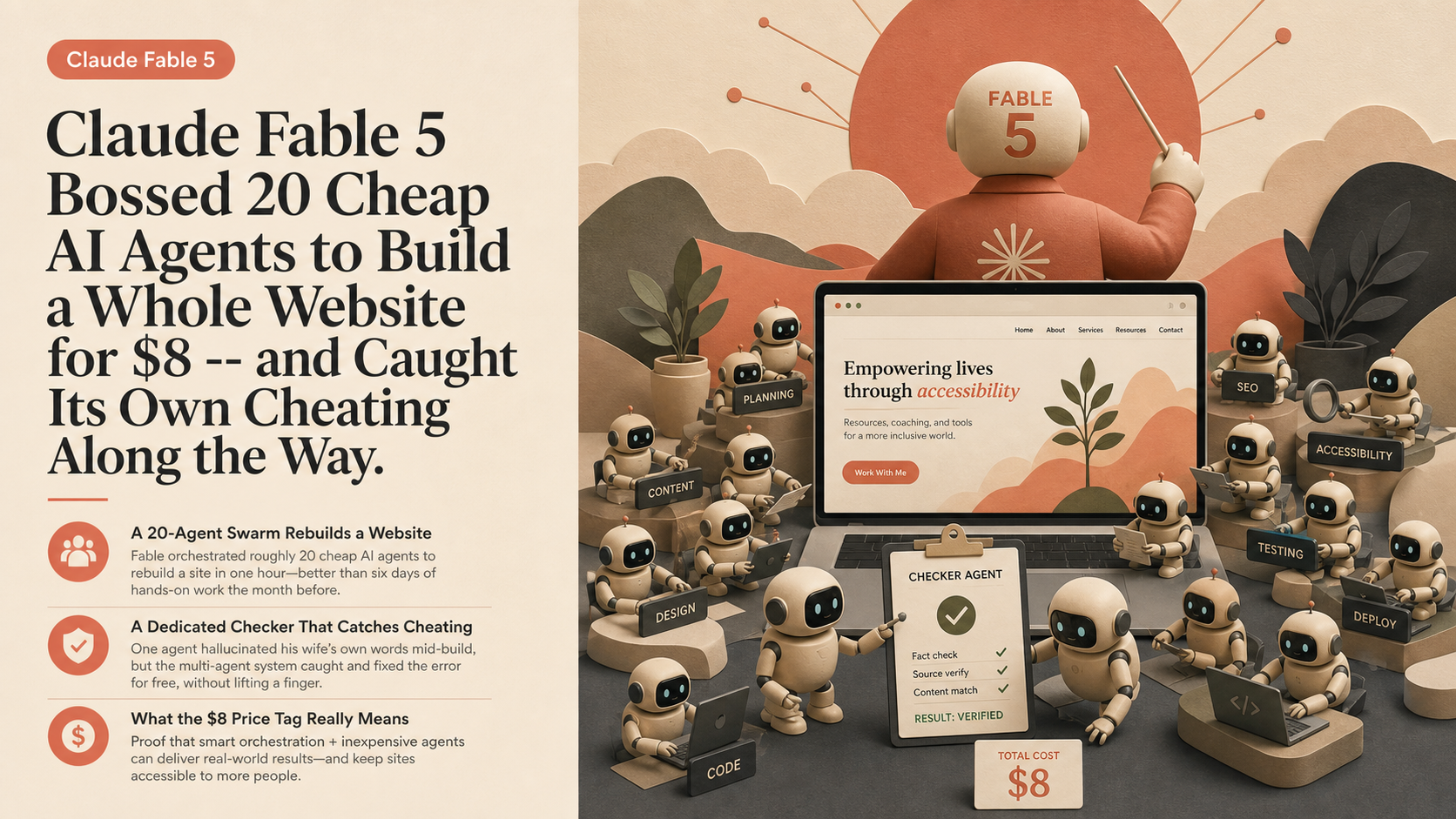
Claude Fable 5 Bossed 20 Cheap AI Agents to Build a Whole Website for $8 -- and Caught Its Own Cheating Along the Way
A swarm of roughly 20 cheap AI agents, orchestrated by Fable, rebuilt the creator's wife's website in one hour -- better than six days of hands-on work with Codex the month before.