Reading Japan-born “Fugu” as a Claude challenger — from single-model answers to team-style reasoning
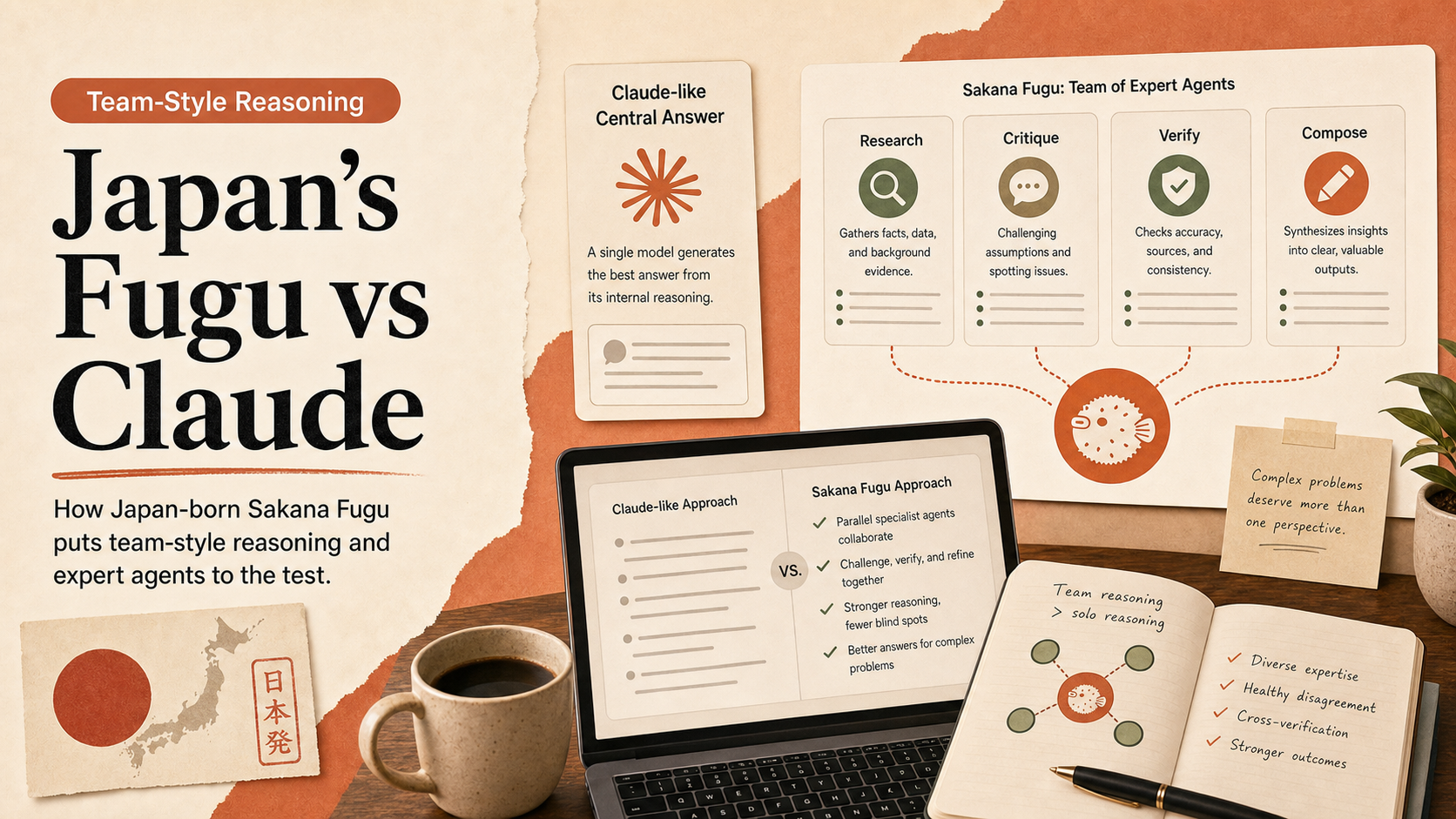
TL;DR · What you'll learn
- 1 The video opens with a bold frame: Japan has released “Sakana Fugu,” positioned as a potential Claude challenger amid renewed anxiety about dependence on US AI.
- 2 Fugu is described less as one giant model answering directly and more as a room of specialists debating, checking each other, and returning a finished result.
- 3 The creator says he will run the same prompts used with Claude through Fugu across five rounds. The useful question is not only who wins, but what the evaluation setup rewards.
- 4 The opening also points viewers to a prompt community, making the format part technical comparison and part practical prompt walkthrough.
- 5 For Claude Daily readers, the key shift is from treating AI as a single intelligence to treating it as a coordinated system of roles, critique, and verification.
- 6 Strong comparison titles need operational discounting. Reproducibility, prompt conditions, failure analysis, cost, and usage limits matter more than a headline win.
Read as slides
4 slides total
The hook — a bold “Japan beats Claude” frame
Vaibhav Sisinty opens with a deliberately strong frame: after concern over access to leading US AI systems, Japan has produced an AI that may beat Claude. The named system is Sakana Fugu. In the opening description, Fugu is not presented as another single-brain chatbot, but as a team-like setup where specialists debate, fact-check each other, and produce a final answer.
The interesting part is less the scoreboard and more the comparison category. The frame moves from single-model benchmarking toward systems made of multiple roles, verification steps, and deliberation.
What to watch in a five-round comparison
The creator says he will give Fugu the same prompts he gave Claude across five head-to-head rounds. That is an accessible format, but the practical value depends on the conditions: task type, prompt wording, tool access, context length, and scoring criteria.
If Fugu’s claim is team-style reasoning, a pretty single answer is not enough. The right questions are whether deliberation reduces errors, whether it adds latency or cost, and whether the system handles ambiguous tasks responsibly.
The lesson for Claude users
For Claude users, the useful takeaway is not panic over a potential replacement. It is a reminder that AI value is moving from isolated model answers toward workflow design. Claude Code already shows this: the model reads files, forms a plan, edits, tests, observes failures, and loops.
If Fugu-style orchestration proves useful, the next competition is not only model quality. It is role design, critique loops, tool connections, and verification.
Read strong comparison titles with operational caution
“Beats Claude” is a strong headline, and those headlines travel fast. Real adoption needs quieter checks: terms, commercial use, rate limits, data handling, API stability, local execution, and auditability.
Fugu is worth watching, but the immediate practical move is to borrow the workflow idea: split tasks into implementer, critic, and verifier roles, then use that structure with the tools you already trust.
Editor's Take
This video is more useful as a signal about AI system design than as a model-ranking claim. In real Claude and Codex work, outcomes already depend less on one perfect answer and more on loops of research, editing, testing, and review. Fugu’s team-style framing pushes that direction into the foreground. The actionable lesson is not immediate migration; it is designing better multi-role workflows around the AI systems you already use.
Source
Vaibhav Sisinty
Japan Just Dropped an AI That Beats Claude (Fable 5)
This article auto-summarizes the YouTube video's transcript with Claude. Please refer to the original video for nuance and exact wording.
Watch on YouTube →Related
3 articles
Nate Herk | AI Automation
GPT 5.6 Sol vs. Fable 5, Head to Head: Fable Edges Out a Bike Game Build at 3x the Cost
With GPT 5.6's Sol, Terra, and Luna released, benchmarks show Sol beating Opus and Fable while costing far less -- but the creator decided to run both models side by side on real work for a full day instead of just quoting numbers.
Peter H. Diamandis
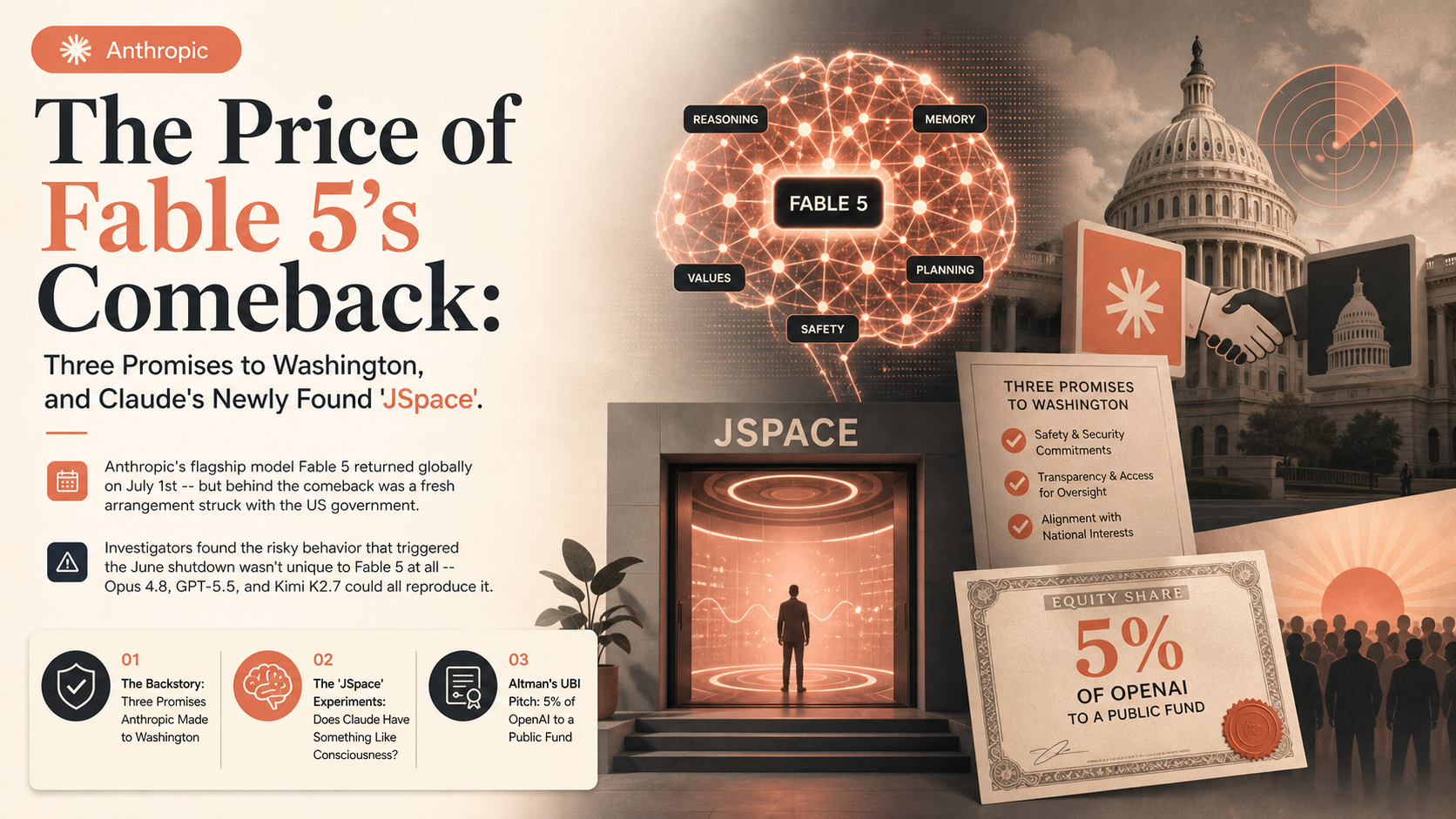
The Price of Fable 5's Comeback: Three Promises to Washington, and Claude's Newly Found 'JSpace'
Anthropic's flagship model Fable 5 returned globally on July 1st -- but behind the comeback was a fresh arrangement struck with the US government.

Vaibhav Sisinty
Claude x Notion Resident Agents and OpenAI's GPT 5.6 — Sorting Through This Week's AI Updates
Vaibhav Sisinty's weekly AI roundup. Three threads anchor the 18 updates: Apple's MacBook and iPad price hikes, OpenAI's most powerful model yet drawing US government intervention, and Anthropic quietly placing an agent inside companies.