Claude Daily Claude Daily
RSS
Austin Marchese 12 min video 3 slides

Stop Prompting Claude — Loop Engineering and the Four Things Every Loop Needs
Stop Prompting Claude. Start Loop Engineering.
33,740 views 8 highlights

TL;DR · What you'll learn

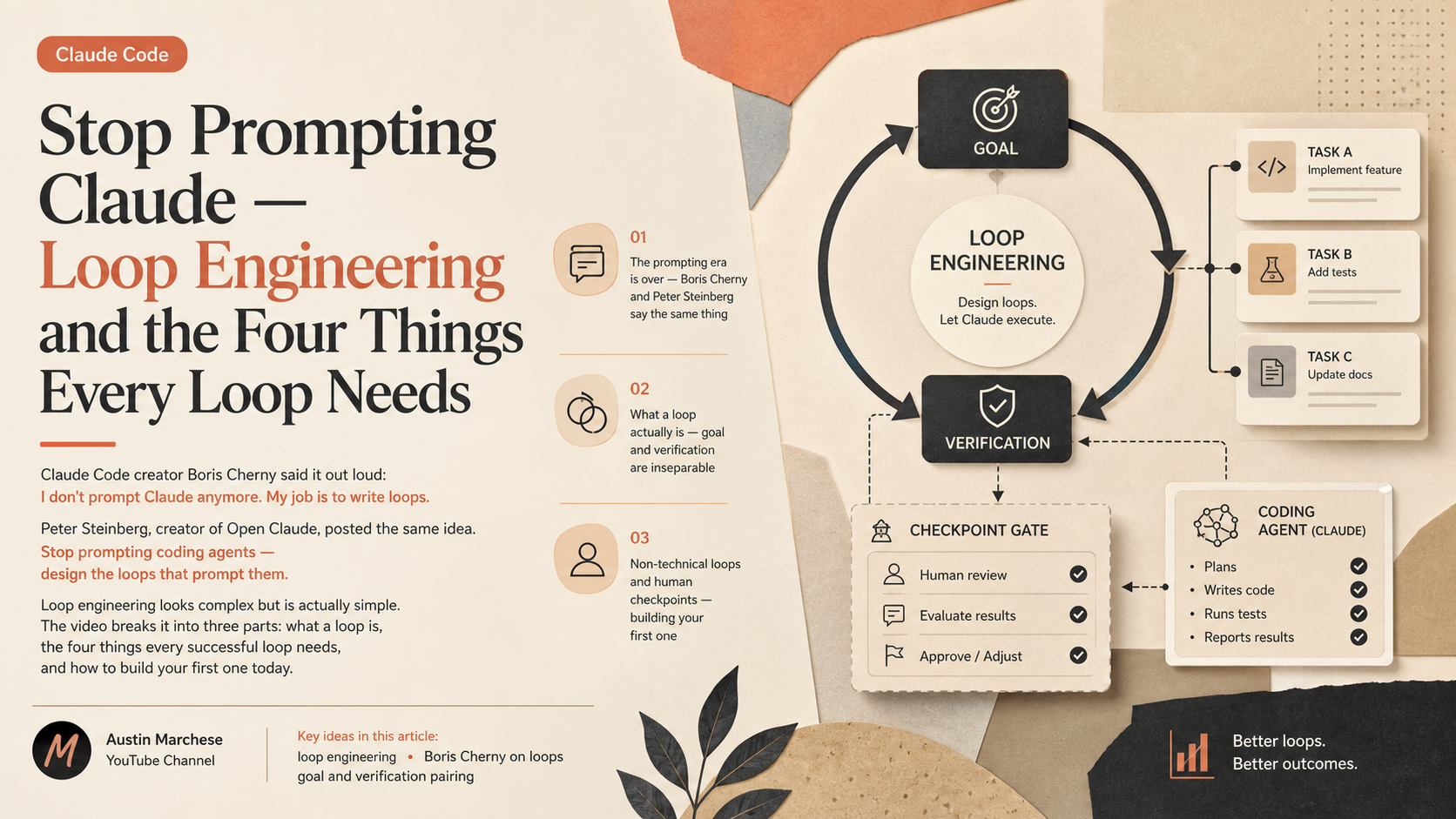
  • 1 Claude Code creator Boris Cherny said it out loud: 'I don't prompt Claude anymore. My job is to write loops.' Peter Steinberg, creator of Open Claude, posted the same idea. Stop prompting coding agents — design the loops that prompt them.
  • 2 Loop engineering looks complex but is actually simple — most people overcomplicate it. The video breaks it into three parts: what a loop is, the four things every successful loop needs, and how to build your first one today.
  • 3 A normal prompt runs once and stops. A loop runs over and over until a specific task or goal is complete. Boris: the loops prompt Claude now, and his job moved to the next level of abstraction.
  • 4 Every successful loop pairs a goal with a verification. You can't have a goal unless you can verify it was reached, and verification gives the loop its terminator.
  • 5 Technical example: 'launch a website to this domain and make sure it loads in under 2 seconds.' Verification — AI hits the domain, checks expected content, calculates load time, and runs /engineer-review for sign-off.
  • 6 Non-technical tasks need the same shape: bridge the abstract to something verifiable. 'Is this code good?' becomes 'did /engineer-review approve?' Same move scales to fuzzier tasks.
  • 7 Rule of thumb: the harder a goal is to quantify, the smaller the sub-goals you should break it into, with checkpoints at each one. Treat the AI like an intern handling a corporate party — you still pick the date, venue, and theme yourself.
  • 8 For non-measurable tasks, mark every key fork where a wrong turn ruins the rest of the loop, and verify those by hand. Start small — build one loop orchestration skill for something concrete.

Read as slides

3 slides total

01 Slide 1 / 3
Watch at 00:00

'The prompting era is over' — Boris Cherny and Peter Steinberg say the same thing

Claude Code creator Boris Cherny said the quiet part out loud: 'I don't prompt Claude anymore. My job is to write loops.' Peter Steinberg, creator of Open Claude, posted the same idea on Twitter — stop prompting coding agents, design the loops that prompt them instead.

AI Twitter is full of hype, but when two of the people who built the tools we use every day land on the same point on the same week, it earns attention. The video author takes the claim seriously and breaks loop engineering into three parts: what a loop actually is, the four ingredients of a successful loop, and how a non-technical person can build their first one today.

Claude Daily 01 / 03
02 Slide 2 / 3
Watch at 05:20

What a loop actually is — goal and verification are inseparable

A normal prompt runs once and stops. A loop is a prompt structure that runs over and over until a specific goal is complete. Boris's own framing: loops are now the things prompting Claude, and his job moved one level up the abstraction stack.

For a loop to work, it needs a goal and a way to verify the goal. The two are inseparable — without verification, the loop has no stopping condition. Technical tasks make this easy. 'Deploy this site and make sure it loads in under 2 seconds' has obvious verification: hit the domain, check content, time the load, and run /engineer-review for the final yes/no.

Claude Daily 02 / 03
03 Slide 3 / 3
Watch at 06:07

Non-technical loops and human checkpoints — building your first one

Non-technical loops are about bridging an abstract goal to a verifiable signal. The /engineer-review skill collapses 'is the code good?' into a yes/no answer. The same move works on fuzzier tasks — find a way to verify the final result even when it isn't strictly measurable.

The operating rule: the less quantifiable your goal, the smaller the sub-goals you should break it into, with checkpoints at each one. Treat the AI like an intern. 'Plan a corporate party' could go anywhere; you'd still want to make the date, venue, and theme calls yourself. Same with loops — mark the forks where one wrong turn ruins the rest of the run, and verify those by hand. The author's closing advice: pick something small and build a single loop orchestration skill for it. That's how the muscle gets built.

Claude Daily 03 / 03

Editor's Take

Boris Cherny's claim — 'I no longer prompt; my job is to write loops' — declares a move up one level of abstraction. The crux is the principle that goal and verification are inseparable: a loop can't end if you can't verify completion. Reducing non-quantitative tasks to a verifiable binary and placing human checkpoints at branch points where a wrong turn ruins everything gives the most practical skeleton for operating agents.

Source

Stop Prompting Claude. Start Loop Engineering.

Austin Marchese

Stop Prompting Claude. Start Loop Engineering.

Published 6/19/2026 12 min 33,740 views

This article auto-summarizes the YouTube video's transcript with Claude. Please refer to the original video for nuance and exact wording.

Watch on YouTube

Related

3 articles