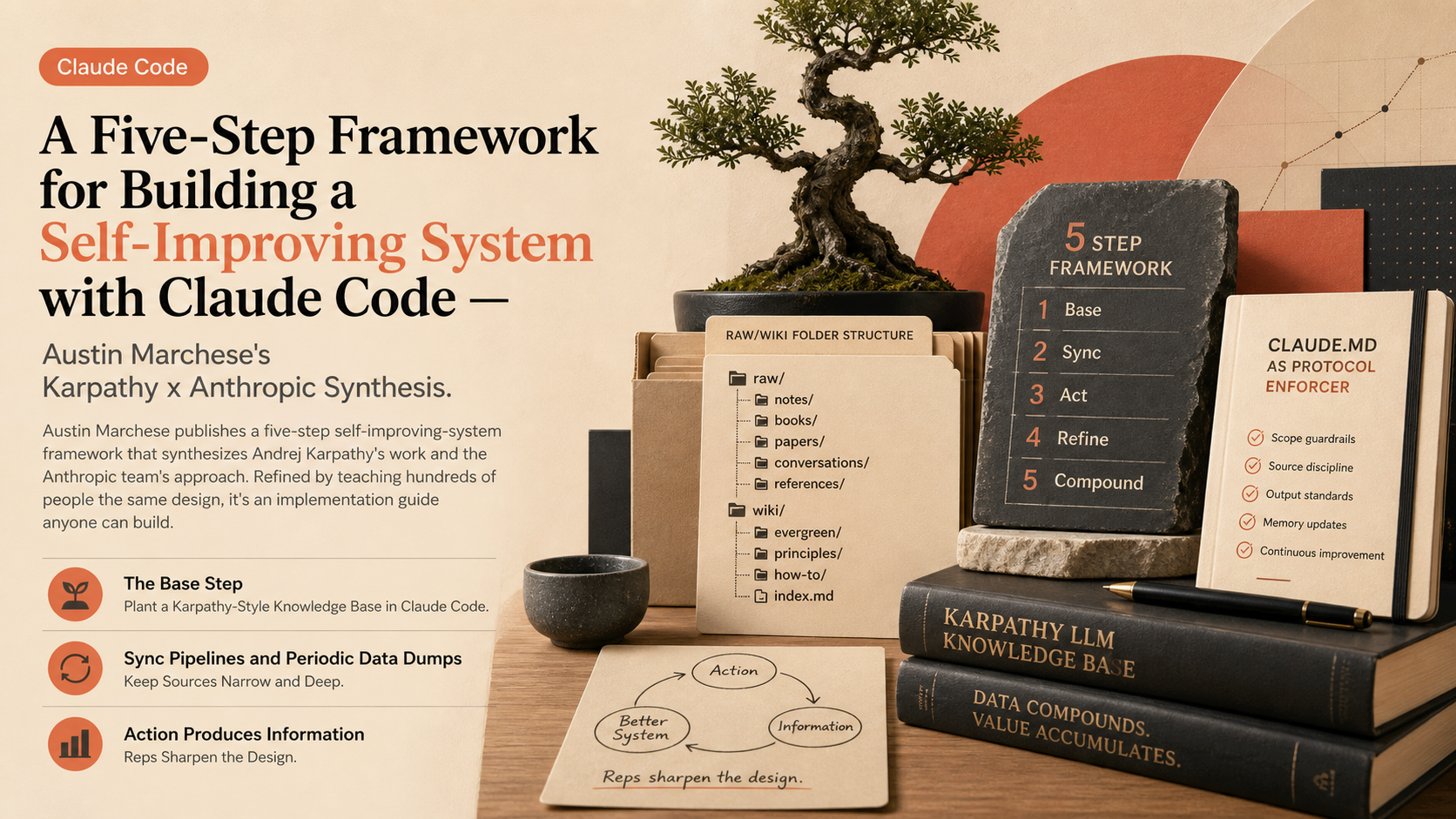
A Five-Step Framework for Building a Self-Improving System with Claude Code — Austin Marchese's Karpathy x Anthropic Synthesis
TL;DR · What you'll learn
- 1 Austin Marchese publishes a five-step self-improving-system framework that synthesizes Andrej Karpathy's work and the Anthropic team's approach. Refined by teaching hundreds of people the same design, it's an implementation guide anyone can build.
- 2 Step 1 is Base. The phase that builds the foundation for improvement. Set up one project, create a container where data accumulates and value compounds over time. The container has two parts: a knowledge base and skills.
- 3 The foundation borrows directly from Karpathy's viral 'LLM knowledge base' concept. A raw folder holds raw resources like call transcripts; a wiki folder holds references into raw, so the AI can locate information quickly — like a book's table of contents.
- 4 The claude.md file makes the structure explicit and enforces consistent reference rules on Claude Code. This is the mechanism that keeps the project consistent across sessions.
- 5 The email pipeline uses an alias domain to make filtering by sender easy. Austin's own newsletter subscription is processed through the same pipeline so the design is consistent.
- 6 What drives ingestion is the 'sync curated content' skill. It pulls newsletters from the alias inbox, extracts the key claims from each one, and processes them into the wiki. The discipline is to deliberately choose only a few high-quality sources.
- 7 Pipeline 4 is periodic data dumps. At the end of a day or a week, you voice-dump what you learned via Whisper Flow into Claude Code. The routine converts raw lived experience into structured knowledge.
- 8 The final rule is 'Action produces information' (a Brian Armstrong line). Of the two failure modes — too few attempts vs. too much analysis — the latter is the fatal one, Austin stresses. Reps sharpen the design.
Read as slides
3 slides total
The Base Step — Plant a Karpathy-Style Knowledge Base in Claude Code
Austin Marchese publishes a five-step self-improving-system framework synthesizing Andrej Karpathy's work and the Anthropic team's approach. The video reflects experience teaching hundreds of people the same design and is structured as a reproducible implementation guide.
Step 1 is Base. This phase builds the foundation for improvement. Set up one project and create a container where data accumulates and value compounds over time. The container splits into two. The first is the knowledge base — adopt Karpathy's viral 'LLM knowledge base' concept directly. A raw folder holds raw resources like call transcripts; a wiki folder holds references into raw so the AI can locate information quickly, in the role of a book's table of contents. The second is skills. The claude.md file explicitly enforces consistent reference rules on Claude Code — it functions as the protocol for 'what to read in what order.'
Sync Pipelines and Periodic Data Dumps — Keep Sources Narrow and Deep
The middle of the video specifies the ingestion pipelines. The email pipeline uses an alias domain to make filtering by sender easy. Austin's own newsletter subscription is processed through the same pipeline, so the design pattern stays consistent.
The driver is the 'sync curated content' skill — it pulls newsletters from the alias inbox, extracts key claims from each, and processes them into the wiki. The design discipline is to deliberately choose only a few high-quality sources. He's explicit: adding more sources dilutes the output. Pipeline 4 is a different shape — periodic data dumps. At the end of a day or week, voice-dump what you learned via Whisper Flow and hand it to the add-new-resource skill. It's a way of converting your own experience — the strongest possible information source — into structured knowledge.
Action Produces Information — Reps Sharpen the Design
The closing section organizes the operating rules. If a skill didn't work the way you wanted, just say 'based on this conversation, improve this skill.' Pushing it forward manually, rather than waiting for auto-improvement, is what gives the system its momentum.
And the final rule is 'Action produces information' — a Brian Armstrong line, which Austin places at the heart of the video. Whether to use raw/inputs or raw/sessions, 6 a.m. or 9 a.m. — these micro-optimizations are meaningless, and overthinking is the only genuinely wrong choice. AI is plenty strong already; just use it and build. Systems sharpen through reps, not whiteboard sessions. The closing mirrors the message: doing produces information, which makes the next decision sharper.
Editor's Take
The shift Austin's five steps represent isn't 'what to ask the AI' but 'what to keep feeding the AI continuously.' Read this way, it's a personal-scale blueprint for what Claude Tag and Notion-resident agents are doing at company scale. Two concrete implications. First, a self-improving system isn't about building something impressive — it's about laying down the pipes that keep information flowing. Spending excess time on initial setup is the wrong move; standing up the minimum raw/wiki/skills configuration and getting it running produces value faster. Second, Brian Armstrong's 'Action produces information' meta-rule is a general guide not specific to AI: small, fast moves are the right use of today's AI tools, especially when you're carrying an uncertain decision. Refusing to wait for the perfect design and sharpening it through iteration is one of the most valuable practical skills of the agent era.
Source
Austin Marchese
How to Build A Self-Improving System with Claude Code
This article auto-summarizes the YouTube video's transcript with Claude. Please refer to the original video for nuance and exact wording.
Watch on YouTube →Related
3 articles
Austin Marchese
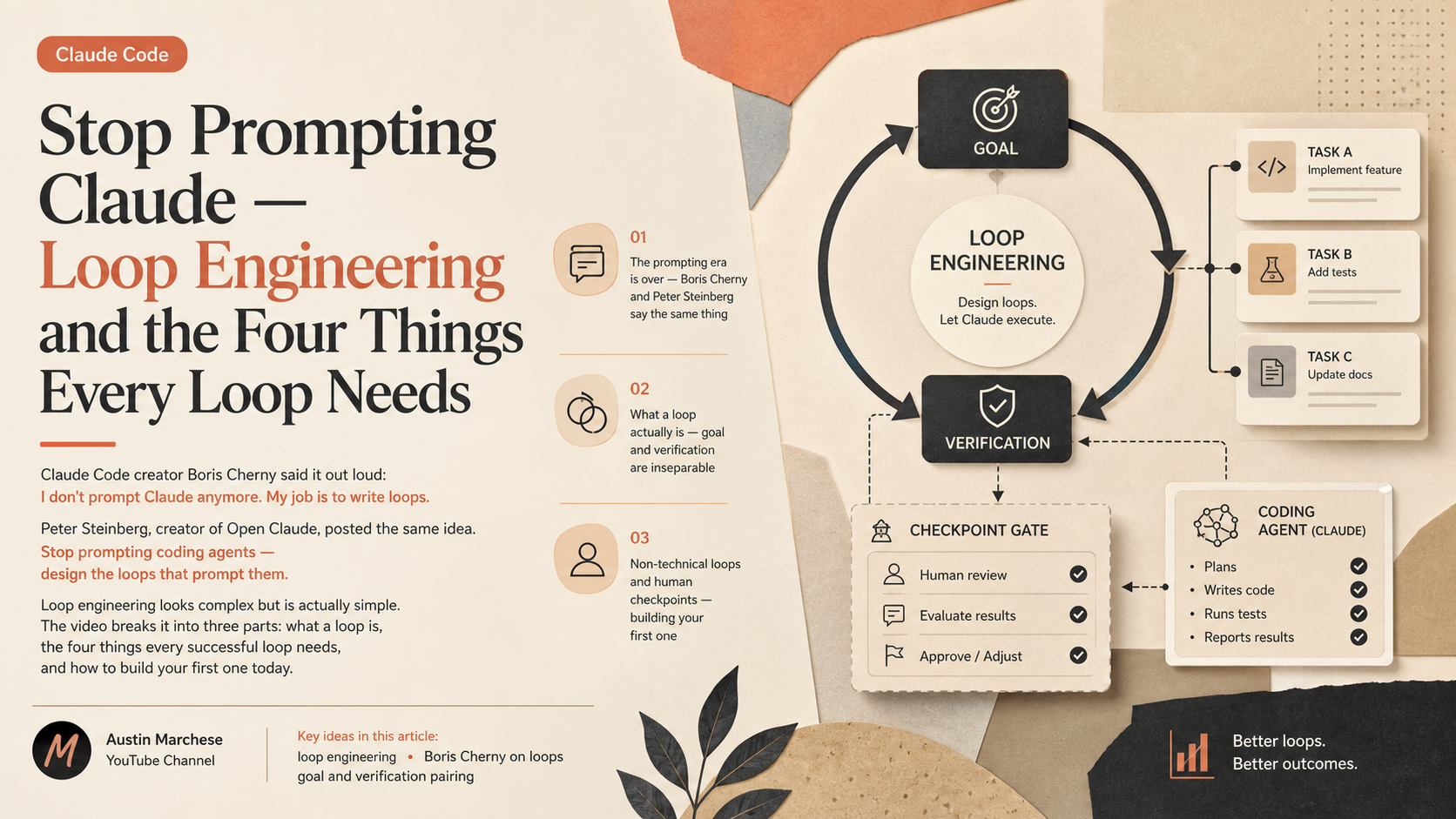
Stop Prompting Claude — Loop Engineering and the Four Things Every Loop Needs
Claude Code creator Boris Cherny said it out loud: 'I don't prompt Claude anymore. My job is to write loops.' Peter Steinberg, creator of Open Claude, posted the same idea. Stop prompting coding agents — design the loops that prompt them.
Nate Herk | AI Automation
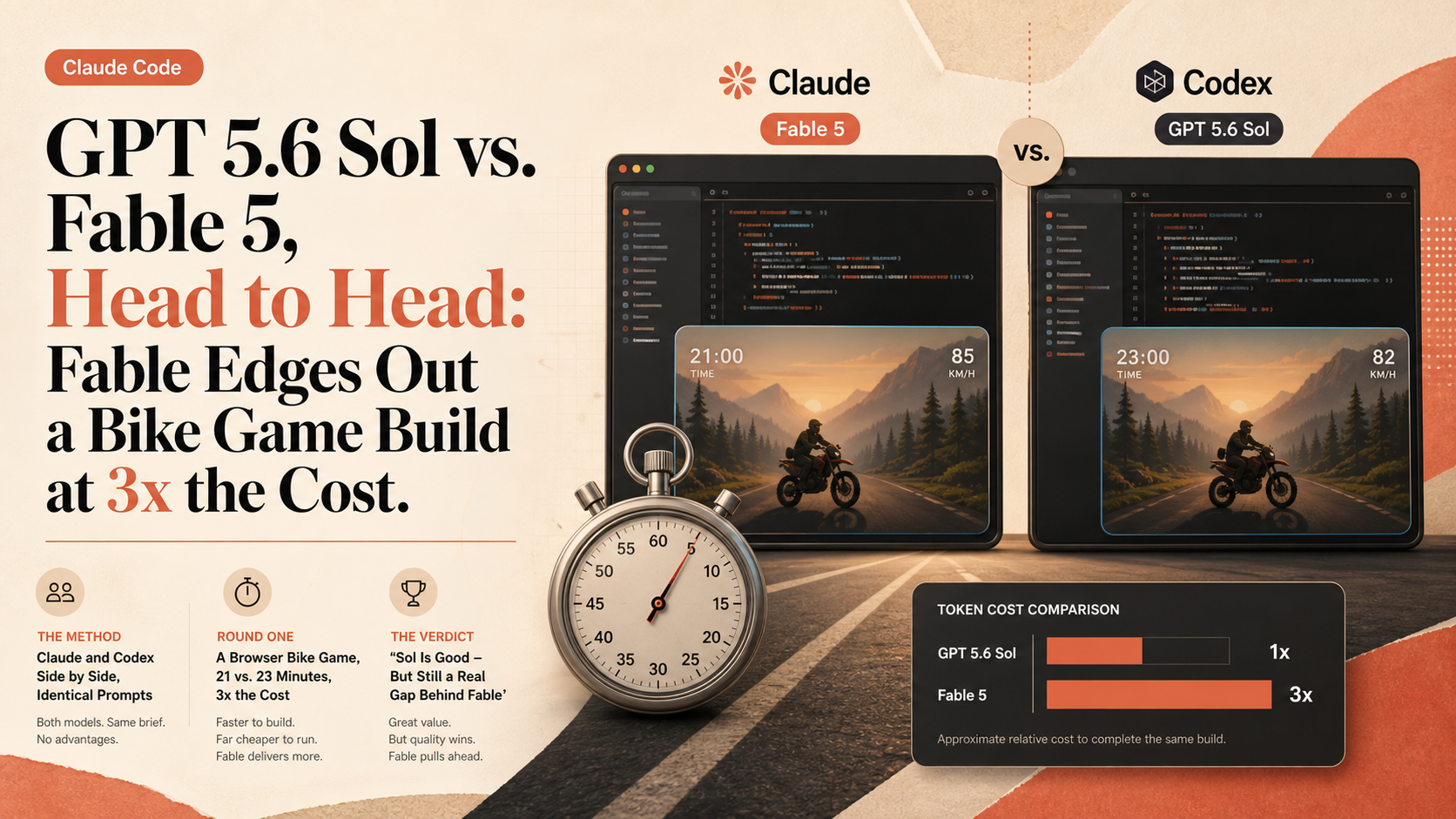
GPT 5.6 Sol vs. Fable 5, Head to Head: Fable Edges Out a Bike Game Build at 3x the Cost
With GPT 5.6's Sol, Terra, and Luna released, benchmarks show Sol beating Opus and Fable while costing far less -- but the creator decided to run both models side by side on real work for a full day instead of just quoting numbers.
Trading with DaviddTech
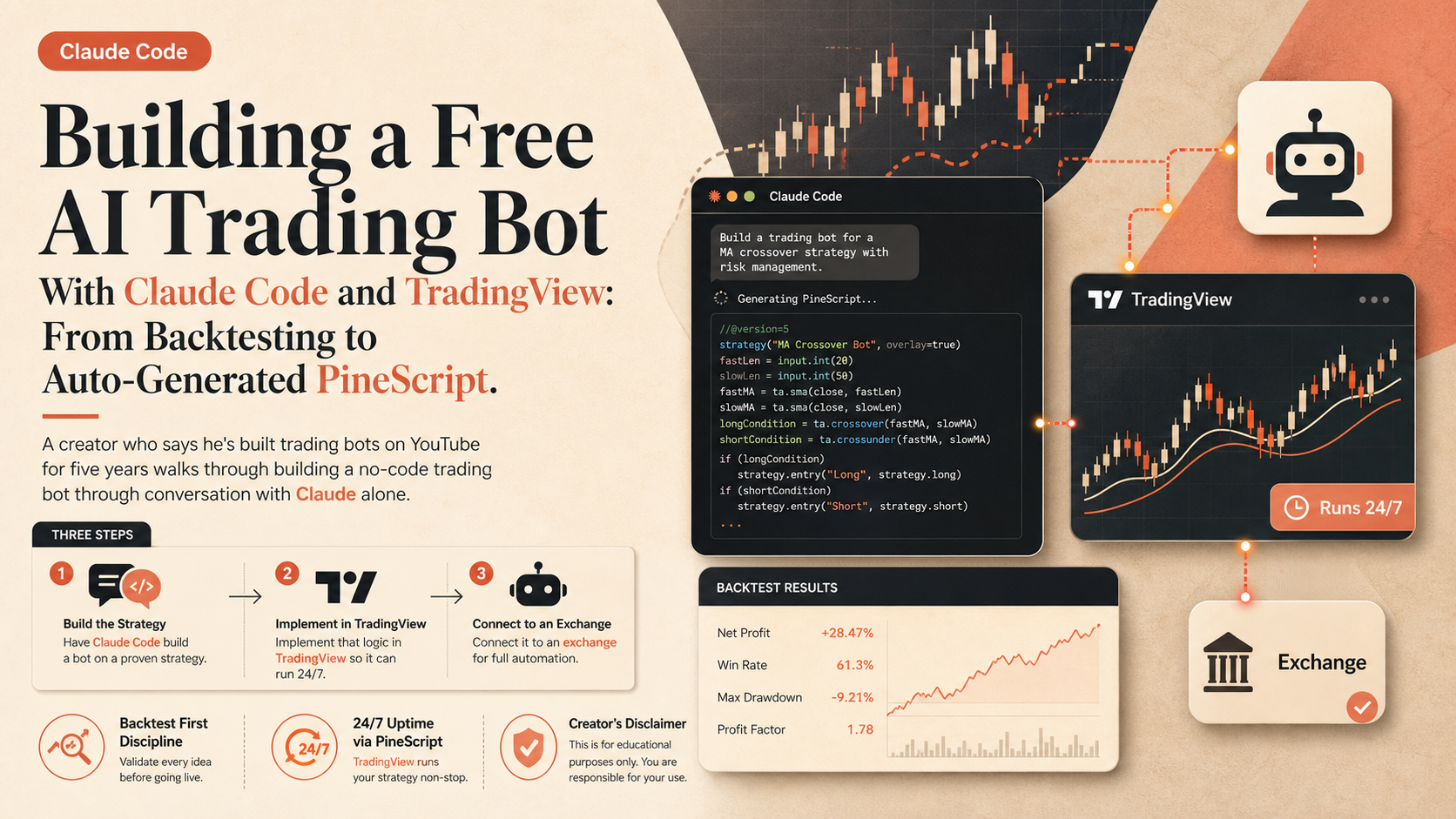
Building a Free AI Trading Bot With Claude Code and TradingView: From Backtesting to Auto-Generated PineScript
A creator who says he's built trading bots on YouTube for five years walks through building a no-code trading bot through conversation with Claude alone.