
Claude Sonnet 5 Has Arrived — Alex Finn's Smart Switching Playbook for 'Changing How I Use AI'
TL;DR · What you'll learn
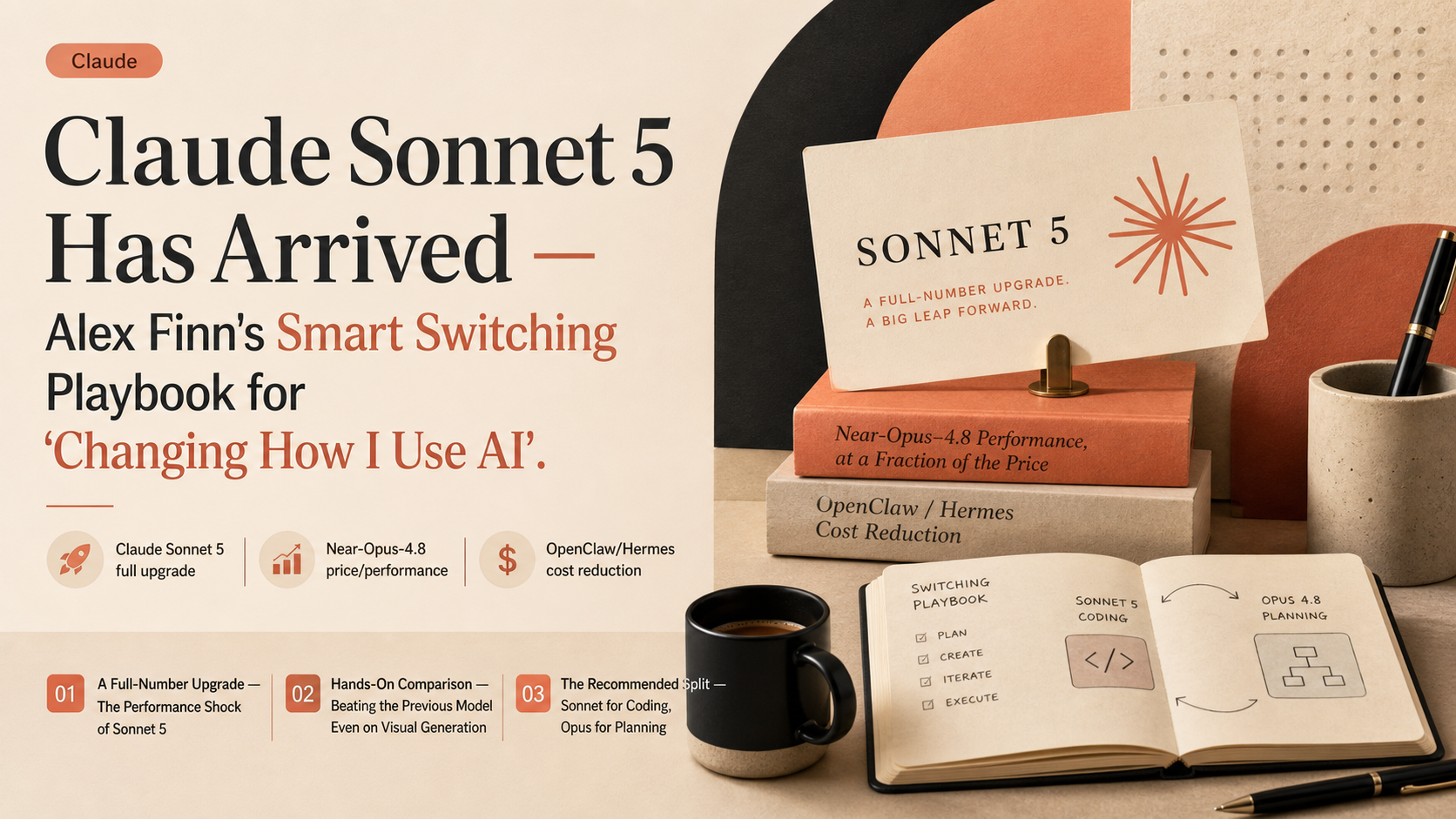
- 1 Alex Finn calls Claude Sonnet 5 'the best bang for your buck in AI right now.' It's near Opus 4.8 performance at a fraction of the price, and the whole video builds a practical playbook for how to divide work between models.
- 2 This isn't a minor update — it's a full-number upgrade. Sonnet 5, not Sonnet 4.9. The performance jump is substantial: this lighter, cheaper, faster model beats the previous-generation Opus 4.6 outright.
- 3 OpenClaw and Hermes users have long complained about paying API pricing to use Claude models. Sonnet 5 largely relieves that burden by delivering near-Opus-4.8 performance at a much lower price.
- 4 In a hands-on ocean-storm simulation test, Sonnet 5 outperformed Sonnet 5.5 — better wave motion, ship movement, and lightning rendering. A concrete uplift in visual generation capability.
- 5 The recommended split is clear: use Sonnet for basic coding tasks, and Opus 4.8's ultra mode for planning and genuinely complex work. Presented as a live workflow in Claude Code Desktop.
- 6 Fable 5's return is teased as imminent, but expected to require identity verification and be US-only. Users outside the US won't have access.
- 7 Alex draws a clear line: Sonnet 5 is not a full replacement for Opus 4.8. It's positioned as a strategically narrow substitution — for cost reduction specifically in high-spend contexts like OpenClaw and Hermes.
- 8 A caveat on pricing: ChatGPT still holds an edge in several respects. For pure coding work paid via API, Alex says he'd still probably lean ChatGPT, offering a balanced read rather than a one-sided endorsement.
Read as slides
3 slides total
A Full-Number Upgrade — The Performance Shock of Sonnet 5
Alex Finn opens by stressing that Sonnet 5 isn't a minor point release like '4.8 to 4.9' — it's a full-number upgrade. The symbolic detail: this lighter, cheaper, faster model beats the previous-generation Opus 4.6 outright. Claude has long led agentic-model rankings, but users of OpenClaw and Hermes have been frustrated by having to pay API pricing to access Claude models there.
Sonnet 5 changes that calculus. It delivers near-Opus-4.8 performance at a substantially lower price. The first half of the video walks through this performance shift concretely, with numbers attached.
Hands-On Comparison — Beating the Previous Model Even on Visual Generation
In a hands-on test, Alex simulates an ocean storm scene and compares Sonnet 5's output against Sonnet 5.5. He judges Sonnet 5's wave motion, ship movement, and lightning rendering to be more natural and convincing. Cranking up the wind produces waves crashing against the ship — a visible uplift in visual generation quality.
He doesn't skip the pricing caveat, though. Despite preferring Sonnet 5's results here, ChatGPT still holds a pricing edge in many respects — particularly for pure coding work billed via API, where Alex says he'd still probably lean ChatGPT. Claude's UI wins on usability, he adds, but for price-sensitive users ChatGPT remains a live option. A balanced read rather than a one-sided endorsement.
The Recommended Split — Sonnet for Coding, Opus for Planning
Alex's practical recommendation is clear-cut: route basic coding tasks to Sonnet, and reserve Opus 4.8's ultra mode for planning and genuinely complex work. He demonstrates this as a live workflow inside Claude Code Desktop.
He also flags Fable 5's teased return near-term, though it looks likely to require identity verification and be US-only — users outside the US won't get access. Alex himself says he'll comply with verification since he does 'nothing illegal or crazy' with AI, while taking both the API pricing and ID hurdles in stride. His conclusion: Sonnet 5 is not a full replacement for Opus 4.8. It's a strategically narrow substitution — specifically for cost reduction in high-spend contexts like OpenClaw and Hermes, where he's spending thousands a month.
Editor's Take
What makes Alex Finn's review practically useful is the sharp line he draws — Sonnet 5 is not 'a replacement for Opus,' it's 'a strategic replacement in specific domains.' That kind of judgment is itself becoming the most valuable skill in a landscape crowded with competing models. Two implications for readers. First, cost optimization isn't a single-model performance comparison anymore — it's a routing-design problem, deciding which model handles which task type. Second, Fable 5's US-only ID-verification policy signals that AI companies are starting to create geography-based access disparities through governance choices. For developers combining AI tools globally, model selection now has to account for geographic usage constraints alongside raw performance.
Source
Alex Finn
Claude Sonnet 5 just dropped. I'm changing how I use AI...
This article auto-summarizes the YouTube video's transcript with Claude. Please refer to the original video for nuance and exact wording.
Watch on YouTube →Related
3 articles
Nate Herk | AI Automation
GPT 5.6 Sol vs. Fable 5, Head to Head: Fable Edges Out a Bike Game Build at 3x the Cost
With GPT 5.6's Sol, Terra, and Luna released, benchmarks show Sol beating Opus and Fable while costing far less -- but the creator decided to run both models side by side on real work for a full day instead of just quoting numbers.

Trading with DaviddTech
Building a Free AI Trading Bot With Claude Code and TradingView: From Backtesting to Auto-Generated PineScript
A creator who says he's built trading bots on YouTube for five years walks through building a no-code trading bot through conversation with Claude alone.

The Calum Johnson Show
Building a Membership Site With Claude Code in a Weekend, $20K in the First Week: 'You Don't Need the Terminal'
The guest says he built a membership platform, digitalcreatorclub.com, that would have previously cost $50,000-$100,000, in a single weekend using Claude Code -- and made about $20,000 in its first week.