Claude Daily Claude Daily
RSS
セキグチガクの未来解剖ch 41 min video 4 slides

How Noda Is Driving LINE Automation to Zero Cost With Claude Code
Claude CodeであらゆるSaaSを0円でばら撒く天才AI起業家に、今後どんな未来が来るのか聞いてみた。【LINE Harness】
36,868 views 7 highlights

TL;DR · What you'll learn

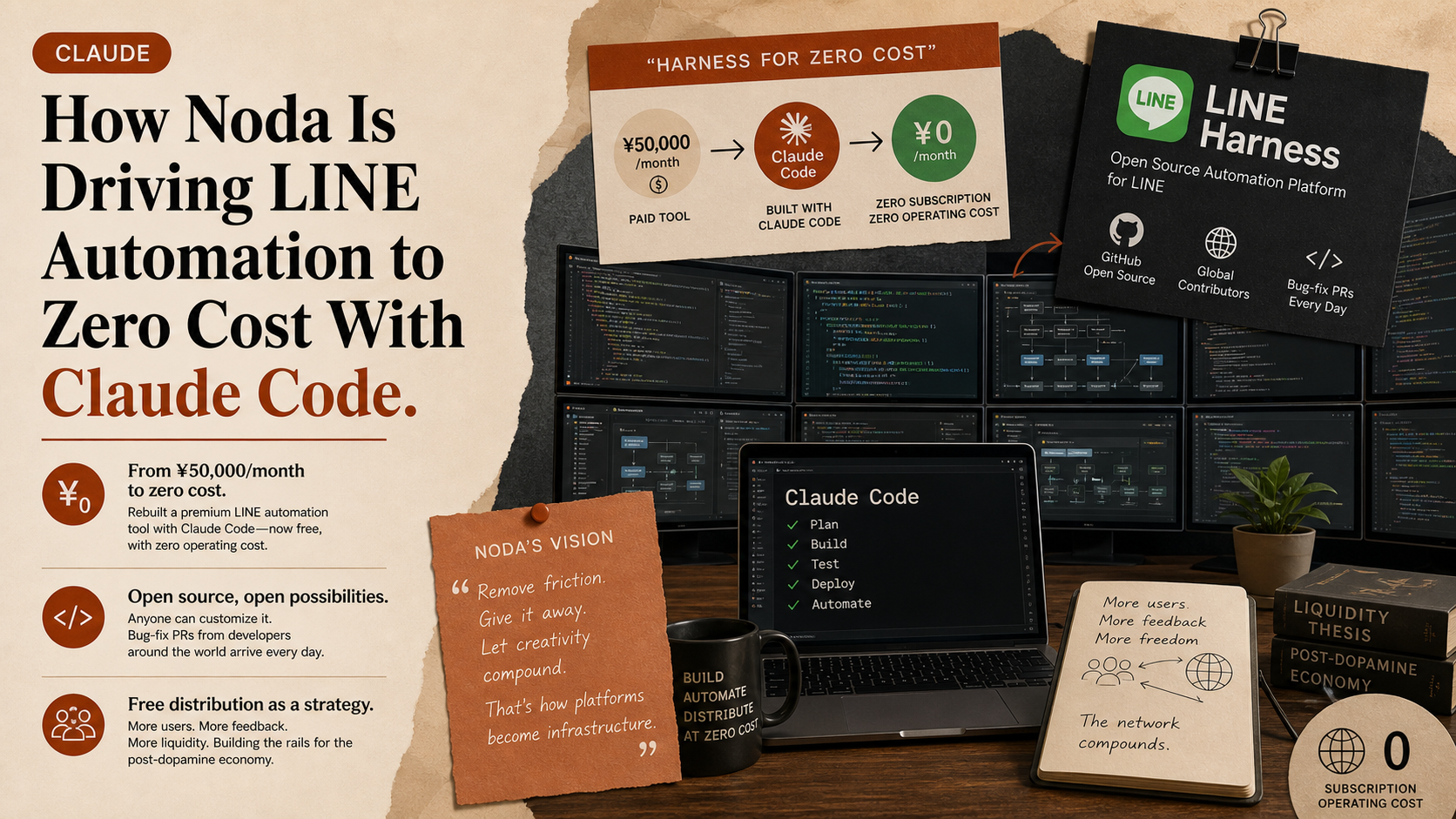
  • 1 Kazushi Noda's "Harness for zero cost": he rebuilt a 50,000-yen-per-month LINE automation tool with Claude Code and now distributes it with zero subscription and zero operating cost.
  • 2 By open-sourcing the project, anyone can customize it for their own needs, and bug-fix PRs from developers around the world arrive routinely.
  • 3 Noda runs Claude Code across 11 screens at once, creating a parallel workflow where new tasks get dropped in the moment he thinks of them.
  • 4 His prompt-design method: feed Claude the official docs plus competitor tool explainers, compare the gaps, and then build the spec from there.
  • 5 The idea behind giving it away for free is "liquidity": dissolving constraints like price and operational complexity so things can move more smoothly.
  • 6 What comes next, he argues, is the "post-dopamine economy" and "agent-to-agent" systems, including a reference to Google's A2A protocol.
  • 7 He envisions a world where AI handles the busywork, leaving agents to translate human friction points such as consensus-building and profit-sharing.

Read as slides

4 slides total

01 Slide 1 / 4
Watch at 01:35

How LINE Harness Turned a 50,000-Yen Tool Into a Free Alternative

Official LINE has long relied on auto-messaging tools that cost tens of thousands of yen per month, and operating multiple accounts could drive annual costs into the millions. Kazushi Noda decided to replace that stack with an in-house tool built around Claude, using Anthropic's Claude Code to create LINE Harness.

The finished product positions itself as a full replacement and upgrade over paid tools, with both subscription and operating costs set to zero. It even includes the ability to spin up an official LINE account quickly, opening the door for individuals and small businesses that previously gave up because of cost. The interviewer says Harness ended up covering a LINE build-out that would otherwise have required an order worth around 1 million yen.

Claude Daily 01 / 04
02 Slide 2 / 4
Watch at 05:20

Running Claude Code on 11 Screens and Designing Better Prompts

Noda runs 11 parallel Claude Code instances on his PC using a screen-splitting setup. Whether it is implementing Harness, preparing workshops, or designing intake sheets, he inserts new tasks sideways the moment they occur to him and processes them in parallel. In his words, it is an operating model built to achieve "11x productivity."

He also lays out a concrete prompt-design technique. Beyond the official documentation, he has Claude read through competitor tool explainers, compare both sides, and surface features that exist in the official spec but are missing from competing products. That gives Claude enough context to suggest both differentiation points and feature priorities for the in-house tool. The approach is grounded in a simple philosophy: when instructing AI, give it the best possible source material.

He also shares an exercise he says every new workshop participant should do first: "Using your past ChatGPT conversation history, classify what AI can do entirely (green), what AI can also do (yellow), and what only you can do (red), using emoji." The goal is to reveal the questions people keep repeating unconsciously.

Claude Daily 02 / 04
03 Slide 3 / 4
Watch at 11:07

The Liquidity Thesis Behind Free Distribution and the Post-Dopamine Economy

Why give it away for free? Noda says there is something inherently satisfying about increasing liquidity itself. He connects the idea to the shift from capped access at movie theaters and record stores to effectively unlimited access through services like Netflix, Apple Music, and Spotify. His core motivation is to use AI to dissolve constraints such as LINE tool pricing and clunky admin interfaces into something more fluid.

What had been nagging at him for years, he says, was a sense of exhaustion with the so-called "dopamine economy" of virality, advertising, and excessive entertainment consumption. Even its seeming opposite, like saunas, camping, and minimalism, eventually becomes repetitive. What remains is the layer of "making, understanding, and passing things on." He calls this new mode, where distribution itself becomes the reward, the "post-dopamine economy."

As AI makes professional-grade production available to everyone and social platforms fill with AI slop, Noda predicts a countertrend: a return to a world where a small number of people create and distribute genuinely valuable things. His goal with LINE Harness is to build that "place" ahead of the curve.

Claude Daily 03 / 04
04 Slide 4 / 4
Watch at 28:36

The Next Layer: Agent-to-Agent Systems and Human Consensus

Near the end of the discussion, Noda points to two emerging technology currents: "human in the loop" and "agent-to-agent." The former describes a pipeline where AI handles planning through execution and asks humans for approval only when needed. He also references Adoness's task-management idea of not using "TODO" but "DOD (Definition of Done)," where the goal is framed around external conditions such as "the other party has replied."

On the latter, he explicitly mentions Google's A2A protocol. He imagines a world where each party's AI agent acts as a translator, helping with the most painful parts of multi-person projects, such as profit allocation and consensus-building. Noda says this could make it possible to bring in "difficult but highly capable people" through their agents. He also argues that video itself will become more multi-layered: instead of uploading one version and stopping there, subtitles, visuals, and difficulty could be transformed per viewer, changing the structure of content distribution.

The final long-range vision he mentions is a "world government." If AI continues pushing toward greater liquidity, he argues, even borders as constraints may gradually dissolve, moving the world closer to a model of regional specialization, though he adds that realization is still far off.

Claude Daily 04 / 04

Editor's Take

Rebuilding a ¥50k/month LINE tool in Claude Code and giving it away for free is a live demonstration of the 'free via the harness' philosophy. Running 11 windows in parallel, and composing specs from the diff between official docs and competitor explainers, show the ceiling of solo-developer productivity rising. The motive of 'dissolving constraints to increase liquidity,' and the outlook toward agent-to-agent interaction, push past tooling to question the shape of the economy itself.

Source

Claude CodeであらゆるSaaSを0円でばら撒く天才AI起業家に、今後どんな未来が来るのか聞いてみた。【LINE Harness】

セキグチガクの未来解剖ch

Claude CodeであらゆるSaaSを0円でばら撒く天才AI起業家に、今後どんな未来が来るのか聞いてみた。【LINE Harness】

Published 6/11/2026 41 min 36,868 views

This article auto-summarizes the YouTube video's transcript with Claude. Please refer to the original video for nuance and exact wording.

Watch on YouTube

Related

3 articles