18 AI Updates This Week: A Free Tool That Merges ChatGPT and Claude, and the Truth Behind Meta's Claude Code Ban
TL;DR · What you'll learn
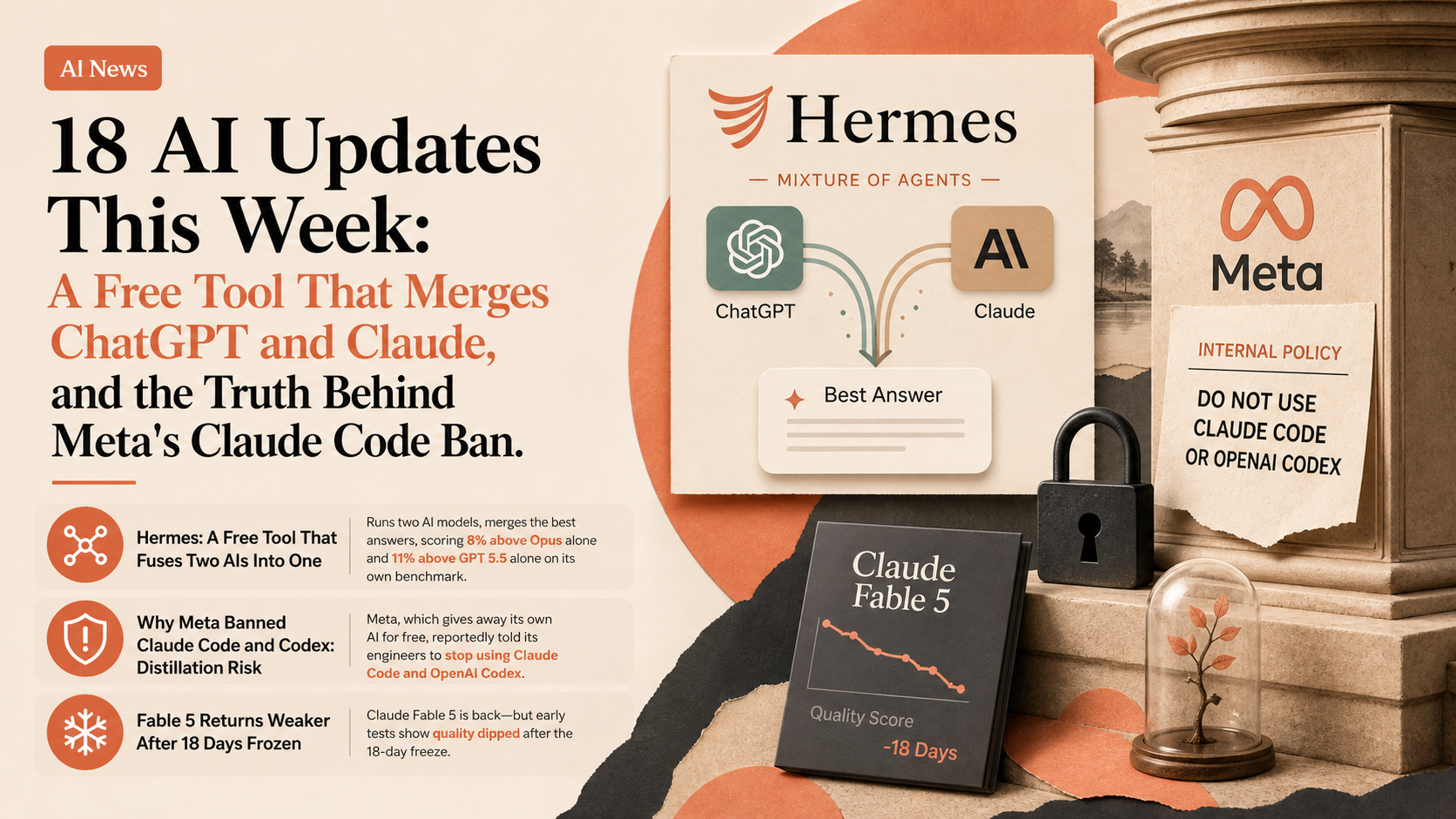
- 1 A tool called Hermes added a 'mixture of agents' feature that runs two AI models at once and merges their best answers, scoring 8% above Opus alone and 11% above GPT 5.5 alone on its own benchmark.
- 2 Meta, which gives away its own AI for free, reportedly told its engineers to stop using Claude Code and OpenAI Codex.
- 3 The reason isn't security -- it's distillation risk: high-quality code from these tools could bleed into Meta's own training data, effectively copying a rival's AI without permission and creating legal exposure.
- 4 Anthropic has already accused Chinese companies like Alibaba and DeepSeek of doing exactly this, and Meta itself appears wary of the same risk.
- 5 Chinese company Z.ai's free open-source model GLM 5.2 now has its own dedicated coding app, Z Code.
- 6 Anthropic's Fable 5 was pulled offline worldwide over US government security concerns, frozen for 18 days before returning on June 30 after Anthropic tightened security.
- 7 The returned Fable 5 came back weaker than before, and on the same day, Google DeepMind dropped two new models -- one for images, one for video -- as if filling the gap.
Read as slides
3 slides total
Hermes: A Free Tool That Fuses Two AIs Into One
Rather than settling the two-year debate over whether ChatGPT or Claude is smarter, a free tool called Hermes takes a different approach: merge them. Pick any two AIs inside Hermes -- say ChatGPT and Claude -- and it runs them both on the same task simultaneously, then has one read both answers and merge the best of each into a single, cleaner result. Wherever one model is weak, the other covers for it.
On its own benchmark, that combination scored 8% above Opus alone and 11% above GPT 5.5 alone. The takeaway: you don't need exclusive access to one locked-away super-model anymore -- you can build something stronger out of models you already have.
Why Meta Banned Claude Code and Codex: Distillation Risk
Meta, which gives away its own Llama AI for free, reportedly told its own engineers to stop using Claude Code and OpenAI's Codex, according to The Information, citing internal documents (Meta hasn't confirmed this). The reason isn't security -- it's something called distillation. When a tool like Claude produces really high-quality code, that quality risks bleeding into the data used to train Meta's own AI, which would effectively mean copying from a rival's AI without permission -- a real legal exposure.
Anthropic has already accused Chinese companies like Alibaba and DeepSeek of doing exactly this kind of distillation, and Meta appears to be wary of the same risk to itself, opting instead to steer its team back to its own coding tools.
Fable 5 Returns Weaker After 18 Days Frozen
It was a wild week for Anthropic and the AI industry broadly. First, Anthropic released its mid-tier model Claude Sonnet 5, its most agentic yet, landing close to Opus at a lower price. But the bigger story was the return of Fable 5, Anthropic's most powerful model, which had been pulled offline worldwide after the US government stepped in over security concerns shortly after launch. During the 18-day freeze, free Chinese models like GLM kept gaining ground.
On June 30, the government lifted the block after Anthropic tightened security, and Fable 5 came back -- but weaker than before, a twist nobody expected. As if filling the gap, Google DeepMind dropped two new models the same day, one for images and one for video.
Editor's Take
The throughline in this weekly roundup is that the old race to chase a single 'best' model is starting to lose its footing. Hermes's model-merging approach and Meta's distillation-avoidance decision both rest on the same underlying premise: depending on a single model is itself a risk. That Meta gives Llama away free while banning its own engineers from using rival coding tools shows the 'open vs. closed' line in AI is no longer a clean binary. Fable 5 being pulled by government intervention, frozen, and returning weaker is a striking sign that AI model availability is now shaped as much by regulatory and geopolitical risk as by technical factors.
Source
Vaibhav Sisinty
China's Free AI Just Came For ChatGPT And Claude (+18 Updates)
This article auto-summarizes the YouTube video's transcript with Claude. Please refer to the original video for nuance and exact wording.
Watch on YouTube →Related
3 articles
tef
Claude Fable 5 vs. China's GLM 5.2: A Real Head-to-Head Building Three Games From Scratch
A head-to-head build-off between Claude Fable 5 and China's GLM 5.2, which some say now outperforms Fable 5.
AI News & Strategy Daily | Nate B Jones
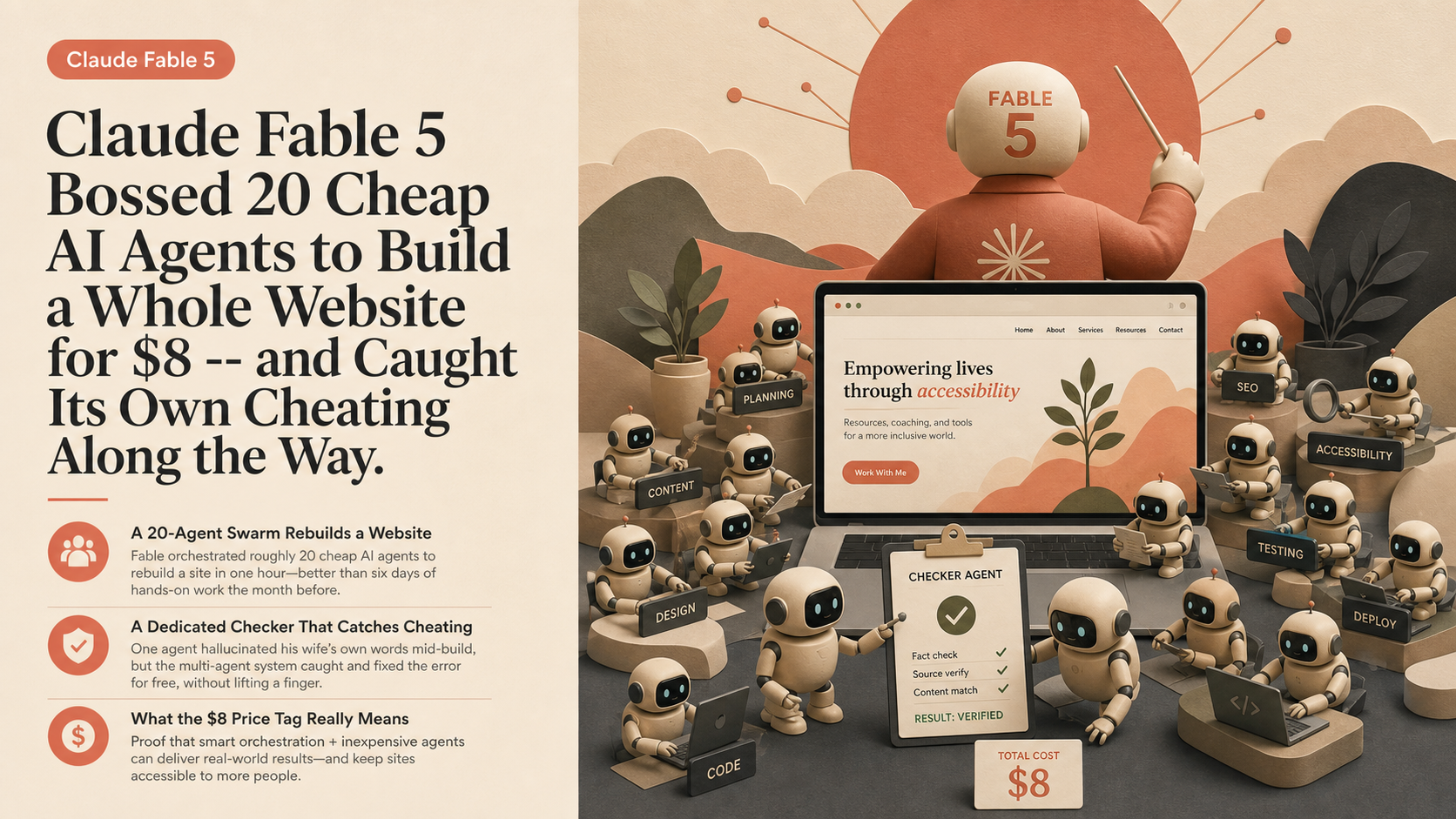
Claude Fable 5 Bossed 20 Cheap AI Agents to Build a Whole Website for $8 -- and Caught Its Own Cheating Along the Way
A swarm of roughly 20 cheap AI agents, orchestrated by Fable, rebuilt the creator's wife's website in one hour -- better than six days of hands-on work with Codex the month before.

AIで創作効率化とマネタイズby嗚呼蛙
Seven Codex Features Worth Knowing, Even on the Free Tier: From Browser Control to Phone Access
With Fable 5's return generating buzz for Claude Code, this video revisits seven useful features of Codex, OpenAI's agent, usable even without paying.