Claude Daily Claude Daily
RSS
Siraj Raval 11 min video 3 slides

I Let an AI Agent Run 5 Dead Websites for 30 Days — Siraj Raval on Wins, Failures, and Next Research
I Let an AI Agent Run 5 Dead Websites for 30 Days
23,864 views 8 highlights

TL;DR · What you'll learn

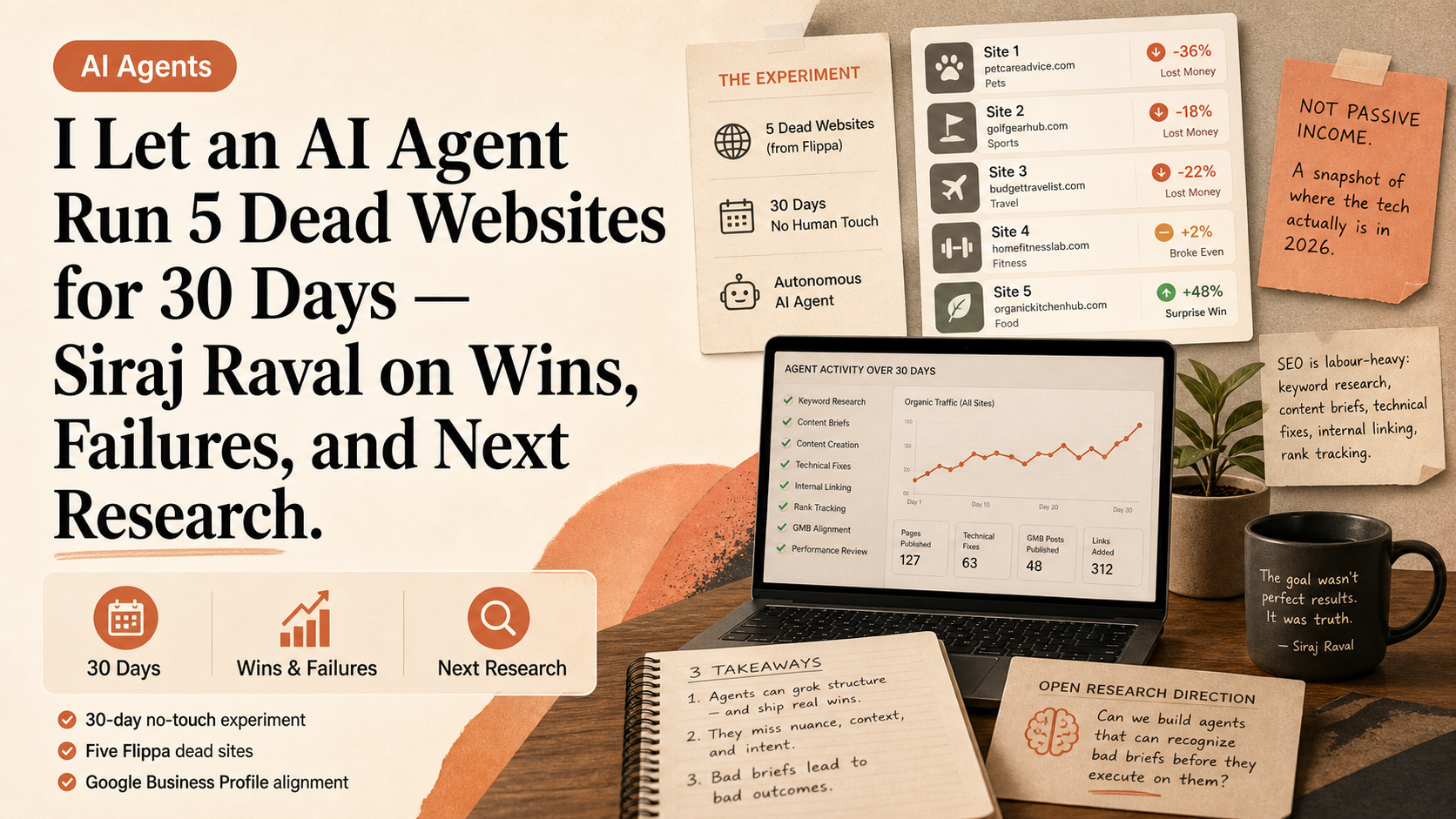
  • 1 Siraj Raval gave an AI agent five websites and zero instructions for 30 days. Three lost money, one barely broke even, one was a genuine surprise. Not a passive-income pitch — a snapshot of where the technology actually is in 2026.
  • 2 SEO has historically been one of the most labour-heavy parts of running an internet business — keyword research, content briefs, technical fixes, internal linking, ranking tracking. The question: can an autonomous agent handle this without a human in the loop, and what are the failure modes.
  • 3 Setup: bought 5 sites from Flippa that had been built but never properly operated, deliberately in different niches, total $2,500. Day-one command per site, then closed the laptop. 30 days, no revisions, no tuning, no human.
  • 4 The agent: Auto from SearchAtlas, who sponsored the video. Disclosed up front. Fair test conditions otherwise — no mid-experiment intervention.
  • 5 Site 3 (local services): on day 9, the agent figured out the structural insight — local-pack rankings attach to Google Business Profile, not the website. So it prioritised GBP alignment, migrated reviews, built location pages that backlinked the GBP rather than competing with it. 47 leads sold at $25/lead = $1,200. Above acquisition cost.
  • 6 Site 4 (affiliate comparisons): the agent executed flawlessly — 22 comparison pages, internal linking optimised, schema markup added. Result: $230 in affiliate revenue against a $700 target. Total failure of correctness despite perfect execution.
  • 7 30-day totals: $2,500 in, $4,120 out, $1,620 net. 1.64× return (excluding Auto subscription). Not a viral money printer, but real numbers for sites that were generating $0 going in.
  • 8 Three takeaways. (1) For businesses: agents like Auto are the right-shape tool for the marketing labour problem. (2) For marketers: leverage moves to writing the right brief — strategy, niche selection, prompt quality. (3) For agent builders: the site 4 failure points to an open research direction — agents that can recognise when their own brief is structurally bad.

Read as slides

3 slides total

01 Slide 1 / 3
Watch at 00:00

Setup — five dead sites, 30 days, no human touch

Siraj Raval's video locks the framing up front. He gave an AI agent five websites and zero instructions for 30 days. Three lost money, one barely broke even, one was a real surprise. This is explicitly not a passive-income hype piece. What he wants to show is where this kind of agent makes smart architectural decisions, where it breaks, and what that tells us about where the technology actually is in 2026.

SEO is historically among the most labour-heavy parts of running an internet business — keyword research, content briefs, technical fixes, internal linking, ranking tracking, months of compounding work. The question Siraj wanted to answer was whether an autonomous agent can do this work without him in the loop, and what the failure modes look like when it does. He bought 5 sites from Flippa that had been built but never properly operated (deliberately in different niches, $2,500 total), typed one command per site on day 1, and closed the laptop. The agent was Auto from SearchAtlas, who sponsored the video — disclosed up front.

Claude Daily 01 / 03
02 Slide 2 / 3
Watch at 04:45

Wins and failures — when the agent groks structure, and when it misses it

The standout win is site 3, a local services site untouched in years. Siraj's day-one command was clean: dominate local SEO for city + service, fix Google Business Profile alignment, build location keyword landing pages, rank in the local pack. On day 9, the agent surfaced a structural insight on its own — local-pack rankings attach to the Google Business Profile, not the website. So rather than pouring effort into website pages first, it prioritised GBP alignment, migrated reviews, and built location pages that backlinked the GBP rather than competing with it. Result: 47 leads through the contact form, sold to a partner trade business at $25/lead, $1,200 total — above acquisition cost. The agent figured out the niche-correct strategy unaided.

The failure on site 4 is more instructive. Affiliate comparison site, day-one brief in the same shape as the others — identify the highest-opportunity review keywords in the niche, write authoritative comparisons, build internal linking that concentrates authority on the money pages. Auto executed flawlessly: 22 comparison pages, internal linking optimised, schema markup added. Technically all correct. Result: $230 in affiliate revenue against a $700 target. The agent did what was asked. The brief itself was structurally wrong. The agent had no way to notice.

Claude Daily 02 / 03
03 Slide 3 / 3
Watch at 09:09

Three takeaways — and an open research direction

30-day totals: $2,500 in, $4,120 out, $1,620 net — a 1.64× return excluding Auto subscription costs. Not the viral 'make money while you sleep' shape. But for sites that were generating $0 going in, the numbers are real.

Three takeaways segmented by audience. (1) For businesses: agents like Auto are the right-shape tool for the marketing labour problem — test it on one underperforming page with the free 7-day trial. (2) For marketers: the leverage moves to writing the right brief. The agent will execute. Your value shifts to strategy, niche selection, and prompt quality. That's not a worse job — that's a more interesting one. (3) For agent builders: the failure mode on site 4 is the architectural problem worth solving. An agent that can recognise when its own brief is structurally bad — not just execute inside it — is the next interesting research direction. Siraj calls out Mistral, Anthropic, and OpenAI by name: that primitive doesn't exist yet.

Claude Daily 03 / 03

Editor's Take

The most useful part of Siraj's experiment isn't the success rate or the margin — it's the open research direction that site 4 points to. An AI agent can execute a brief flawlessly and still fail if the brief itself is structurally wrong. That moves the problem off 'prompt engineering as personal skill' and onto a higher abstraction: an agent's capacity to evaluate the validity of the task it was given. Today's Claude and Codex optimise well against a stated goal, but the layer that questions whether the goal is well-formed is thin. As Loop Engineering and Claude Tag-style organisational agents get embedded in real workflows, that gap will show up as real damage. Two takeaways. Teams embedding agents in their work should keep human brief-quality review in the loop for the foreseeable future. Agent builders have a clearly-bounded, valuable research target: classify failures like site 4 and design the brief-critique layer.

Source

I Let an AI Agent Run 5 Dead Websites for 30 Days

Siraj Raval

I Let an AI Agent Run 5 Dead Websites for 30 Days

Published 6/25/2026 11 min 23,864 views

This article auto-summarizes the YouTube video's transcript with Claude. Please refer to the original video for nuance and exact wording.

Watch on YouTube

Related

3 articles