Trump Tripped Claude's Breaker, China Cashes In — France's HugoDécryptes on the US AI Ban
TL;DR · What you'll learn
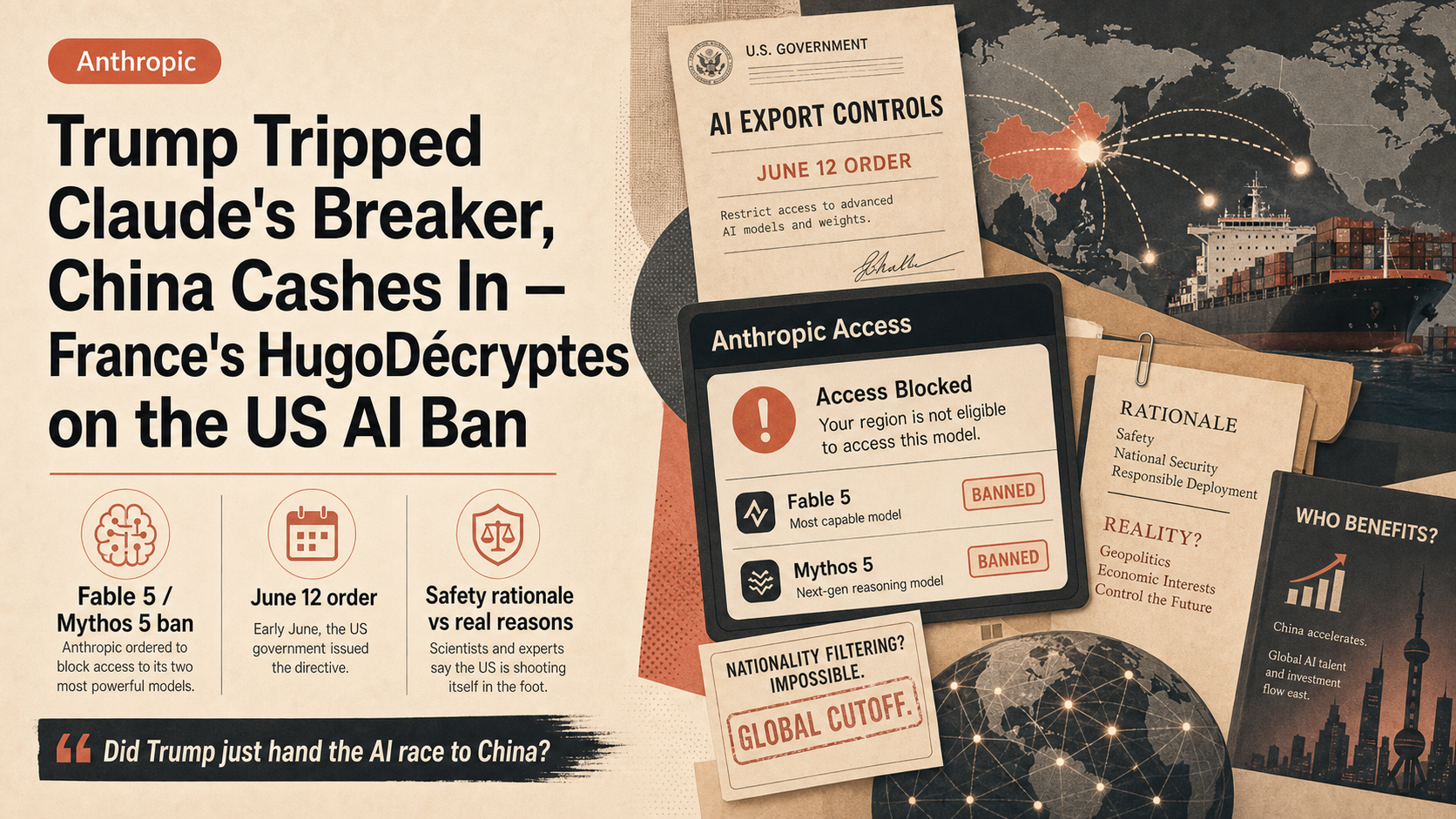
- 1 HugoDécryptes opens with a direct question. Did Trump just hand the AI race to China? Early June, the US ordered Anthropic to ban access to its two most powerful models, Fable 5 and Mythos 5.
- 2 Since then, many scientists and experts have accused the US of shooting itself in the foot. Why the alarm has spread is the topic of the segment.
- 3 Timeline recap: on June 12, the US ordered Anthropic to block these two models for any foreign national, inside or outside the US.
- 4 Anthropic has no technical way to filter users by nationality, so it ended up cutting global access to both models — including for US users.
- 5 The decision drew strong reactions worldwide, especially in France. HugoDécryptes has a separate dedicated piece for viewers who want to go deeper.
- 6 At the time, the Trump administration offered no detail beyond claiming the models were 'powerful enough to present cybersecurity risks' — for example, in cyberattacks.
- 7 Now more is emerging about the actual reasons that motivated the US to issue that demand, the show notes.
- 8 The core message: AI export controls justified on national-security grounds can end up weakening US dominance. China is positioned to use that gap.
Read as slides
3 slides total
The Fable 5 / Mythos 5 ban in one frame
HugoDécryptes is one of France's main news-explainer channels. This segment opens with a provocative question — did Trump just hand the AI race to China? In early June, the US ordered Anthropic to halt access to its two most powerful models, Fable 5 and Mythos 5, and since then, scientists and experts have been calling it a self-inflicted wound.
The segment is a short briefing for French-language viewers — a longer dedicated piece is linked separately. The point of the format is to contextualise the US decision from a European vantage, which is the typical move when a major US policy decision spills over into the rest of the world's AI economy.
June 12 order and the worldwide cutoff
The sequence is simple but the impact isn't. On June 12, the US ordered Anthropic to block 'any foreign national, inside or outside the US' from accessing Fable 5 and Mythos 5. Then the technical problem hit. Anthropic doesn't have a way to filter users by nationality.
The operational response was to cut global access — including for US citizens. US citizens lost access to a US-built AI because of a US government decision. That perverse outcome is what triggered strong international reaction, France included, and reopened debates about national sovereignty, industrial policy, and US dependency that had been simmering at lower temperature.
The official safety rationale and the 'real reasons'
At the time, the Trump administration's only explanation was that the models were 'powerful enough to present cybersecurity risks — for example, in cyberattacks.' Cybersecurity and national security framing as the basis for export controls is formally coherent, but skipping the details was always going to invite scepticism.
The segment notes that more is now emerging about the actual reasons that motivated the demand. The closing message is the sharp one. AI export controls justified on national-security grounds can end up weakening US dominance — and Anthropic is the first to absorb the impact. China is positioned to step into the gap. It's a calm read, not a polemic, which is part of what makes it land.
Editor's Take
That HugoDécryptes — a mainstream French outlet — covered this story matters in itself. In US press, the framing is usually 'Anthropic vs the Trump administration.' In Europe it's reframed as 'the risk of depending on US-built AI.' Technically, two things are worth noting: filtering users by nationality is not really implementable, and that constraint propagated the US government's order into a cutoff for US citizens too — a feedback loop the policy authors apparently didn't model. Two takeaways for readers. Short term: any business depending on Anthropic infrastructure needs to assess political risk on the same level as supply chain risk. Long term: any service whose availability can be revoked by a single government decision is, by design, a fragile foundation. The 'China cashes in' headline reads sensational, but the economic logic behind diversifying geopolitical exposure is genuinely solid.
Source
HugoDécrypte - Actus du jour
Trump vient de faire disjoncter Claude, la Chine en profite
This article auto-summarizes the YouTube video's transcript with Claude. Please refer to the original video for nuance and exact wording.
Watch on YouTube →Related
3 articles
Higgsfield AI
Recreating a 'Faceless' YouTube Pipeline With Claude Fable 5: One Prompt, From a 10-Minute Video to Multilingual Dubs
The video asks whether a multi-million-view 'faceless' 10-minute explainer production pipeline can be recreated with a single prompt.
Alva Majo
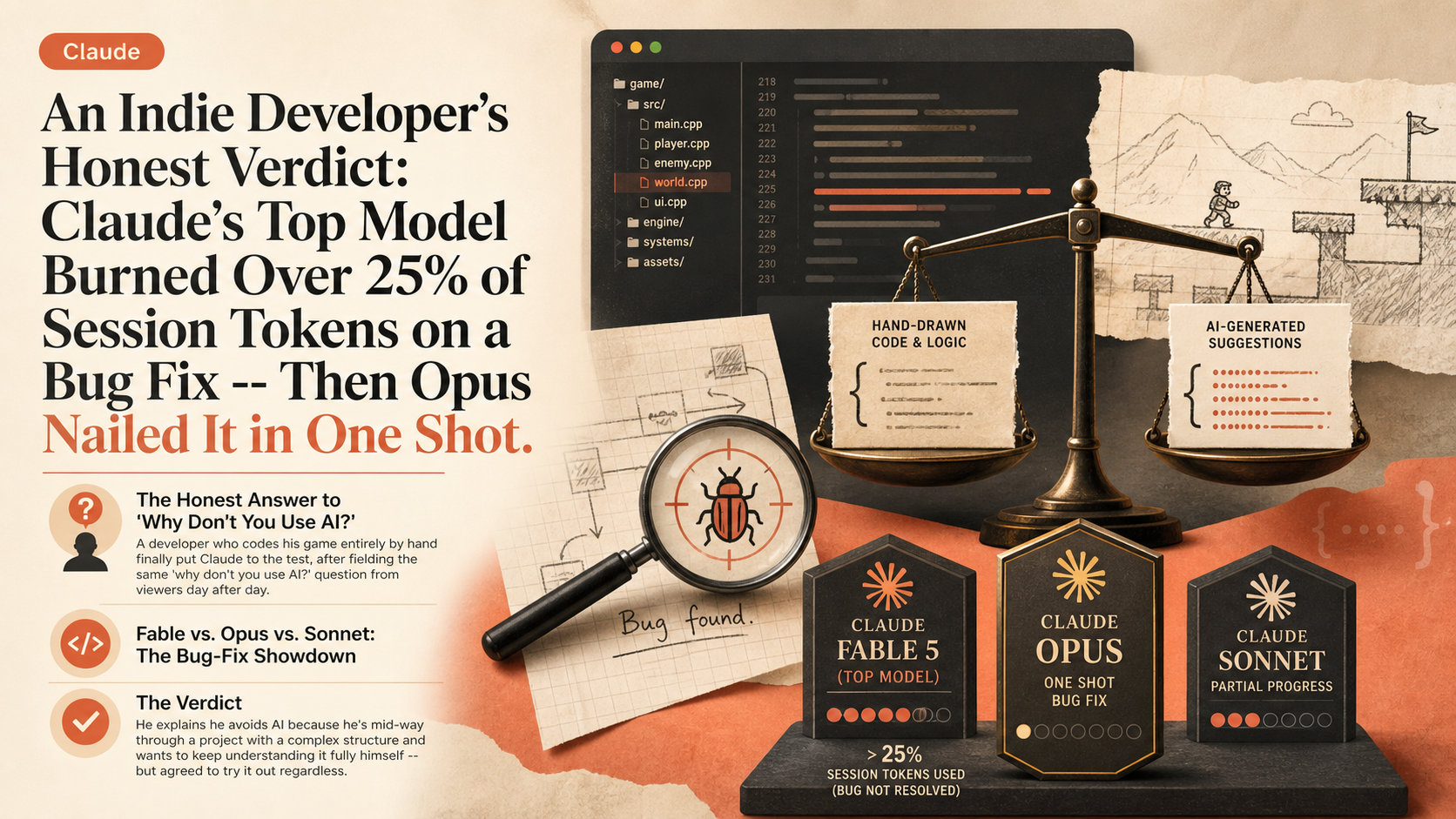
An Indie Developer's Honest Verdict: Claude's Top Model Burned Over 25% of Session Tokens on a Bug Fix -- Then Opus Nailed It in One Shot
A developer who codes his game entirely by hand finally put Claude to the test, after fielding the same 'why don't you use AI?' question from viewers day after day.
Aywen
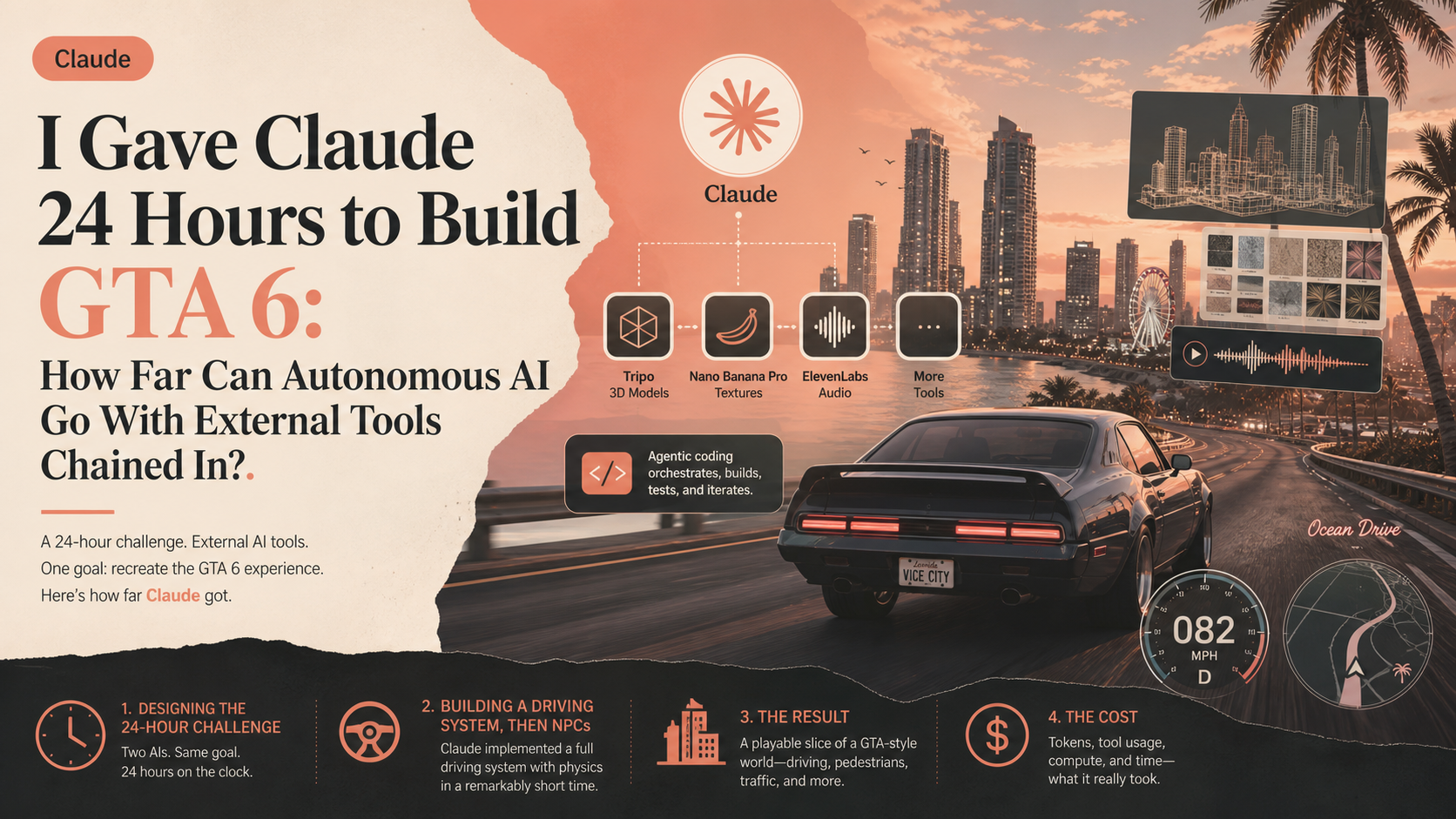
I Gave Claude 24 Hours to Build GTA 6: How Far Can Autonomous AI Go With External Tools Chained In?
The creator gave ChatGPT and then Claude 24 hours each, chaining in external AI services -- Tripo for 3D models, Nano Banana Pro for textures, ElevenLabs for audio -- to attempt recreating GTA 6.