GLM 5.2 Is Free and Beats Claude — So Why Can't Companies Switch? Nate B Jones on the Claude Tag Trap
TL;DR · What you'll learn
- 1 Nate B Jones puts GLM 5.2 through real work and lays out where an open-source model can safely replace an expensive one — and where switching is a trap because you're replacing a whole work system, not a single model call.
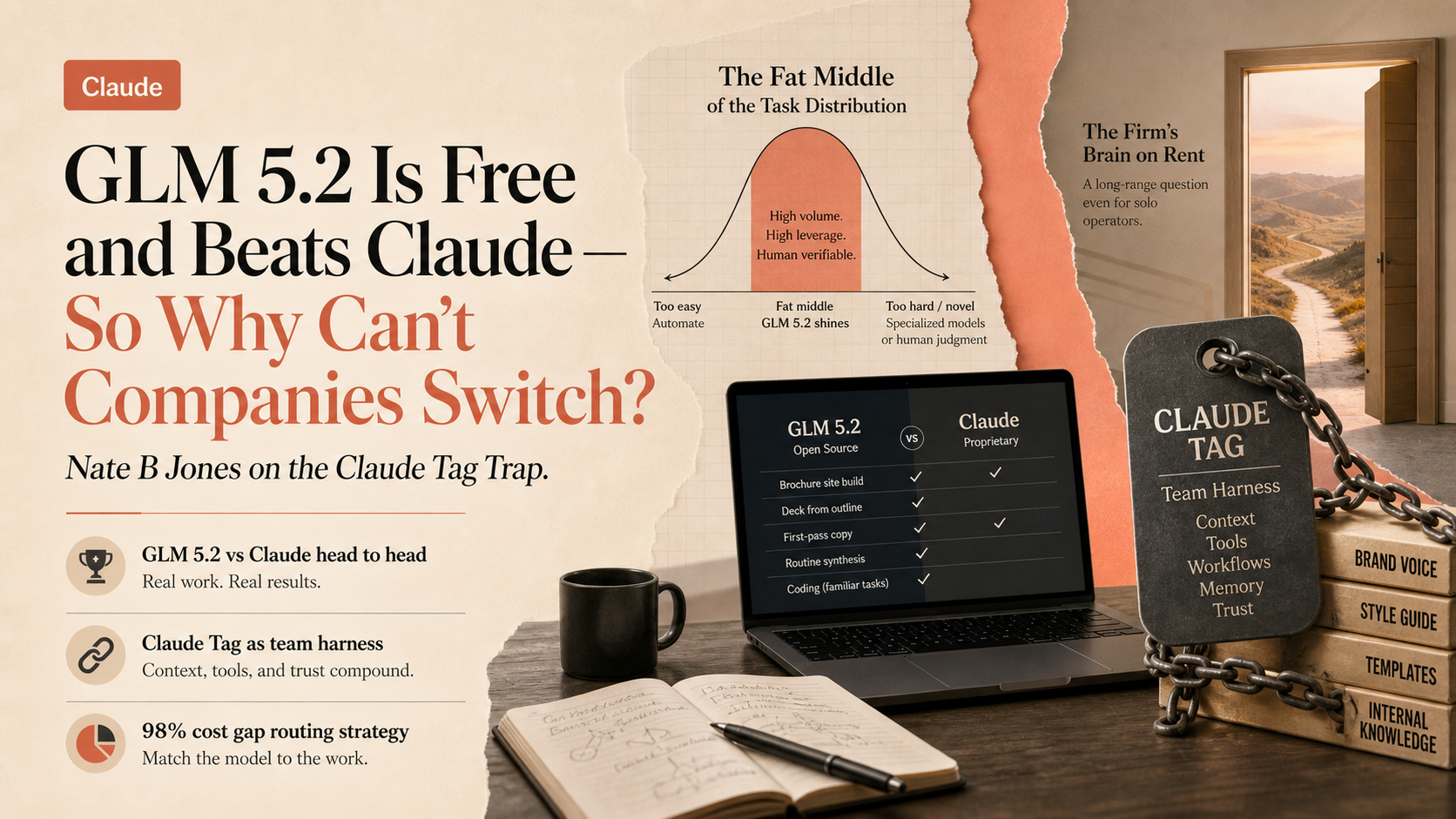
- 2 GLM 5.2 is exceptionally strong in the fat middle of the AI task distribution. Brochure-site builds, decks generated from PowerPoint outlines, first-pass copy, routine synthesis, coding tasks of familiar shape — anywhere examples are plentiful and humans can verify the output quickly.
- 3 On that middle-distribution work, GLM 5.2 is fast, cheap, easy, and often higher-quality than Claude. The typical case: there are millions of prior examples, the answer pattern is familiar, and the output is easy to inspect.
- 4 From Anthropic's strategic vantage point, Claude Tag isn't just capturing engineers — it's pulling in every knowledge worker on Slack, ingesting the messy, undocumented context that lives there, and feeding it to Claude automatically.
- 5 Here's the switching trap. GLM 5.2 is roughly 98% cheaper than Claude, and the rational move on most tasks is to route them to GLM 5.2. But doing so means giving up the Claude Tag convenience — re-handing context to a different AI from scratch.
- 6 Data is alpha. For decades we've taught companies that data is the edge if you're serious. So what does it mean to hand all of your context — Slack chatter, implicit relationships, working assumptions — to one vendor's AI?
- 7 Nate calls this a pivotal moment for corporations. The firm's brain has never before been on rent. Claude Tag is dangerous precisely because it's so useful, and the usefulness is the structural problem.
- 8 Independent operators face the same question. Build your long-term context-ownership strategy, map your task distribution, decide where to route. GLM 5.2 opened the door; what each company or individual does with it is up to them.
Read as slides
3 slides total
Where GLM 5.2 Wins — The Fat Middle of the Task Distribution
Nate B Jones tries GLM 5.2 on real work and is — by his own framing — impressed for the right reasons. It's cheap, free if you self-host, and the quality on a lot of normal work is genuinely high. 'Normal work' is what he calls the fat middle of the AI task distribution — brochure-site builds, decks from PowerPoint outlines, first-pass copy, routine synthesis, coding tasks of familiar shape.
This is the territory where there are millions of prior examples behind the answer pattern, and where humans can inspect the output quickly. On that surface, GLM 5.2 is fast, cheap, easy, and often higher-quality than Claude. The opening message of the video, in short, is that on pure performance grounds, switching to GLM 5.2 is a serious option that deserves consideration.
The Claude Tag Trap — Context Ownership Quietly Changes Hands
From here Nate turns to the strategic side of Claude Tag. Anthropic isn't just capturing engineers with Claude Tag — it's pulling in every knowledge worker on Slack and ingesting the messy, undocumented context they live in. That context becomes the material Anthropic can use to tune how Claude behaves in your specific company, over time, within their privacy framework.
Here's the trap. GLM 5.2 is around 98% cheaper than Claude. On most tasks, routing to GLM 5.2 looks rational. But doing so means giving up the Claude Tag convenience. The Claude that has all your Slack-acquired context becomes sticky in a way that no comparison-shopping can capture — switching means re-handing that context to a different AI from scratch. For executives who have learned that data is alpha for decades, the choice to rent out that context and intelligence is not casual.
The Firm's Brain on Rent — A Long-Range Question Even for Solo Operators
Nate frames the situation as 'the first time in history the firm's brain has been on rent.' Claude Tag is dangerous precisely because it's so useful; the usefulness is the structural problem.
The same question applies to small operators, even one-person consultancies and agencies. Design a long-term context-ownership strategy. Map your task distribution. Decide based on technical resources whether you can build the last-mile routing yourself. Identify the task sets that would save a lot in tokens if shifted. Nate has a detailed question set on his Substack, but the core point is the act of sitting down with pen and paper. GLM 5.2 opened the door; what each company and each individual does on the other side is the actual decision.
Editor's Take
What makes Nate's framing useful is the refusal to argue 'switch because it's cheap' or 'switch because it's equally capable.' His move is to push the decision up one level: model selection is not an API-call choice, it's a choice about your work system and the ownership of your context. Two concrete implications. First, the design that matters over the next 12 months isn't 'GLM 5.2 or Claude' — it's the routing map that decides which tasks go where, and that map will determine your AI cost structure. Second, the decision to adopt a sticky resident harness like Claude Tag should be evaluated not on cost/quality but as a long-range choice about whether your firm's context and decision patterns get rented to a single vendor. We're standing at the moment where convenience starts to create qualitative path dependence.
Source
AI News & Strategy Daily | Nate B Jones
GLM 5.2 Is Free And Beats Claude On Most Work. So Why Can't Companies Switch?
This article auto-summarizes the YouTube video's transcript with Claude. Please refer to the original video for nuance and exact wording.
Watch on YouTube →Related
3 articles
Higgsfield AI
Recreating a 'Faceless' YouTube Pipeline With Claude Fable 5: One Prompt, From a 10-Minute Video to Multilingual Dubs
The video asks whether a multi-million-view 'faceless' 10-minute explainer production pipeline can be recreated with a single prompt.
Alva Majo
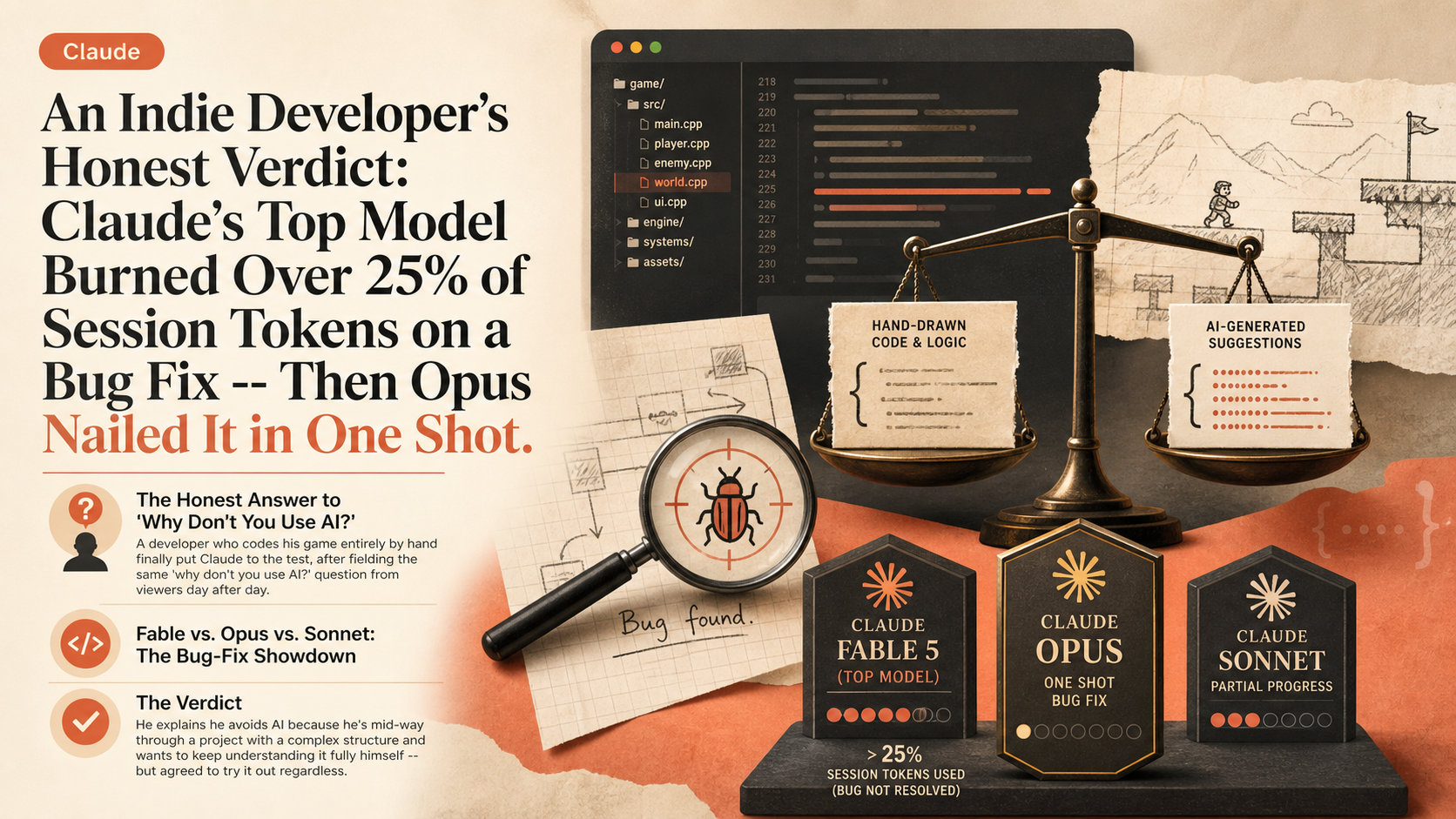
An Indie Developer's Honest Verdict: Claude's Top Model Burned Over 25% of Session Tokens on a Bug Fix -- Then Opus Nailed It in One Shot
A developer who codes his game entirely by hand finally put Claude to the test, after fielding the same 'why don't you use AI?' question from viewers day after day.
Aywen
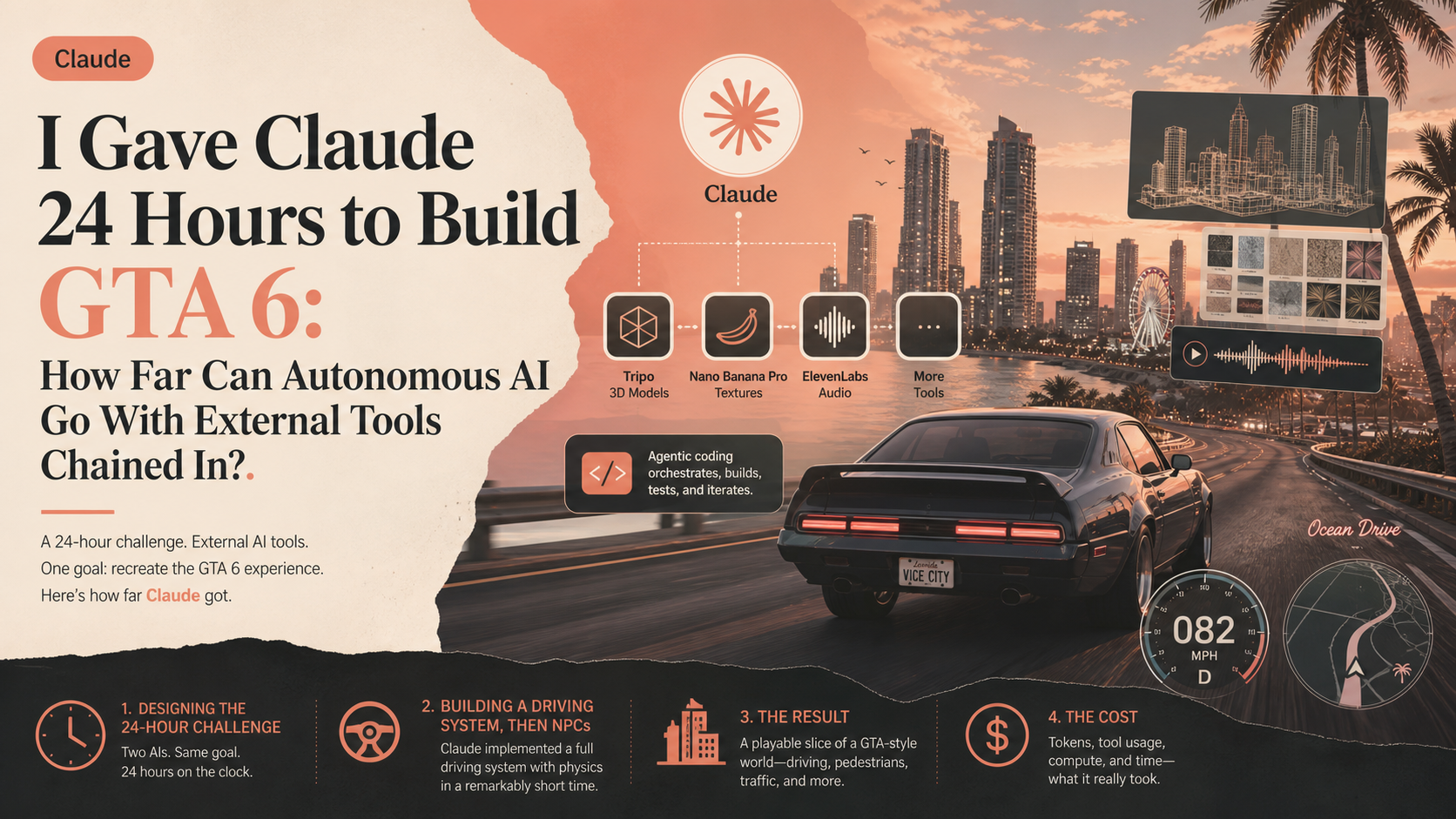
I Gave Claude 24 Hours to Build GTA 6: How Far Can Autonomous AI Go With External Tools Chained In?
The creator gave ChatGPT and then Claude 24 hours each, chaining in external AI services -- Tripo for 3D models, Nano Banana Pro for textures, ElevenLabs for audio -- to attempt recreating GTA 6.