Claude Daily Claude Daily
RSS
AI Pathways 20 min video 3 slides

Running 9,000 Backtests Through Claude — Only Mean Reversion Survived in Brendan's Method
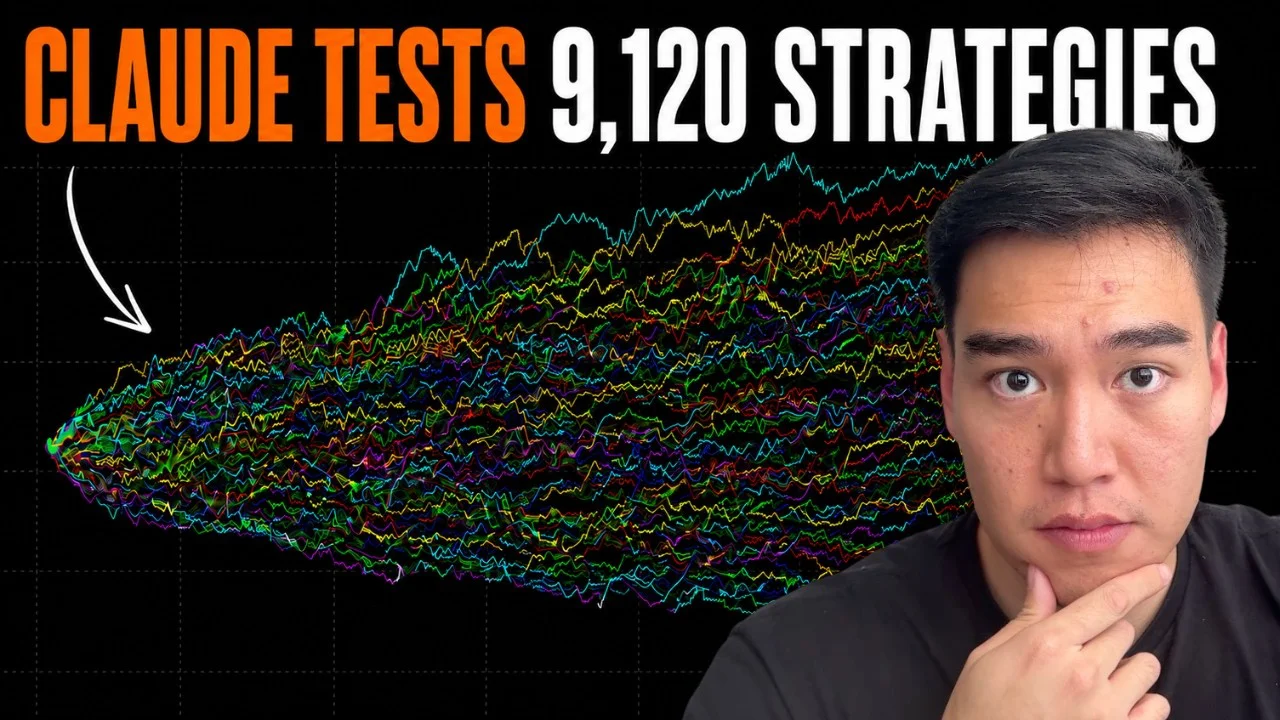
Claude Tested Over 9,000 Trading Strategies (Here's What Works)
129,391 views 8 highlights

TL;DR · What you'll learn

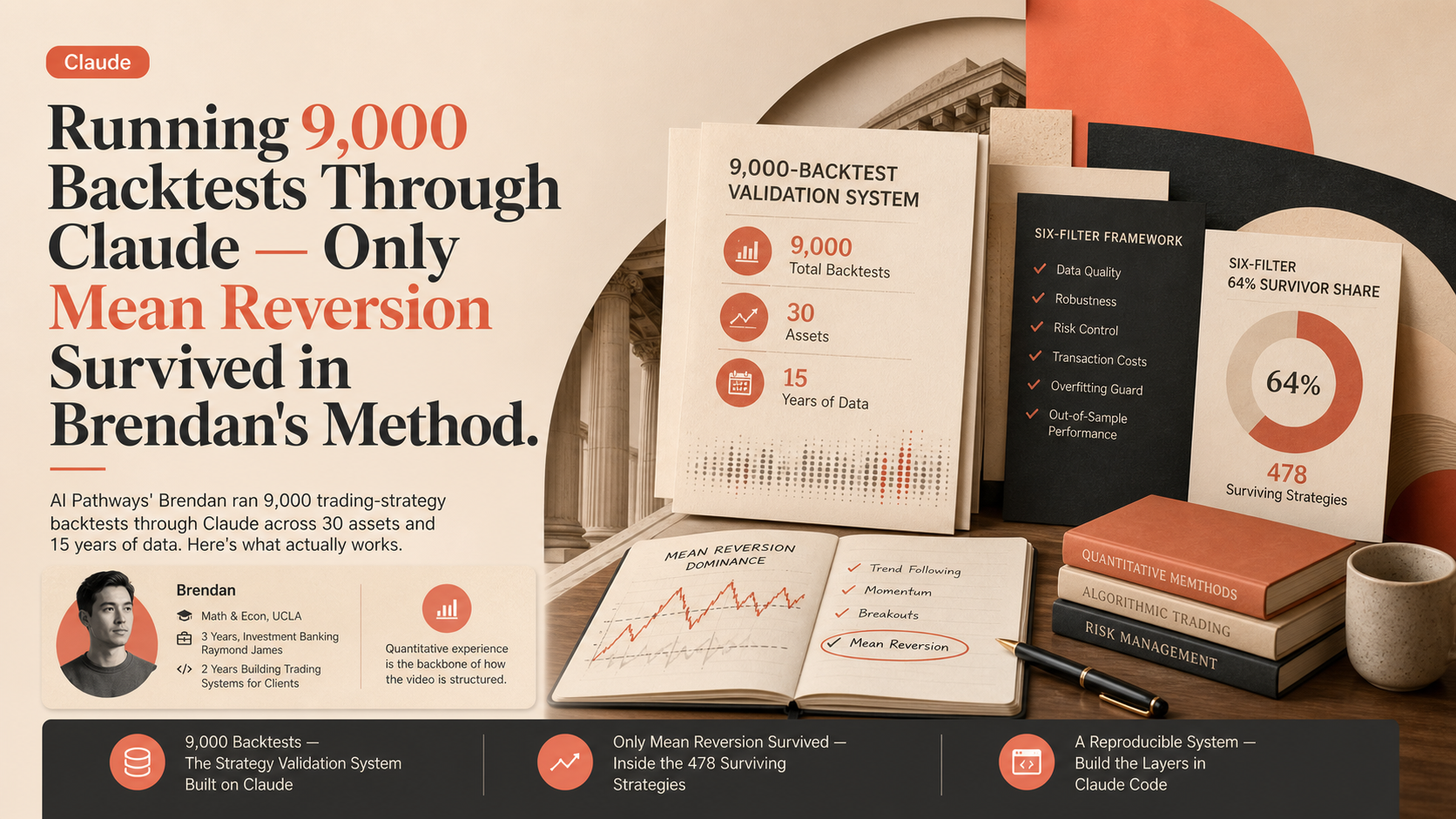
  • 1 AI Pathways' Brendan ran 9,000 trading-strategy backtests through Claude. Trend following, mean reversion, momentum, breakouts — every major family — across 30 assets and 15 years of data, with the results published in this video.
  • 2 Brendan's background: math and econ at UCLA, three years in investment banking at Raymond James, and two years building trading systems for clients. The quantitative experience is the backbone of how the video is structured.
  • 3 The test system Brendan built with Claude funnels 9,000 backtests through six filters in stages. The video walks through what each tile (module) in the system does, in order.
  • 4 The test surface is daily bars on liquid assets — major ETFs like S&P 500 and NASDAQ, the sector ETFs, gold, oil, bonds, Bitcoin, Ethereum — across 15 years of history (2010-2025).
  • 5 The result is clear. Among the major strategy families, mean reversion was the only category that came out positive. Even shuffling the order of trades didn't break it — the robustness signal showed it wasn't relying on luck.
  • 6 524 strategies passed all six filters; narrowing to assets with over 10 years of history drops it to 478. Of those 478, 64% are mean reversion — about two-thirds of everything that survived.
  • 7 Mean reversion has the deepest academic backing of any major strategy. The mechanism — prices that overshoot mean-revert due to both human psychology and market structure — is well-documented over decades. By contrast, a moving-average crossover has no theoretical reason to predict anything, and the data showed mostly that it doesn't.
  • 8 The system is reproducible. Screenshot the prompts and hand them to an AI model — you can build it in claude.ai or in Claude Code. Data and strategy library, six-filter backtest funnel, robustness checks — each layer is published.

Read as slides

3 slides total

01 Slide 1 / 3
Watch at 00:00

9,000 Backtests — The Strategy Validation System Built on Claude

AI Pathways' Brendan publishes the strategy-validation system he built on Claude. Trend following, mean reversion, momentum, breakouts — every major family — tested across 30 assets and 15 years of data, with 9,000 backtests in total. The frame is to show quantitatively what survives.

His background: math and econ at UCLA, three years at Raymond James in investment banking, and two years building trading systems for clients. The video opens with a clear disclaimer that nothing here is financial advice, and is then disciplined in sticking to data and methodology. The test surface is daily bars on liquid assets — major ETFs like S&P 500 and NASDAQ, the sector ETFs, gold, oil, bonds, Bitcoin and Ethereum. Six filters whittle the candidate set down in stages.

Claude Daily 01 / 03
02 Slide 2 / 3
Watch at 09:17

Only Mean Reversion Survived — Inside the 478 Surviving Strategies

The result lands cleanly. Among the major categories, mean reversion was the only family that came out positive, and shuffling the trade order didn't break it — a sign the result wasn't a luck artifact. 524 strategies cleared all six filters; restrict that to assets with over 10 years of history and it drops to 478. Of those 478, 64% are mean reversion strategies.

Why mean reversion dominates is consistent with the academic literature. After prices overshoot the mean, both human psychology (the unwinding of overreaction) and market structure pull them back. Decades of research underwrite the mechanism. By contrast, a moving-average crossover — one line crossing another — has no theoretical reason to predict anything, and the 9,000 backtests didn't support it either.

Claude Daily 02 / 03
03 Slide 3 / 3
Watch at 18:32

A Reproducible System — Build the Layers in Claude Code

Brendan publishes this in a form anyone can replicate. Screenshot the prompts and hand them to an AI model — you can build it in the claude.ai web app or in Claude Code. Claude Code has the advantage of letting you manage and update the codebase in one place.

The construction is layered. The first layer is the data and strategy library — copy it into Claude Code and you're up. The second is the backtest funnel — walk-forward / out-of-sample validation plus the six filters. The third layer is robustness checks — parameter sensitivity and bootstrap stress testing. The final layer is the cross-sectional check, specific to momentum-based strategies. Together the layers give you a tool to validate your own ideas quantitatively, rather than trusting a backtest you happened to see on TradingView.

Claude Daily 03 / 03

Editor's Take

What this validation actually shows isn't the splashy 'AI makes trading profitable' claim — it's the collapse of the implementation barrier. Running 9,000 backtests, the kind of work that used to require a specialist quant team and bespoke infrastructure, has become a personal-investor capability via Claude. Two implications for readers. First, the higher-ROI move is no longer using AI to 'discover' a good strategy — it's using AI to quickly reproduce the existing validation literature against your own constraints. Second, with a complete prompt set publicly shared as Brendan has done here, the competitive edge moves off 'do you have the prompt' and onto 'do you make the right method and asset choices behind the six filters.' Tools level out; judgment is what stays differentiated.

Source

Claude Tested Over 9,000 Trading Strategies (Here's What Works)

AI Pathways

Claude Tested Over 9,000 Trading Strategies (Here's What Works)

Published 6/28/2026 20 min 129,391 views

This article auto-summarizes the YouTube video's transcript with Claude. Please refer to the original video for nuance and exact wording.

Watch on YouTube

Related

3 articles