
Claude Daily Claude Daily
RSS
安野貴博の自由研究 14 min video 5 slides

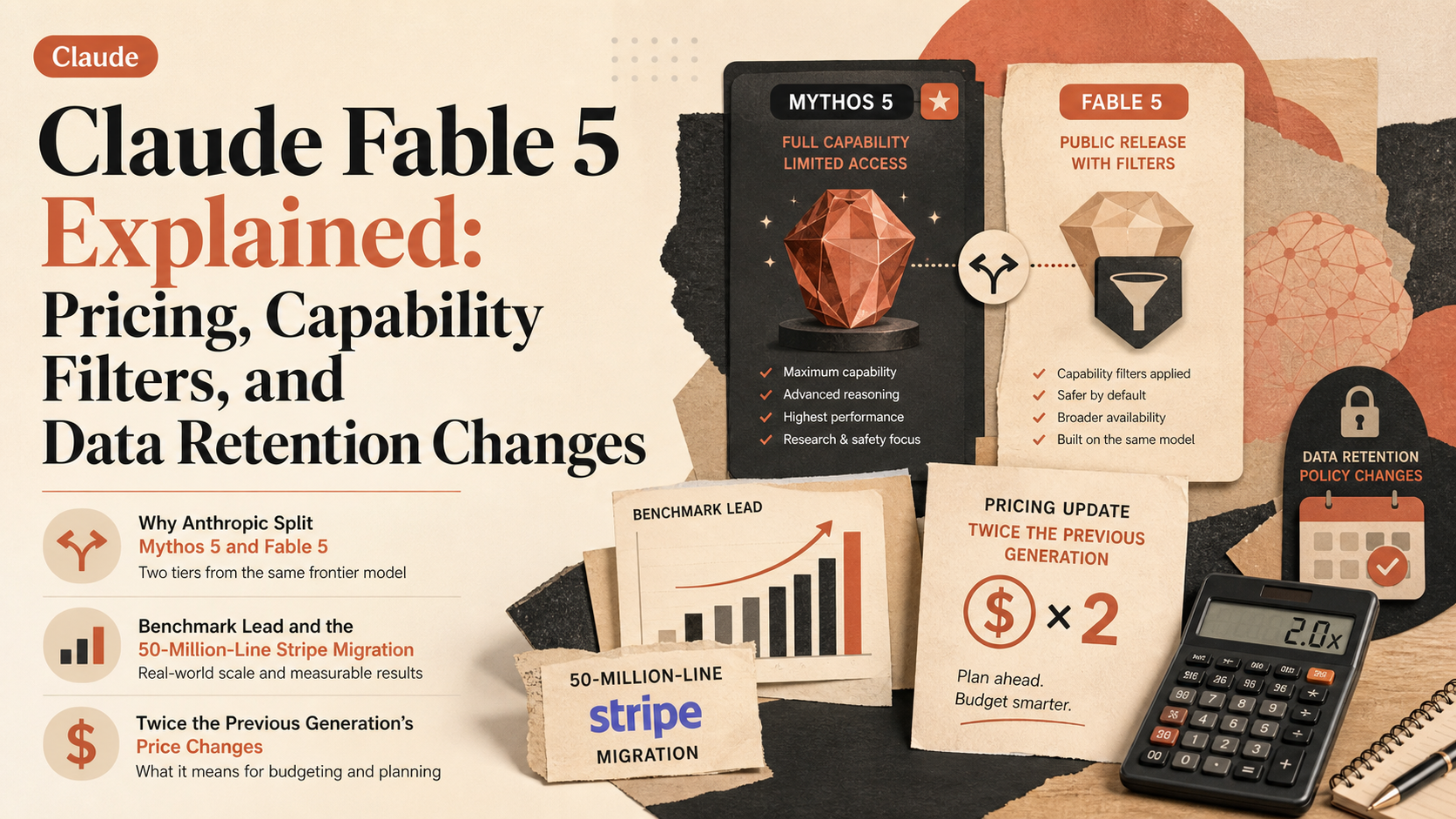
Claude Fable 5 Explained: Pricing, Capability Filters, and Data Retention Changes
【速報解説】AnthropicのMythos級モデル「Claude Fable 5」をゆる解説 / Mythos 5と何が違う? / 注目の価格設定 / 性能が弱体化されているのはなぜ?
135,679 views 7 highlights

TL;DR · What you'll learn

  • 1 Claude Mythos, announced in April 2026 but held back from release because it was too capable, was ultimately launched in a two-tier structure.
  • 2 Mythos 5 is the full-capability version offered on a limited basis, while Fable 5 is the public release with capability filters applied to the same underlying model.
  • 3 One shared example claimed Fable 5 migrated Stripe’s 50 million lines of Ruby code in one day, versus roughly two months by hand.
  • 4 Token pricing lands at $10 input and $50 output, about 2x the previous Opus 4.8 generation and below the leaked Mythos preview pricing of $25/$125.
  • 5 Capabilities are weakened across four domains: cybersecurity, biology, chemistry, and AI development. If distillation is detected, performance is silently reduced.
  • 6 The model remains included in subscriptions through June 23, then shifts to usage-based billing. The remaining two weeks are framed as a good test window.
  • 7 Only Fable 5 moves to 30-day data retention, a change enterprise IT teams need to watch because it breaks prior no-retention assumptions.

Read as slides

5 slides total

01 Slide 1 / 5
Watch at 00:41

Why Anthropic Split Mythos 5 and Fable 5

Anthropic announced Claude Mythos in April 2026, but held back a general release because its offensive cybersecurity capabilities were considered too strong. About two months later, on June 9 (June 10 in Japan time), a Mythos-class model finally reached the market.

This launch was unusual because the same underlying model was released in two different forms. The full-capability version, "Mythos 5," is restricted to a narrow set of trusted use cases such as security work. The public-facing release is "Fable 5," which applies capability filters. Only the latter is broadly accessible.

Claude Daily 01 / 05
02 Slide 2 / 5
Watch at 01:56

Benchmark Lead and the 50-Million-Line Stripe Migration

Yasuno argues that Fable 5 ranks first across many major benchmarks, and not just by slim margins. In several areas, he says, it opens up a visibly larger lead over competing models such as ChatGPT and Gemini.

As a concrete example, he points to the migration of Stripe’s 50-million-line Ruby codebase. Work that would have taken more than two months manually was reportedly completed by Fable 5 in a single day. He also highlights demos ranging from automating the game Factorio, to designing printable models in browser-based 3D CAD, to a fluid simulator synced to EDM beats, as signs of unusually broad applicability.

Claude Daily 02 / 05
03 Slide 3 / 5
Watch at 04:23

Twice the Previous Generation’s Price Changes Budget Planning

Compared with Opus 4.8, token pricing is roughly double: $10 per million input tokens and $50 per million output tokens. In yen terms, that works out to around 1,600 yen for input and 8,000 yen for output.

Because leaked Mythos preview pricing had suggested $25 input and $125 output, Yasuno says he expected it to come in even higher. Even so, doubling versus the previous generation is enough that finance teams at companies scaling AI use will need to revisit next year’s token budgets. The segment frames this as a broader planning problem: how to set the right balance between AI and human labor while assuming the models will keep improving over the next year.

Claude Daily 03 / 05
04 Slide 4 / 5
Watch at 06:57

Capability Filters and Silent Degradation

Fable 5 includes capability filters across four domains: cyberattacks, biology, chemistry, and AI development. Cyber was already the core concern. Biology and chemistry were added because of possible misuse involving dangerous substances or DNA/RNA synthesis. AI development restrictions were introduced to block distillation by rival labs.

The distillation response is the most novel part. If Anthropic decides another company is using its model to collect input-output data for training a different model, it can silently degrade performance. Because the company does not normally disclose whether the downgrade is happening, a firm attempting distillation may not easily notice that the model has been weakened. Yasuno describes this as a sign that competition among AI companies has entered a new phase.

Claude Daily 04 / 05
05 Slide 5 / 5
Watch at 11:03

Two-Week Test Window and a New 30-Day Retention Policy

For now, Fable 5 is available as part of subscription plans, but after June 23 it will move to usage-based billing. Yasuno recommends using the remaining two weeks as a de facto evaluation period, especially to surface issues hidden inside existing codebases all at once.

There is also an operational caveat: the data retention policy changes. Fable 5 retains data for 30 days for safety verification. That alters the assumptions for organizations that had been operating enterprise plans on a no-retention basis. IT departments will want to review how that fits with their internal data policies.

Claude Daily 05 / 05

Editor's Take

For practitioners, the most important takeaways on Fable 5 are three: the capability filter, pricing, and data retention. The two-tier design — identical to Mythos 5 except for the filter — is a sensible way to reconcile safety and availability. But token pricing at roughly twice Opus 4.8, and Fable 5 alone shifting to 30-day retention, breaks the no-retention assumption enterprises rely on. Easy to miss amid capability talk, budget and compliance design are what to check first.

Source

【速報解説】AnthropicのMythos級モデル「Claude Fable 5」をゆる解説 / Mythos 5と何が違う? / 注目の価格設定 / 性能が弱体化されているのはなぜ?

安野貴博の自由研究

【速報解説】AnthropicのMythos級モデル「Claude Fable 5」をゆる解説 / Mythos 5と何が違う? / 注目の価格設定 / 性能が弱体化されているのはなぜ?

Published 6/11/2026 14 min 135,679 views

This article auto-summarizes the YouTube video's transcript with Claude. Please refer to the original video for nuance and exact wording.

Watch on YouTube

Related

3 articles